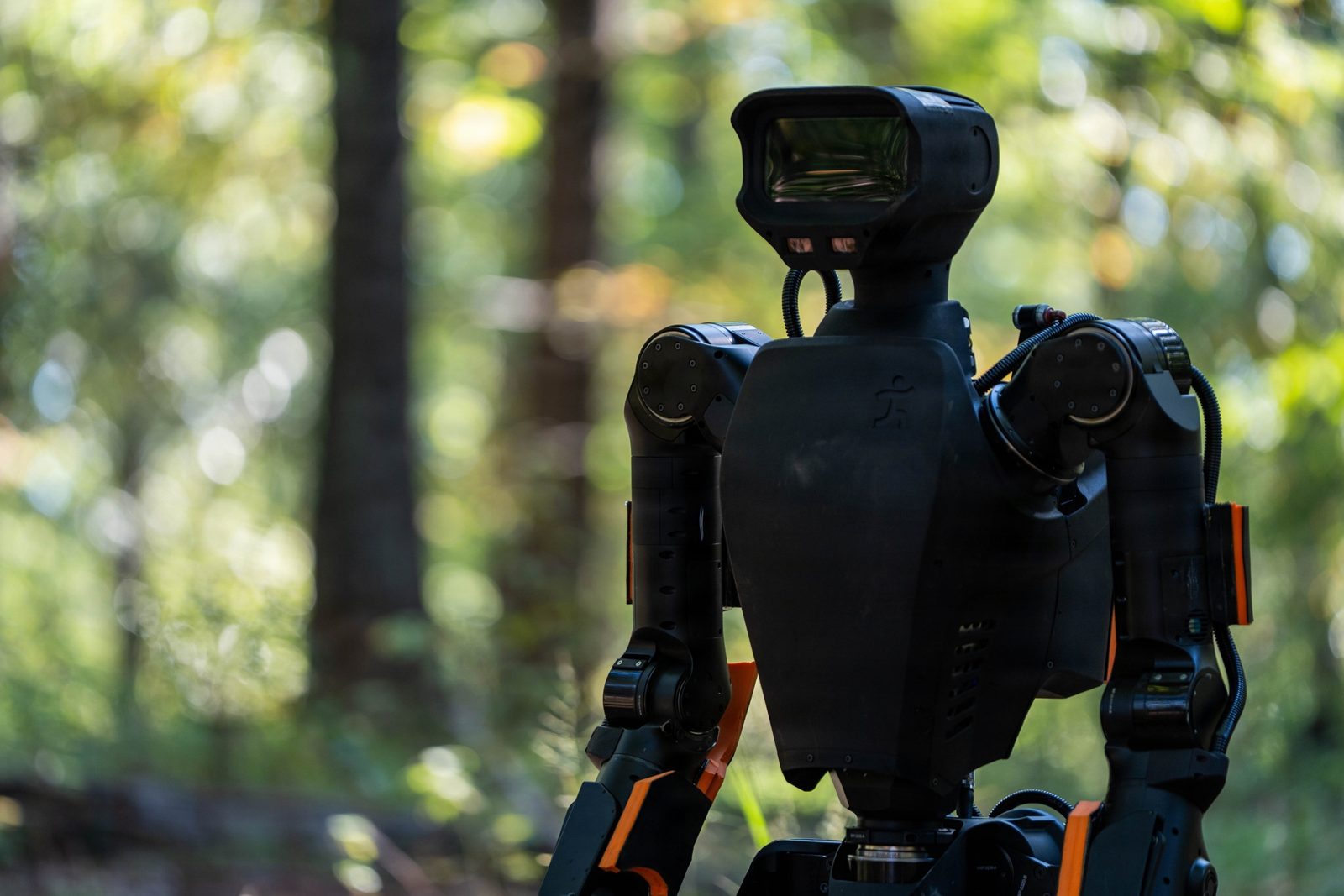
On September 10, a two-legged robot named Alex walked into the woods at Marine Corps Base Quantico, Virginia, a moment captured in a U.S. Army photograph that SOFREP published with its account of the event. A day later the Army named five winners of xTechHumanoid, a prize competition meant to show how far commercial humanoid technology has come. Alex, built by the Florida Institute for Human and Machine Cognition (IHMC), was the only complete robot among them. The other four winners make power systems, fingertip sensors and command software.
What the winners receive is modest. The competition rules set a prize of $75,000 for a winning baseline humanoid and $30,000 for a winning subsystem, on top of $25,000 paid to each finalist, with a separate pool of up to $1.25 million for possible follow-on contracts. The Army did not say how much each winner was paid. One winner, Hydroplane, says it will receive $30,000 and a chance to pursue further government funding.
Why the Army ran it
The competition was run by the Army FUZE xTech program in partnership with the Humanoid Community of Collaboration, a joint-force group set up in December 2023. The Army's stated purpose was to find promising commercial approaches and establish a technical baseline for a new capability area. The program page frames the need in terms of a fight against a capable peer adversary, where the opening phase could bring heavy human losses, and says humanoids are meant to work alongside troops and not replace them.
The Army announced the competition in September 2025, with white papers accepted from August 6 to October 1 of that year. It drew 103 submissions, and ten companies advanced. Finalists then went through technical reviews with Army officials, including one in May, a finalist engineer told Military.com in March. Nine of the ten demonstrated at Quantico on September 9 and 10, the winners were picked on September 11, and the Army published the result on September 28.
There were two tracks. The program page lists three finalists under “Baseline Humanoid System” and seven under “Advanced Humanoid Subsystems.” The rules allowed for up to two baseline winners and up to three subsystem winners. The Army instead picked one baseline robot and four subsystems, an outcome that suggests evaluators found more maturity in components than in whole robots.
What the robots were asked to do
The public record is thin on this point. The competition announcement scored white papers on seven weighted criteria, led by the technical maturation plan at 25 percent, with military benefit and current technical maturity at 20 percent each. It said detailed evaluation criteria for the finals would be provided to finalists later. The Army's winners announcement says only that companies demonstrated before military leaders, technical experts and evaluators. It gives no task list, scores or pass rates.
The announcement document does show what the Army had in mind. Its reference scenario is a small reconnaissance unit of humans and humanoids moving about 5 kilometers through fields, forest and rocky ground, starting in daylight and ending at night. Its baseline expectations include a maximum weight of 200 pounds with power source, a 50-pound load on two legs, 24 hours of mixed active and passive operation, and protection against 5.56 mm projectiles. SOFREP noted that the Army has not published proof that the winning robot met those figures.
Participants described the event as closer to a field trial than a trade show. Alec Leesberg, president of Velocity Explorations, said in the Army release that the format “allows you to pressure test your technology in a field exercise paradigm.” Hydroplane says it ran its hydrogen fuel cell unit outdoors at Quantico on September 9.
Five winners, one robot
The Army's descriptions are brief. IHMC's Alex has impact-resilient actuators, ballistic protection and what the Army calls hybrid autonomy, a mix of artificial intelligence and human control. ACES Group won for an integrated power system that scales from single robot batteries to larger infrastructure. Hydroplane won for a compact mobile power generator intended for contested logistics. Ras Labs won for fingertip tactile sensors that detect force, object shape and slip. Velocity Explorations won for software that turns command intent into discrete robot actions.
Details on Alex remain scarce. The Defense Post reported that it weighs 85 kilograms, or 187 pounds, with its battery. Army Recognition noted that the service has not disclosed its endurance, payload or protection level. TechRepublic pointed out that the announcement does not say which tasks Alex performs on its own and when an operator has to step in.
The finalists that did not win include two other baseline robots, from Vision One and Vigil Robotics, according to the program page. Vision One has since issued a press release promoting its TITAN humanoid as a future robotic teammate with thermal, depth and LiDAR sensing. Those are company claims, and the release does not report how TITAN performed at Quantico.
What the Army has and has not committed to
Officials described a survey of the market. “We are identifying the problems, mission needs, and opportunities to enable our formations with the right mix of tools,” Army Chief Technology Officer Dr. Alex Miller said in the release. The only next step the Army named is more work by the Humanoid Community of Collaboration on power and energy limits. The release mentions no contract awards, soldier evaluations or fielding dates. The program page says the government may award follow-on contracts to one or more winners and lists the legal routes, including other transaction agreements and small business research awards. As Army Recognition put it, the mechanism is not a procurement decision, and no combat role has been announced.
The Army has released no figures on runtime, task completion, repair time or how often a human had to intervene, the measures TechRepublic argued matter more than a competition win. Outside evidence suggests those are the hard parts. Robert Griffin, who works on humanoid robots at IHMC, the institute behind Alex, told the BBC in June that autonomous humanoids “don’t know how to handle open-ended uncertainty yet,” and that short runtime is “plaguing every humanoid company.”
Field experience elsewhere points the same way. A trial of two Phantom MK-1 humanoids in Ukraine found a payload of about 20 kilograms, no waterproofing and too little battery life for large-scale use, Militarnyi reported in May. In China, a Reuters review of more than 100 military procurement records and related documents found no evidence of an armed humanoid deployed with an operational unit, according to Tech Times. With two of its five awards going to power technology, the Army's own results suggest it reached a similar conclusion about what limits these machines today.
This analysis draws on the public sources linked in the text. Send corrections to [email protected].