Sharper satellite imagery answers what an object looks like. Repeated observation helps answer what changed. BlackSky’s Gen-3 rollout brings those two questions together, making the interval between useful observations as important as the detail inside any single frame.
A service milestone, not just an image
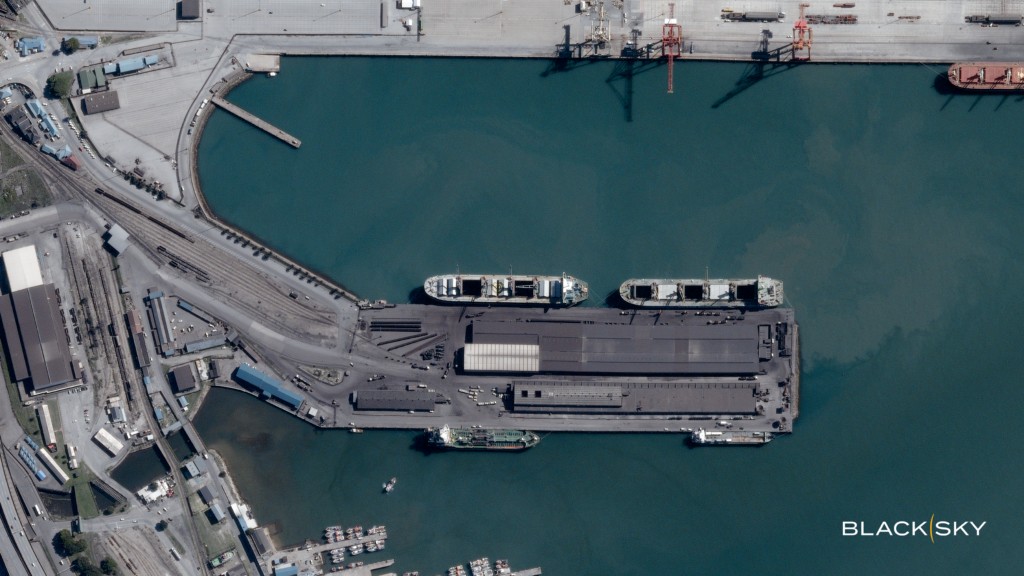
On March 12, 2026, BlackSky announced general availability of Gen-3 capabilities after commissioning its fourth Gen-3 satellite in under a week. The company described 35-centimeter imagery and AI-enabled analytics available through its Spectra platform.
Its announcement distinguished daily Gen-3 service from hourly Gen-2 monitoring. Those claims should not be combined into a promise of hourly 35-centimeter coverage everywhere. The published demonstration image shows port and rail facilities at Gqeberha, South Africa, on March 9.
Change detection needs a baseline
For an intelligence analyst, a busy port is not automatically an unusual port. The harder question is whether activity differs from its normal pattern. A model needs comparable observations and enough context to distinguish meaningful movement from routine variation.
Consider a hypothetical vessel that appears between two collections. The images establish that it arrived within an interval. They do not establish its exact arrival time or purpose. Automation should preserve that interval instead of converting it into an invented timestamp.
Collection and analysis are one workflow
The commercial opportunity is broader than selling a clearer picture. A customer wants to decide where to look next, receive the collection, compare it with earlier observations and review the resulting alert. Delays at any stage can erase the value of faster processing elsewhere.
Our assessment is that this favors services evaluated end to end. Resolution alone cannot tell a buyer how quickly a consequential change will be noticed.
Measure the missing observations too
A useful trial would record missed collections, delivery latency, false changes and the analyst time needed to validate alerts. It would include weather and illumination constraints rather than select only clean examples. The strongest intelligence service is not the one that never admits a gap; it is the one that makes gaps visible before a decision depends on them.
What would change the assessment
Customer-specific collection intervals, weather-related gaps and measured alert accuracy would support a firmer judgment than selected demonstration images.
This analysis draws on the public sources linked in the text. Send corrections to [email protected].