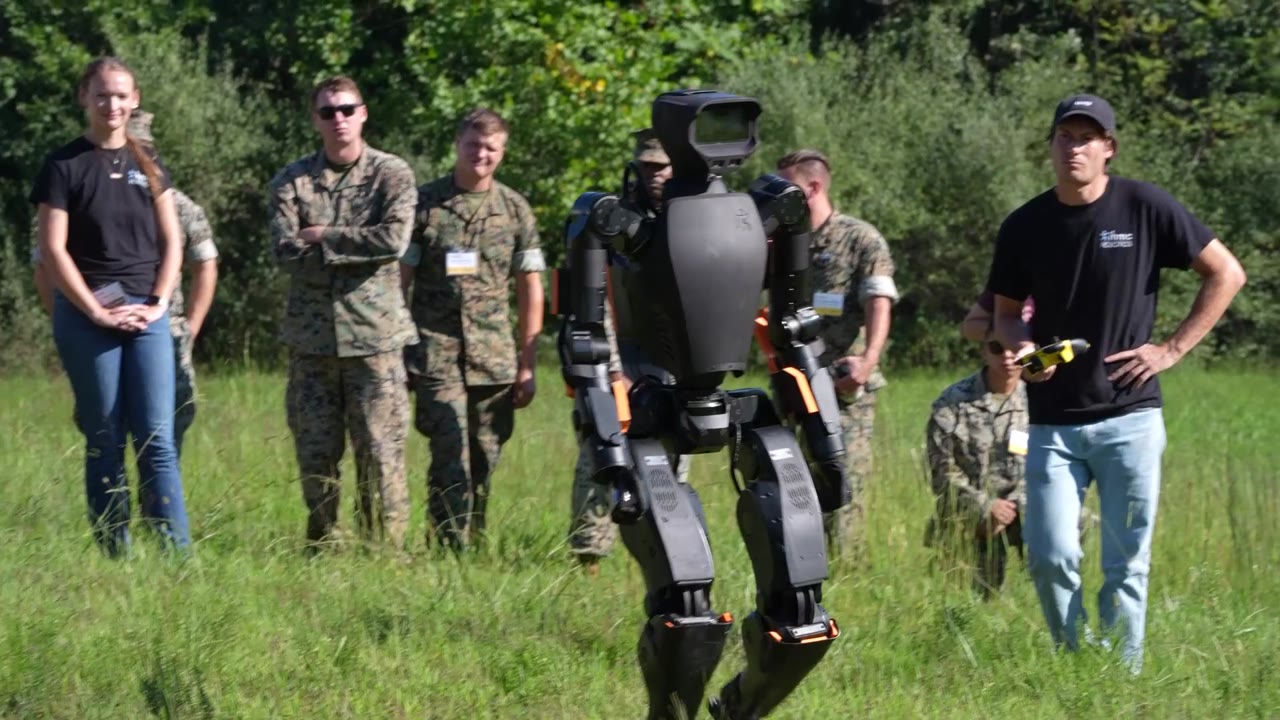
On Sept. 9 and 10, nine finalists showed humanoid-robot technology to the Army at Marine Corps Base Quantico. According to an Army release, the xTechHumanoid competition had drawn 103 white papers, and five winners were named: ACEs Group, the Florida Institute for Human and Machine Cognition, Hydroplane, RAS Labs and Velocity Explorations. Only one winning entry, the Florida institute’s Alex, is a complete humanoid.
That outcome is a fair measure of where the field stands. Several companies now say they are close to putting human-shaped robots into military service, and some quote orders and prices. What the public record contains is thinner: executive interviews, company videos, one research preprint and a small trial in Ukraine reported through the press.
What the Army says it is doing
Army Chief Technology Officer Alex Miller said in the release that “humanoid robots are part of a broader autonomy push.” The release refers to “the technical challenges that remain” and names power and energy as the next line of work. The Ukrainian outlet Militarnyi, reporting on the result, concluded that near-term humanoids will mainly do logistics and support work.
A company that builds the whole robot
Foundation Future Industries of San Francisco builds its own machine, the Phantom MK-1, along with the software that drives it. The Chosun Ilbo reported in June that two Phantoms were sent to Ukraine in February to carry supplies, and it described the 180-centimeter, 80-kilogram machine again in September. The BBC reported that Foundation holds $24 million in U.S. military research contracts.
The Ukraine trial is also the source of the most specific public criticism. Militarnyi, citing a CNBC report, wrote that the Phantom MK-1 tested there carried about 20 kilograms, was not waterproof and lacked the battery life for large-scale use, at a cost of about $150,000. The same report raised a risk that applies to any system that learns after deployment, warning that decision-making can drift as models adapt in real conditions.
A company that supplies only the software
Skylark Labs of Menlo Park, California, takes the other route. “Humanoids are procured off the shelf as basic models,” its founder and chief executive, Amarjot Singh, told Military.com in an interview published Aug. 2. “We build the brains for them.” He described building entry and close-quarters reconnaissance as target missions and conceded a limit: “If it is open warfare, you can send in drones.” Military.com gave the cost as roughly $450,000 per unit and up. The article does not say whether that price includes the robot body, and it does not identify the hardware supplier.
In the same interview Singh said the company held an order for 25 units from India and letters of intent for about 250 more from a Middle East customer, with interest but no firm orders in the United States. He named no buyer. South Korea’s Maeil Business Newspaper repeated the figures in a profile published Aug. 7. No contract document, customer statement or government announcement confirming them appears in the sources reviewed for this article, and no government has described the demonstrations the company says it has given.
The company’s public descriptions are not fully consistent on whether these are combat machines. Military.com’s article calls the applications “non-combat” while quoting Singh on teaching a robot to fire a gun. The company’s website uses the label “Combat-Ready Humanoid,” while a separate use-case page states, “Detection and movement do not confer decision authority.” Maeil reported the company’s position that its robots do not select or attack targets on their own and that every engagement requires human approval. No outside test of that design appears in the sources reviewed.
The most detailed technical evidence is a paper posted to the preprint server arXiv on Sept. 3, whose authors include Singh, other company staff and four academics whom Robotics & Automation News identified as faculty at Carnegie Mellon University and the University of California, Berkeley. It reports that storing verified successes after deployment raised action success from 74.0 percent to 87.9 percent across five machine types, a humanoid among them. Those results come from the company’s own dataset, and the abstract states that “open-world novelty is outside scope.” It reports no trials of weapons handling or building entry. Skylark Labs is not among the xTechHumanoid winners, and no source reviewed says whether it entered.
What outside voices say
Robert Griffin of the Florida Institute for Human and Machine Cognition, the institute that later won at Quantico, told the BBC in June that such systems “don’t know how to handle open-ended uncertainty yet.” Dean Fankhauser of the advisory firm Robozaps told the BBC that quadrupeds cross terrain more efficiently. Nicole van Rooijen of the Stop Killer Robots coalition called the human form “extra worrying” in the same report.
What a buyer still cannot check
The open items are specific. For Foundation, the public account of how Phantom performed in Ukraine comes through news reports, and the sources reviewed include no published test report. For Skylark Labs, the orders it cites have not been confirmed by a buyer in any source reviewed, and its learning results have not been reproduced outside the company and its co-authors. For the Army’s winners, the competition showed components and one full robot over two days, and the service itself points to power and energy as unsolved.
A program office weighing any of these machines can ask for the same things it would ask of a ground vehicle: who the customer is, what was tested and by whom, how long the robot ran before it needed a person, and what it does when its instructions no longer fit the situation.
This analysis draws on the public sources linked in the text. Send corrections to [email protected].