Most companies pitching humanoid robots to the military are selling a machine. Skylark Labs, of Menlo Park, California, says it is selling what goes inside one. “Humanoids are procured off the shelf as basic models,” its founder and chief executive, Amarjot Singh, told Military.com in an interview published Aug. 2. “We build the brains for them.”
The company’s case is that one body, bought commercially, can be taught different jobs by changing its software, and that the software can keep learning after the robot is in use. This article sets out what the company has said about that approach, what it has published, and what has yet to be confirmed by anyone outside it.
One body, several mission sets
Singh described building entry and close-quarters reconnaissance to Military.com as target missions, along with fire and rescue work. He also drew a boundary: “If it is open warfare, you can send in drones.” South Korea’s Maeil Business Newspaper, in a profile published Aug. 7, listed explosive ordnance disposal, building entry, reconnaissance and fire and rescue as the intended tasks.
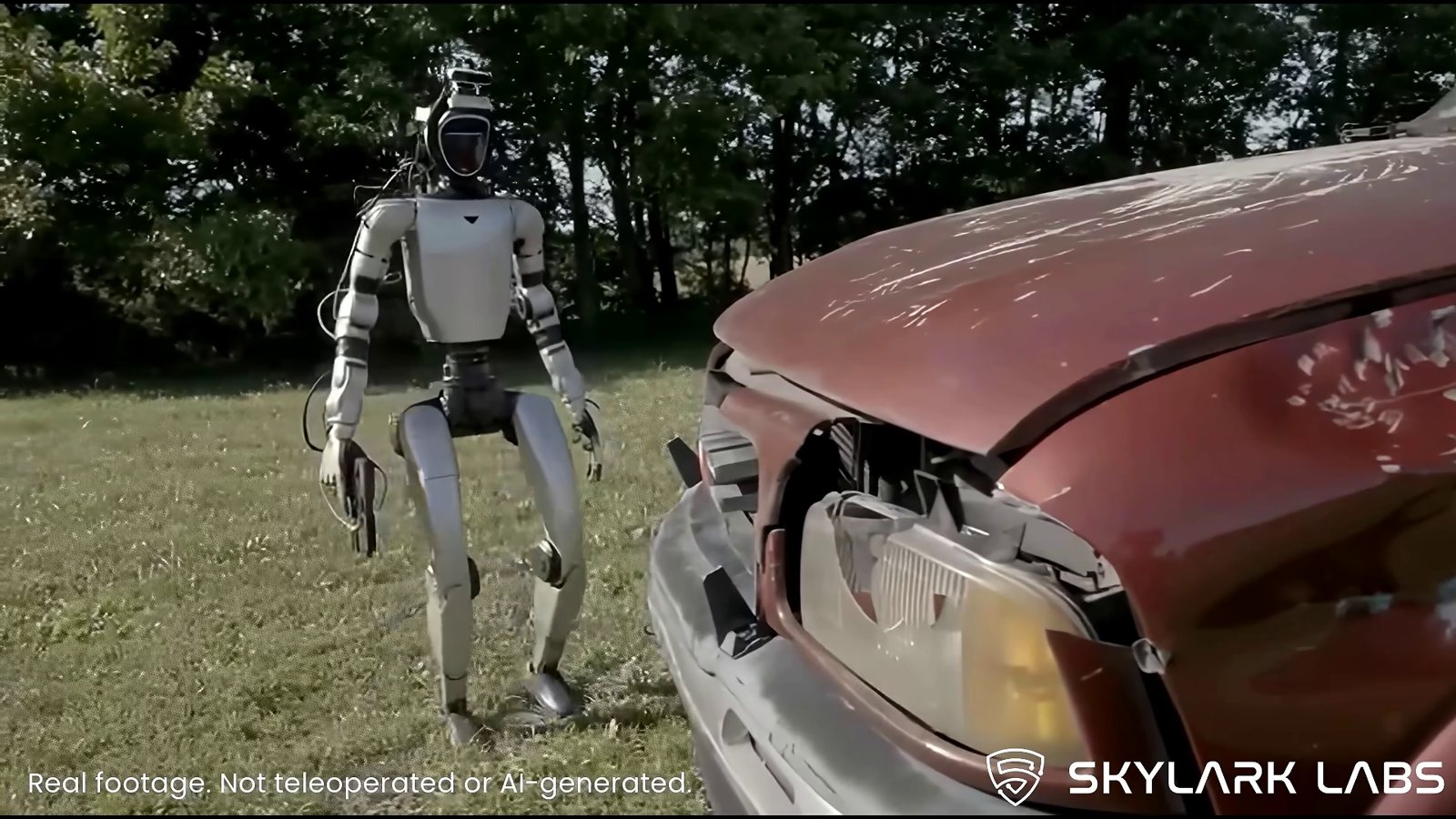
A 65-second video the company published in July shows a humanoid walking across a field, aiming a pistol at targets and being taught hand movements by an operator wearing a headset. On-screen text says the footage is real and not teleoperated. Singh told the Indian business daily Mint in July that the company’s models can learn tasks “from handling to firing weapons” in about 15 minutes.
On the use of force, Maeil reported the company’s position that its robots do not select or attack targets on their own and that every engagement requires human approval. A page on the company’s website puts it this way: “Detection and movement do not confer decision authority.” Military.com’s article describes the applications as “non-combat” while quoting Singh on teaching a robot to fire a gun, and the company’s site uses the label “Combat-Ready Humanoid.”
The research behind the software
The most detailed technical account is a paper posted to the preprint server arXiv on Sept. 3. Its authors include Singh, other company staff and four academics whom Robotics & Automation News identified as faculty at Carnegie Mellon University and the University of California, Berkeley. It describes what the company calls Continual Field-Adaptive Models, which pair a fixed core model with an on-device memory of experiences that have been checked as successful.
The authors report tests on five machine types, a humanoid among them, and say that storing verified successes after deployment raised action success from 74.0 percent to 87.9 percent. The results come from the company’s own dataset of more than 2.6 million trajectories, according to Robotics & Automation News. The abstract sets a limit, stating that “open-world novelty is outside scope,” and it reports no trials of weapons handling or building entry. A preprint has not been through peer review.
Orders, price and customers
Military.com gave the cost as roughly $450,000 per unit and up. Singh told the outlet the company holds an order for 25 units from India and letters of intent for about 250 more from a Middle East customer over two years, and that in the United States there is interest but no firm order. He said the company has demonstrated its software to the U.S. government, some Middle East governments and the Indian government.
Those figures are the company’s. The buyers were not named, and no contract notice, customer statement or government account of a demonstration appears in the sources reviewed for this article. Military.com’s article does not say whether the price includes the robot body or who supplies it.
Maeil reported that the company’s systems have run at an Indian Navy airfield, and Mint lists Indian military and border services, the U.S. Air Force and the U.S. Navy among organizations it has worked with on other products. Singh told Maeil he wants to supply software to South Korean robot makers and does not intend to compete with them on whole platforms. The sources differ on the founding year, with Military.com giving 2022 and the other two 2021.
Where it sits in the field
The software-only route contrasts with Foundation Future Industries, which builds its own Phantom robot, and with the Army’s recent xTechHumanoid competition, where four of the five winners were components and only one was a complete humanoid. Skylark Labs is not among those winners, and no source reviewed says whether it entered.
The Army’s release names power and energy as the next line of work for humanoids generally, a limit that software does not remove. Maeil closed its profile by noting that the company is a late entrant with a field record still to build. What would settle the open questions is the same for any vendor in this market: a named customer, a test run by someone other than the developer, and results on the missions the robot is being sold for.
This analysis draws on the public sources linked in the text. Send corrections to [email protected].