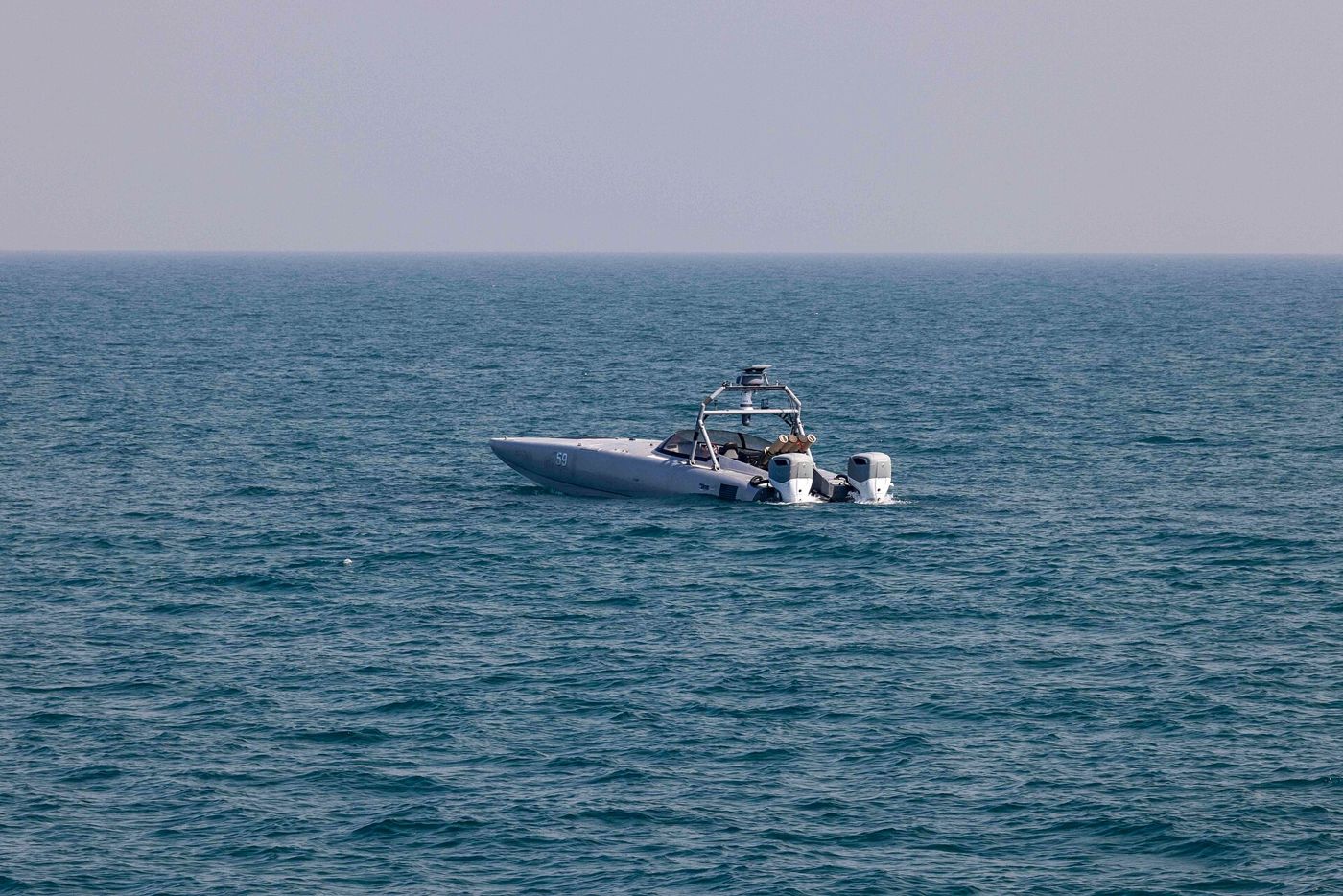
On Sunday, July 12, 2026, three 24-foot boats with nobody aboard ran in toward the docks of Iran’s naval base at Bandar Abbas and blew up. The video that U.S. Central Command posted the next day, as Breaking Defense described it, shows each craft approaching shoreline structures from overhead, cuts to a camera on one boat’s bow as it closes on a dock holding a small exposed submersible, and ends with three explosions. CENTCOM said the Corsair craft had struck a submarine and ship maintenance facility, and called it “the first time American forces have employed sea drones in combat operations.”
Three months later that sentence is still most of the official record. This article sets out what the public evidence establishes about the strike and what it does not. The evidence shows that the Navy can buy a small attack boat, ship it to a theater and use it within about a year. It does not show how much of the attack the boats did on their own, whether they could reach a defended target, or which commander owns them. Those gaps matter because the rules that govern all three are being rewritten in Washington this autumn.
The production deal was seven months old when it was announced
The Corsair’s path into service is usually dated to December 8, 2025, when Navy Secretary John Phelan announced a production award to Saronic, the Austin company that builds it. Naval News quoted him: “Prototype to production in under 12 months.” The paperwork was older. DefenseScoop had found the agreement in federal procurement records in August 2025 and reported that Naval Sea Systems Command formalized a $392 million other transaction agreement on May 16, 2025, running to May 30, 2031, with roughly $197 million obligated that July. A Navy official confirmed the records to the outlet and declined to give quantities, products or delivery dates. None of those have been published since.
Other figures come from outside the Navy. Aaron Marchant, a Navy submarine officer on a fellowship at the Center for Strategic and Budgetary Assessments, writing in War on the Rocks in January, put the Corsair’s price at about $1.2 million, citing a private market-research report. Naval News, citing a company social media post, reported that Saronic had built at least 300 Corsairs by May 2026. Neither number has been confirmed by the service.
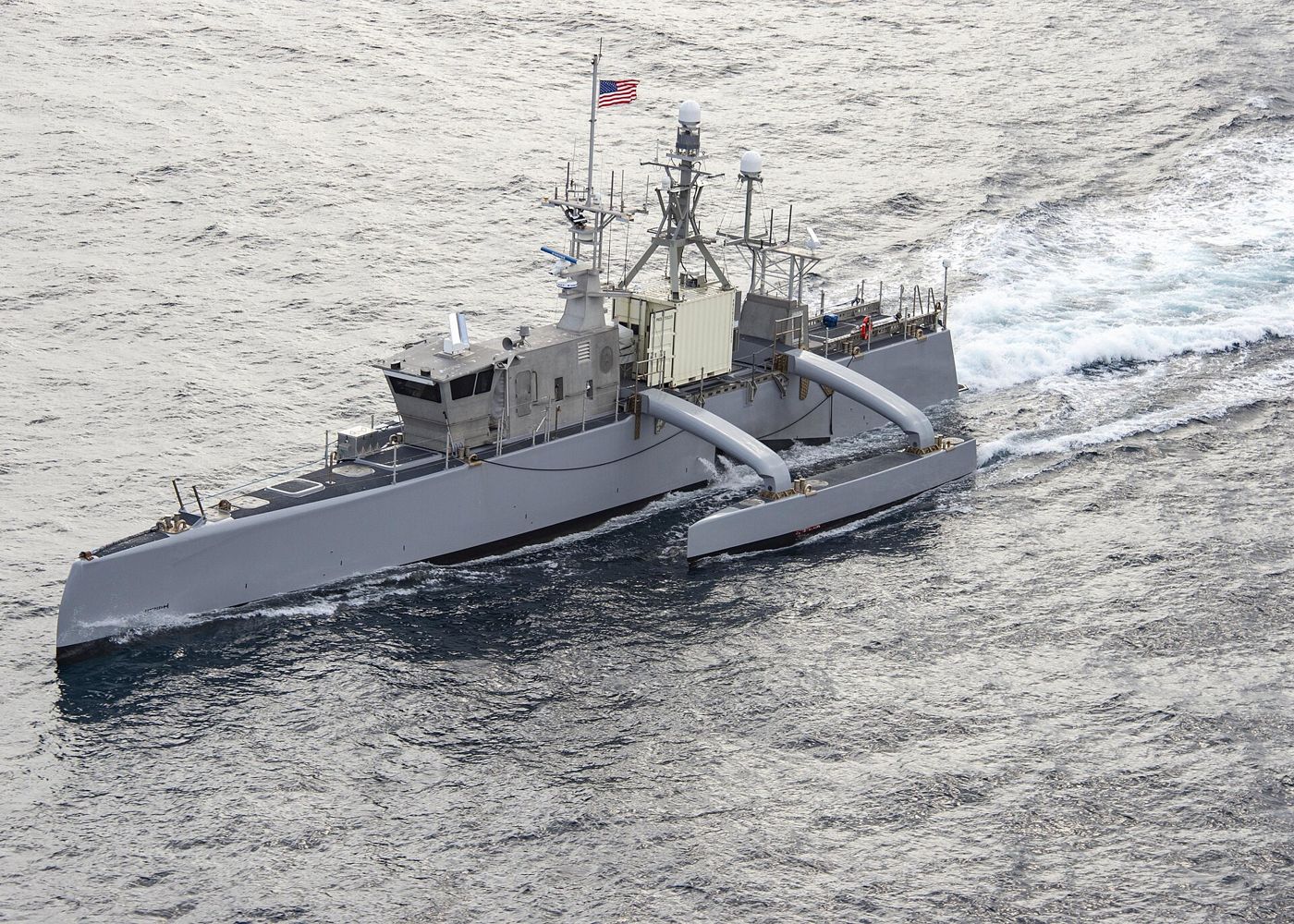
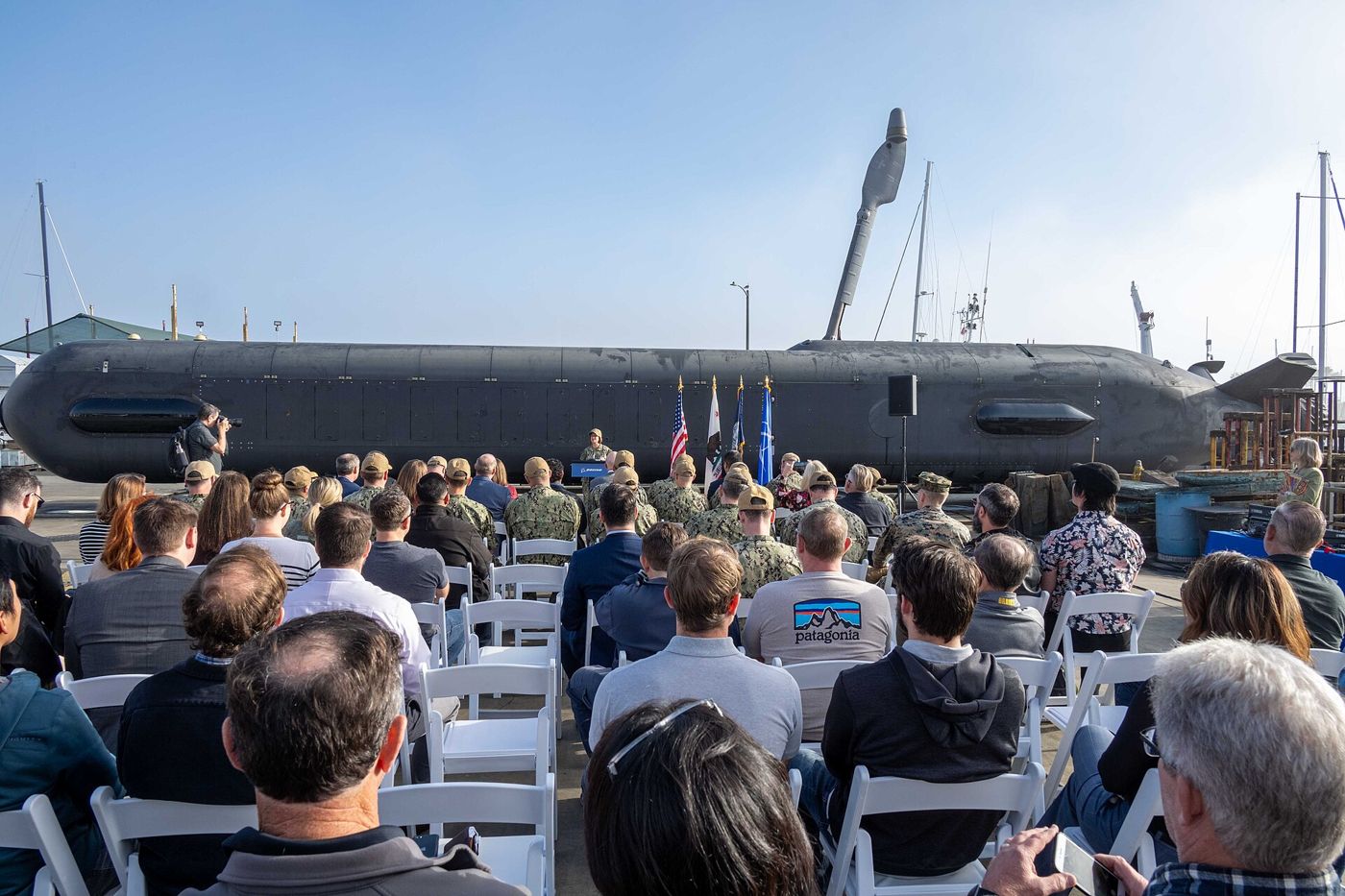
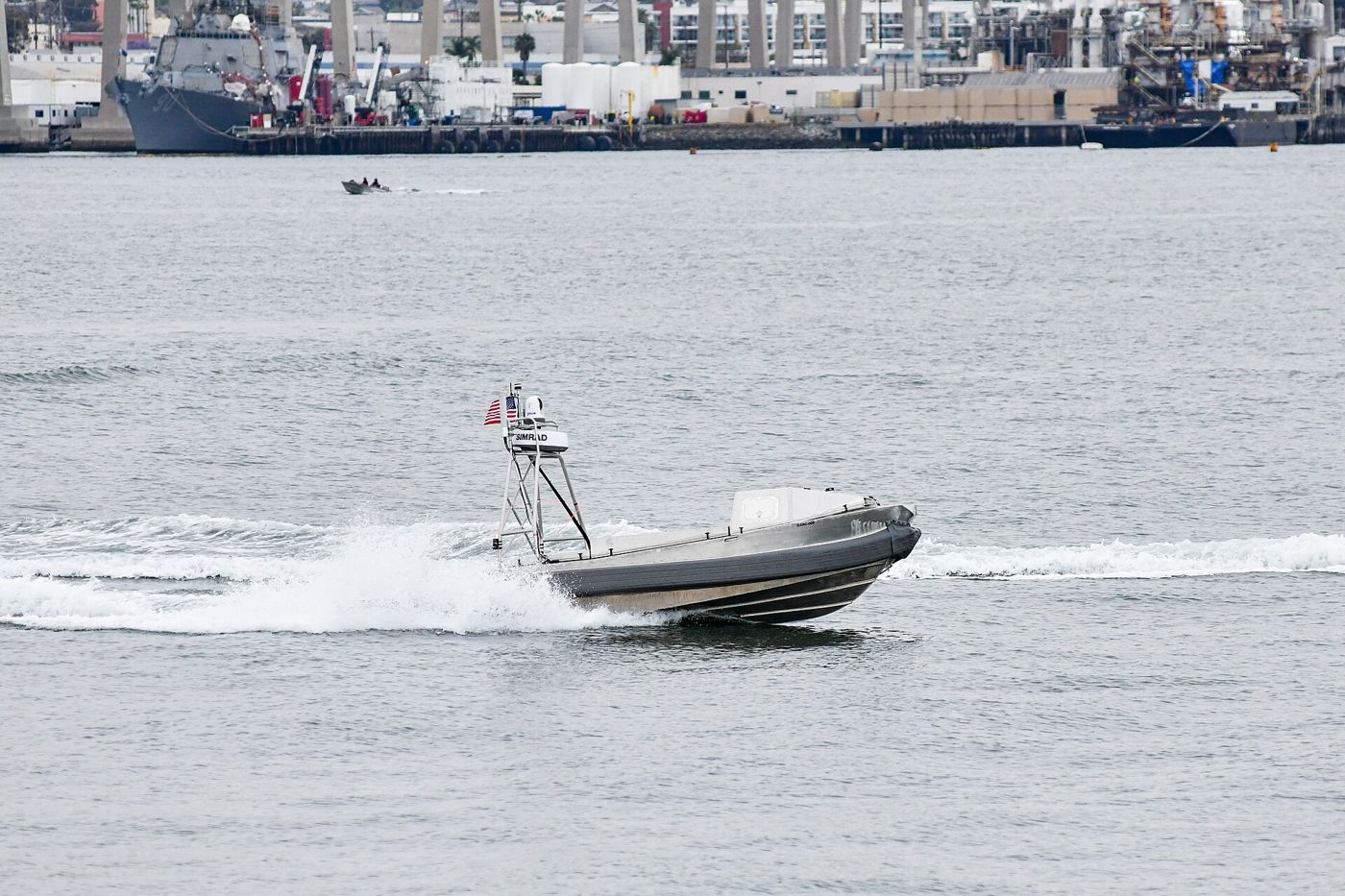
What the Navy has disclosed is the scale of its small-boat inventory. Rear Adm. Christopher Alexander said in January that the service went from four small uncrewed surface vessels to about 400 during 2025 and expected roughly 500 by the end of 2026. The organization built to absorb them began with Unmanned Surface Vessel Squadron Three, established in San Diego in May 2024 with about 400 sailors and the 16-foot Global Autonomous Reconnaissance Craft. Officials said then that concepts of operations for small and medium craft were still being finished.
From a rescue off Oman to a dock in Iran
The Corsairs that reached the Middle East went to a different kind of unit: Task Force 59, the 5th Fleet unit in Bahrain commissioned in September 2021 to combine uncrewed systems and artificial intelligence with crewed ships. “The task force began fielding these drones in theater in late March,” CENTCOM spokesman Capt. Tim Hawkins said in June, about a month into the war that began on February 28.
Hawkins was explaining a rescue. On June 8 an Army AH-64 Apache went down off Oman, and a Corsair picked up both crew members and carried them to a point where a helicopter hoisted them aboard, about two hours after the crash. Gen. Dan Caine, the chairman of the Joint Chiefs, later said the Apache had been shot down by an Iranian drone. His account of the recovery gave the credit to people: sailors and joint personnel “on watch floors, at piers, managing networks of unmanned systems,” using AI to assemble the maritime picture.
The attack role followed within five weeks. A 14-point memorandum signed on June 17 had extended a ceasefire, The War Zone reported, and it broke down over control of the Strait of Hormuz. Stars and Stripes reported that U.S. forces hit about 140 Iranian military positions on Saturday, July 11, and continued the next day with fighter aircraft, warships and one-way attack drones in the air and on the water. Task & Purpose counted more than 300 targets across southern Iran that weekend. The Corsair attack was a small part of that total.
What the video shows and what CENTCOM left out
CENTCOM’s claim about results is one sentence: the strikes “degraded Iran’s ability to continue attacking commercial shipping.” No battle damage assessment has been released, and none of the reporting reviewed for this article cites satellite imagery, an Iranian account of the damage or any other independent check.
The identification of the target came from reporters studying the footage. The War Zone judged that the vessel in the video was a Ghadir-class midget submarine and noted that it was “sitting on the dock,” suggesting Iran might have hauled it out after the ceasefire took effect. Naval News called the boat “laid up.” The War Zone also recalled that U.S. forces had sunk another Ghadir with a Hellfire missile in March and that prior estimates put the class at 16 to 20 hulls. Whether the submarine hit in July was in working order is not publicly known. A boat out of the water at a base that had been under air attack for months is a target that could not move, shoot or dive.
The public record is also silent on the approach. No account says where the Corsairs were launched, how far they traveled, whether Iranian forces detected or engaged them, or what barriers the harbor had. Saronic described the craft as a “military variant” of the Corsair; the warhead has not been described. All three reached the dock area in the released clips, and CENTCOM has not said whether three was the number sent.
Even the unit is unclear. Coverage in July pointed to Task Force 59, which had fielded the boats and run the rescue. In August, DefenseScoop reported that Task Force Scorpion Strike launched the three Corsairs. That is the one-way attack drone squadron CENTCOM set up in December 2025, and the two are entangled: when a littoral combat ship first launched a LUCAS attack drone that month, DefenseScoop said Task Force 59 operated the weapon as part of Scorpion Strike. CENTCOM’s own statement credited only “CENTCOM forces.”
A person was on the link, as far as anyone has said
Saronic calls the Corsair an autonomous surface vessel, and its marketing says the boat can execute a mission alone or in a group with, in the company’s words, “minimal human interaction.” The same War Zone report, written after the June rescue, said human operators remain in the loop over a datalink during such operations and that the number and configuration of Task Force 59’s boats were unclear. The company’s control software, Echelon, is advertised as a way to command and monitor vessels live, with video and telemetry feeds. No official has said how the July attack was controlled in its final minutes.
For policy purposes the answer may not have mattered. The Pentagon’s autonomous weapons directive, as the Congressional Research Service summarizes it, treats a weapon that engages only targets a human operator has selected as semi-autonomous, and reserves the autonomous label for one that can select and engage targets without further human intervention. A fixed dock chosen in advance by a targeting cell falls in the first category however the boat steers itself. The directive demands “appropriate levels of human judgment over the use of force,” and CRS notes that it does not prohibit autonomous weapons.
So the strike is weak evidence about autonomy in either direction. It did not require a boat to find or classify anything, and it took place where, as far as is known, the control link worked. The harder case is the one advocates describe for the Pacific. Marchant argued that jammed craft could navigate inertially to a preset position and then find and attack targets with onboard seekers, and he acknowledged the objection that assured command and control cannot be guaranteed and that target discrimination is unresolved. Nothing made public about Bandar Abbas tests that proposition.
The case that the strike matters anyway
The strongest reply is that autonomy was never the point. A boat reportedly priced near a million dollars did a job that would otherwise have consumed a missile, in a war in which, The War Zone wrote, concern was mounting over the expenditure of expensive munitions that are hard to replace. Michael Horowitz of the University of Pennsylvania and the Council on Foreign Relations argued in May that the Iran war was draining Tomahawk stocks and that the Navy needs cheap systems it can replace as fast as it loses them. On that view a remotely supervised boat hitting a stationary target is exactly the intended use, and the notable fact is the calendar: in theater in late March, in combat by mid-July. Saronic co-founder Rob Lehman, in an interview The War Zone quoted in its report on the strike, said autonomous systems are now perceived as “real credible capabilities.”
That argument is sound about procurement and thinner about combat value. Joshua Tallis of the Center for Naval Analyses wrote in 2024 that uncrewed surface craft have had their greatest effect as one part of a larger system built around long-range fires, and concluded that “the missile still matters.” Bandar Abbas fits his description: the boats went in on the second day of a campaign that was striking air defenses and coastal radars around them. Nor did the wider effort achieve its stated purpose. Two Stimson Center analysts wrote at the end of July that Iranian drones and missiles had struck more than 30 commercial vessels and that the strait remained effectively closed.
Uncrewed craft also bring a risk of their own. On September 8 Iran’s Revolutionary Guard announced it had taken an American underwater drone at the entrance to the strait; a U.S. official told The War Zone the vehicle, identified as an Anduril Dive-LD, had malfunctioned more than a day earlier and carried nothing sensitive. A machine that fails without a crew can be collected by the other side, and CRS has listed the potential for miscalculation or escalation at sea among the oversight issues that the Navy’s larger uncrewed vessels raise for Congress.
The rules are being rewritten after the fact
The directive that classified the July strike is itself under revision. A presidential memorandum signed on June 5 ordered the Pentagon to update Directive 3000.09 within 90 days and review it annually. Sen. Ruben Gallego wrote to the department a week later that the compressed schedule raised “serious questions” about whether the risks had been analyzed. The 90 days ran out in early September. No revised text, and no report of one, turned up in the coverage reviewed for this article.
Ownership of the boats is moving at the same time. On June 29 Defense Secretary Pete Hegseth created a portfolio manager for unmanned systems with directive authority over uncrewed surface vessels across the department. On September 30 he announced an Autonomous Warfare Command, a four-star combatant command to stand up by October 1, 2027. Inside the Navy, Adm. Daryl Caudle, the chief of naval operations, said in February that sorting robots by domain was not working: “I need a RAS warfighting commander.” In September he opened a robotic and autonomous systems warfighting development center in Virginia and told the audience that “a prototype is not combat power,” listing authorities and command relationships among the things still needed.
In the theater, CENTCOM has gone further. Task Force Falcon Strike, announced August 13, is to employ one-way attack drones “from above, on, and below the sea” with staff from the United States and regional partners, under the special operations component rather than the Navy’s 5th Fleet. CENTCOM declined to tell DefenseScoop which countries had joined. If Corsairs are assigned to it, foreign personnel could sit in the control chain of an American strike weapon, and nothing public says who would approve a target.
Several decisions are therefore open, and each has an owner. The Pentagon’s policy office has to issue the revised directive and say whether a boat that loses its link may complete an attack. Adm. Brad Cooper at CENTCOM has to state which task force commands the Corsairs and under whose targeting authority. Caudle has to settle whether the craft belong to the surface squadrons, to a new robotics commander or to the combatant command Hegseth has promised. Congress has a lever in conference on the fiscal 2027 defense bill: the House version, by War on the Rocks’ reading, directs a strategy for acquiring and operating small uncrewed surface vessels, and the Senate version only permits a robotics command. A 2024 law already requires annual unclassified reports on autonomous weapons approved, waived or rejected through 2029. Whether the Corsair appears in the next one, and in which column, would say more about what happened at Bandar Abbas than the video did.
This analysis draws on the public sources linked in the text. Send corrections to [email protected].