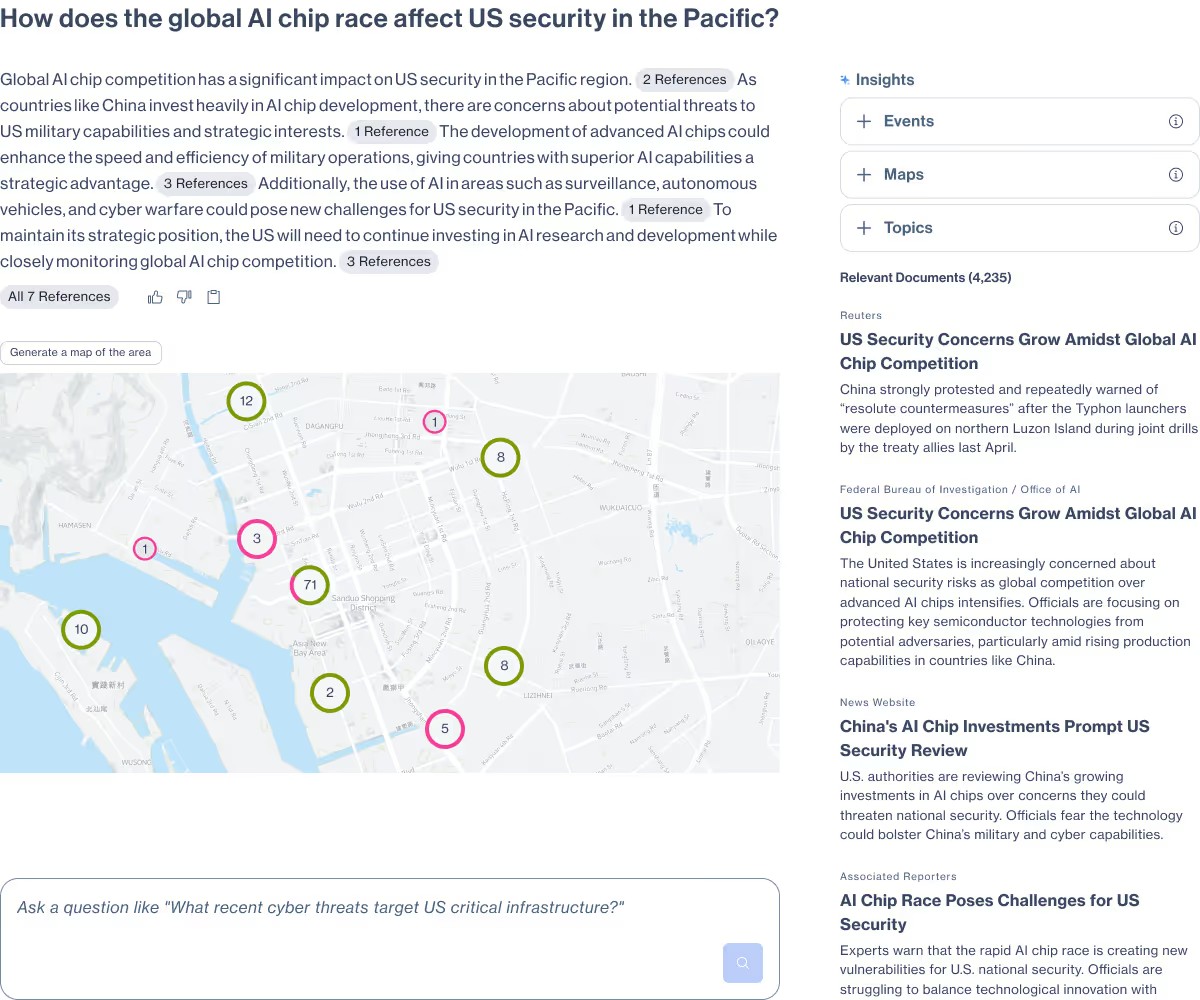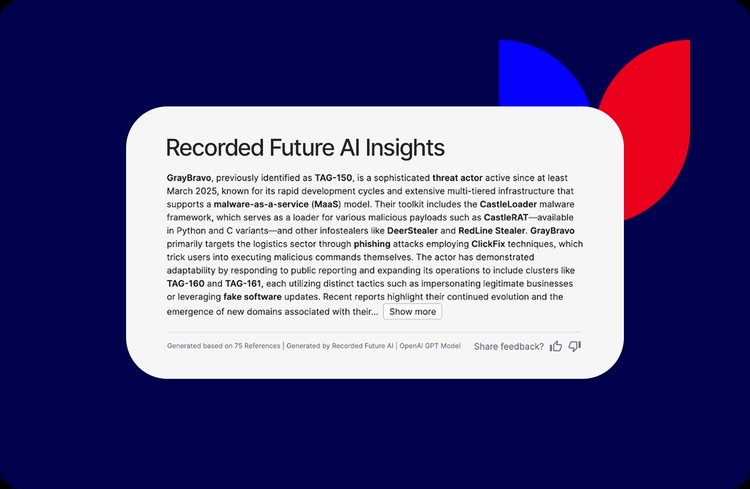
An intelligence report once waited for a person to read it. An AI agent can consume the same finding as an input to its next action. Recorded Future’s move to make threat intelligence accessible to agents therefore changes the consequences of an analytical mistake.
Recorded Future’s company history identifies In-Q-Tel among its first investors in 2009. That is a historical funding relationship, not a claim about present ownership.
Intelligence enters the tool chain
Recorded Future’s MCP documentation, updated September 28, 2026, describes authenticated access for AI clients to its intelligence, alerts and related tools. Its AI platform page also describes report generation and answers grounded in its Intelligence Graph.
These are product capabilities described by the vendor. They do not demonstrate autonomous performance in a classified defense environment. The relevance to defense is the workflow: cyber intelligence can inform the systems protecting military networks and their suppliers.
Reading and acting are different permissions
Suppose an agent finds that an internet address has been associated with malicious activity. A human analyst might investigate whether the observation is recent and whether the address is shared. An automated workflow could instead propose blocking it immediately.
This hypothetical illustrates the critical boundary. Access to intelligence is not authority to act on it. A well-designed integration must retain that distinction even when retrieval becomes almost effortless.
References must survive automation
A source link helps a person audit a report. An agent also needs to retain the observation date, confidence and reasons a conclusion might no longer apply. Repeatedly summarizing a finding can strip away precisely those qualifications.
Our assessment is that intelligence suppliers will increasingly compete on how safely machines can consume their outputs, alongside breadth of collection. A concise answer that loses its caveats can be less useful than a longer record with explicit uncertainty.
Evaluate decisions, not fluent reports
For a defense buyer, a practical pilot should begin with bounded, reviewable tasks. Measure whether analysts catch more relevant threats and whether erroneous recommendations are easy to reverse. Keep a record of what evidence was available at the time of each recommendation.
The possible benefit is less repetitive research. The unresolved burden is accountability when an agent links several individually plausible findings into a bad recommendation. A polished report is not evidence that this burden has disappeared.
What would change the assessment
Bounded operational trials with error rates, action logs and reversal times would establish whether agent integration improves defense rather than just output volume.
This analysis draws on the public sources linked in the text. Send corrections to [email protected].