A satellite image can show a striking detail while leaving its significance unresolved. Analysts need to connect the observation to position, orientation, time and other evidence before drawing a conclusion. HEO's Insights Next launch addresses that interpretive workload. Our judgment is that bringing the context into the same workspace is a useful advance, provided the interface preserves the distinction between an observation and the model used to explain it.
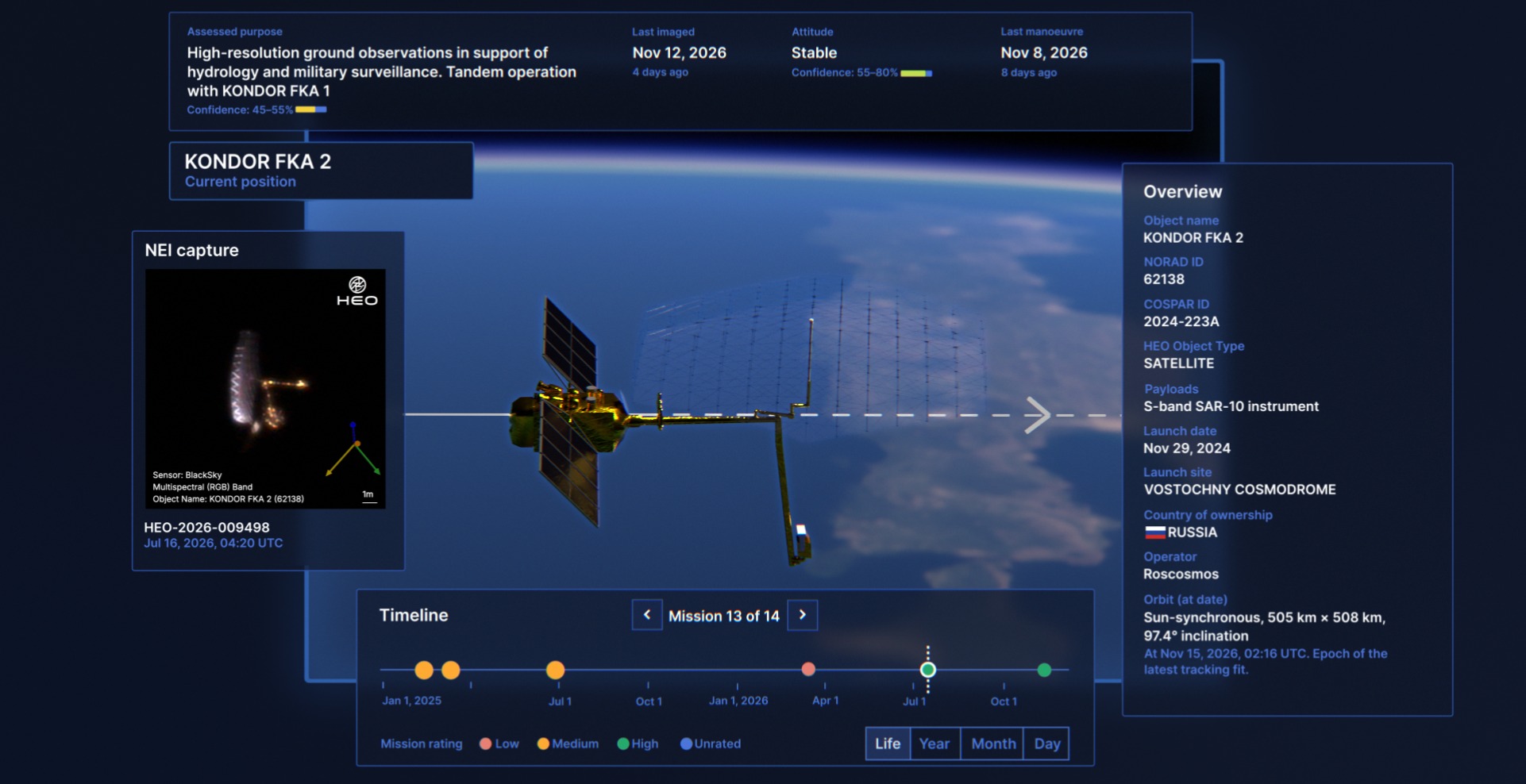
HEO's November 19 release introduces an interactive 3D environment within HEO Inspect. The company says it combines non-Earth imagery with information about an object's configuration, dimensions, orientation and pointing direction. It reports a collection base exceeding 7,500 imaging missions across 1,200 objects, with existing customers to be onboarded progressively. Those figures describe HEO's stated observation history; they do not independently measure the accuracy of every assessment made in the new environment.
The interface can change the analytical task
Our inference is that the main benefit could be reduced assembly work. If an analyst no longer has to reconcile several tools before examining an event, more attention can go toward testing explanations. That is a practical improvement even when the underlying imagery is unchanged. It should be measured through the quality and time of completed assessments, including difficult cases where the available evidence supports no firm conclusion.
A 3D presentation can also make inferred geometry look more definite than the source warrants. The original image, capture time and the basis for the displayed context should remain inspectable. A user should be able to distinguish a measured property from an estimate or an assumption. Presentation quality is most valuable when it makes those distinctions easier to understand, rather than smoothing them away.
More observations do not make intent directly observable
HEO describes the platform as helping users examine what an object is doing and how behavior changes. That is an important analytical ambition, but physical appearance and pointing geometry do not automatically establish purpose. The same observable condition can have several explanations. The workspace should support comparison and revision, including a record of which evidence changed an analyst's view.
The strongest objection to emphasizing these limits is that analysts already understand uncertainty. Many do, but software still shapes the work placed in front of them. A consolidated interface can save effort while also making some alternatives less visible. Evaluation should therefore include whether analysts notice contradictory evidence and whether another authorized reviewer can reconstruct the basis of an assessment.
Test the result with the underlying record available
A practical evaluation would compare the existing workflow with the new environment on representative analytical questions. It should consider analyst time, the evidence consulted, the conclusions reached and the quality of the review trail. A fast answer that omits a material limitation is a different outcome from a faster, well-supported assessment. These measures should remain separate in the account.
The rollout also introduces an integration question for customers with established tools. A specialist may need to carry an observation and its context into another system without losing the provenance or uncertainty attached to it. This is where a commercial workspace can become a dependable part of an institutional process, rather than a separate display used for selected demonstrations.
We would watch for customer evidence describing that complete analytical workflow. HEO's launch deserves attention because it targets a real gap between imagery and judgment. The stronger claim will require showing that users can work more effectively while remaining able to question what they see, trace its basis and revise an interpretation when new observations arrive.
Sources and media credits
HEO’s Insights Next interface illustration. Supplier product context, not an independently verified orbital assessment. Image: HEO
This analysis draws on the public sources linked in the text. Send corrections to [email protected].