Shipboard uncrewed aviation depends on how an aircraft fits the ship’s operating routine. Launch and recovery arrangements, crew familiarity and the control station all shape whether a sensor can be used when the vessel needs it. Qualification is an important bridge between demonstrating an aircraft and accepting it into that routine.
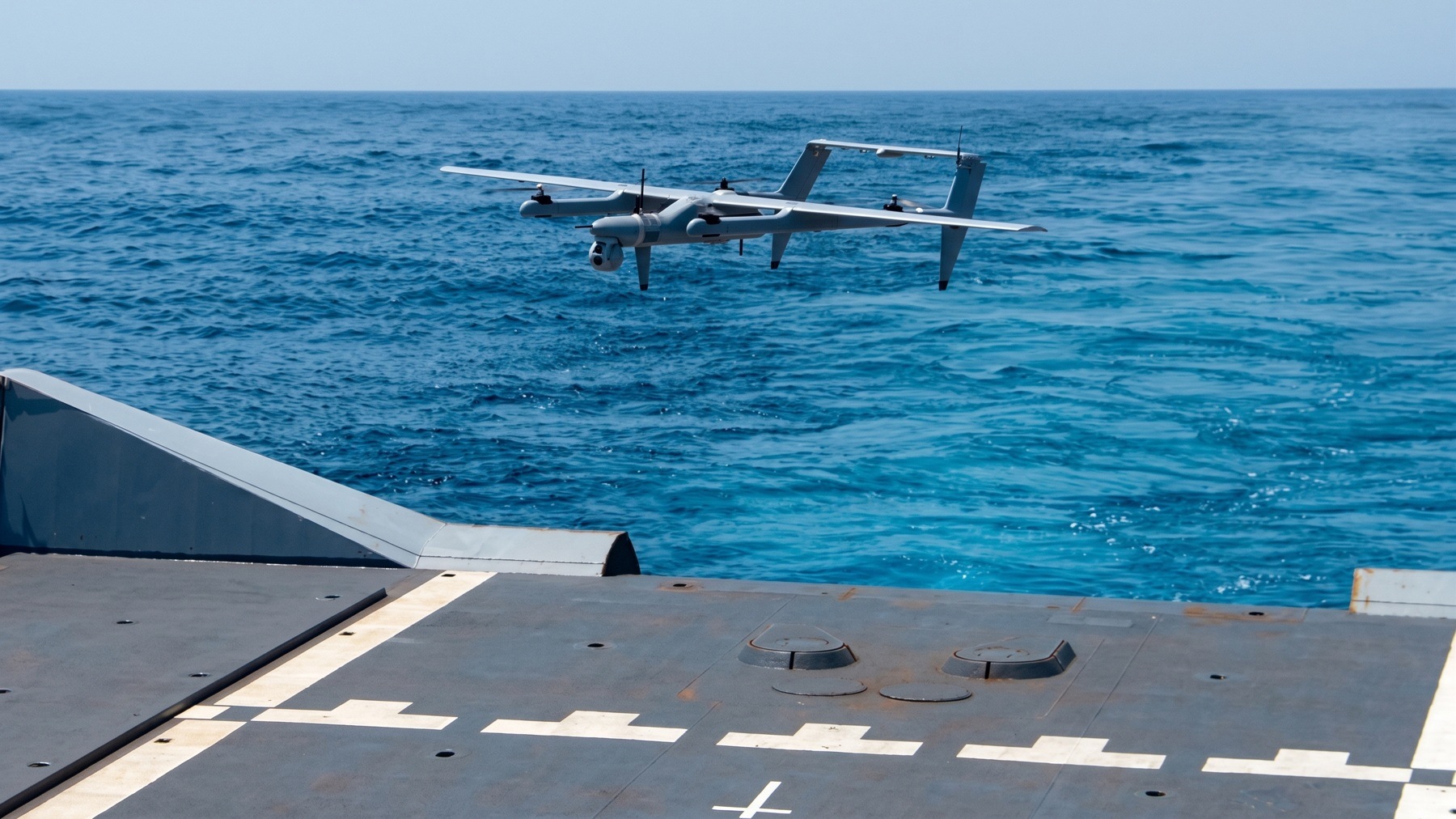
Airbus said on November 3 that the French DGA had qualified the vertical-takeoff-and-landing version of U010 Aliaca following land and sea testing in May and June. The first two systems were delivered to the French Navy in September. Of 34 systems ordered under the SMDM program, eight will be VTOL versions; each system contains two aircraft. Airbus identifies BSAM and BSAOM support vessels as the planned hosts. Read the primary source account.
Continuity at the control station
The company says the Aliaca variants share a ground control station and operating system. That is an important integration detail. Our analysis is that a familiar control environment can make the transition easier to organize, because the new aircraft need not introduce an entirely separate user interface and operating concept. It does not remove the need to learn the procedures specific to vertical launch and recovery.
The relevant distinction is between commonality and equivalence. A crew may recognize the planning and monitoring tools while still needing variant-specific training, maintenance and operating limits. The qualification announcement does not publish the complete test envelope or quantify how long crews need to become proficient. Assertions about an immediate transition should therefore be read as the supplier’s assessment rather than a measured training result.
For a ship’s command team, the useful outcome is an accepted way to obtain an airborne view within the vessel’s constraints. The combination of delivered equipment and qualification makes this a more concrete milestone than an early concept announcement. It still leaves vessel-by-vessel introduction and operational experience to be documented.
From acceptance to routine use
The initial fixed-wing Aliaca configuration has been in French service since 2022, according to Airbus. That provides program context, but experience with one variant should not be treated as a substitute for evidence about another. The VTOL version changes a central part of how the aircraft meets its host vessel.
The immediate implication is a qualified configuration available for the next stage of naval introduction. Longer term, common control infrastructure could help the navy organize a mixed set of Aliaca systems while adapting launch and recovery to different ships. The benefit would depend on dependable support, compatible procedures and demonstrated availability across the planned operating locations.
Separate aircraft qualification from shipboard availability
A shipboard aircraft depends on a sequence of activities before and after its airborne task. Preparation, launch, recovery and maintenance all compete for space and crew attention. Qualification is a meaningful technical gate, but the availability of the complete service also depends on those surrounding activities and the conditions in which the ship operates.
The transition to vertical takeoff and landing changes the integration questions that a crew needs to rehearse. A useful operational record would connect weather and deck conditions to attempted missions, completed recoveries and maintenance required afterward. Those measurements would help distinguish occasional successful use from an operating pattern that can be sustained across a deployment. They are proposed ways to assess service performance, not figures disclosed by Airbus.
The announced delivery and qualification milestones narrow the gap between the program plan and equipment in customer hands. The next evidence should preserve that precision by identifying which ships and configurations are involved and what tasks have been accepted. Without that detail, readers should avoid extending a bounded qualification result to every vessel or operating condition.
The next useful evidence is a dated account of the named ships operating the VTOL systems, including the conditions and practical limits. That would connect the formal qualification to routine mission use. The announced qualification and September deliveries establish progress, while sustained shipboard performance remains the measure that will determine the capability’s operational value.
Source organizations: Airbus.
This analysis draws on the public sources linked in the text. Send corrections to [email protected].