A team of ground robots needs a trustworthy answer to a simple question. Where is each vehicle? Losing that answer can undermine navigation and the interpretation of everything the robots observe. Swarmbotics AI's integration with TERN is therefore worth watching. Our judgment is that dependable positioning is the first result buyers should demand before assigning value to the wider swarm proposition.
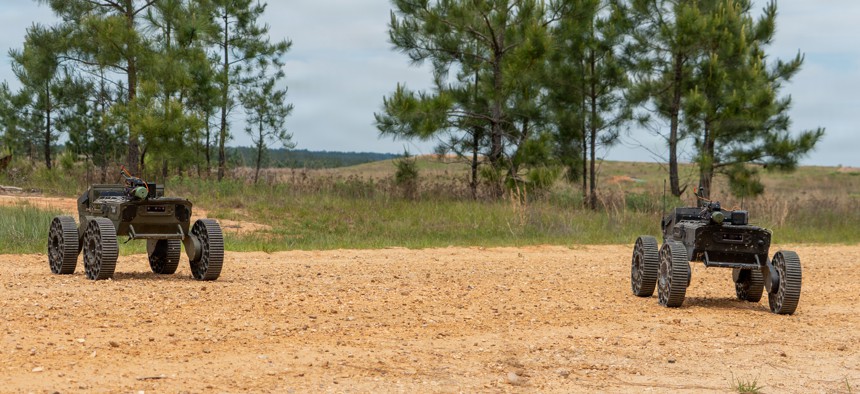
Defense One reported on October 29 that TERN's GPS-independent positioning had been integrated into Swarmbotics AI's FireAnt ground robot. The report describes an integration completed in under a week. TERN explains that its system combines vehicle motion inputs with onboard map data to estimate position. We are examining that earlier development in today's edition; it is not a new November 5 announcement. Read the source account.
What the evidence supports
A quick integration matters because small robots have limited room for additional equipment. But fitting a component and proving its behavior across a mission are different milestones. The published account gives no independently verified drift or accuracy results. Without those, a buyer cannot yet tell how far a team can travel before its shared location picture becomes too uncertain for the intended task.
The near-term test
The immediate opportunity is to test ground autonomy through deliberate satellite-navigation loss. An evaluation should compare the robot's position estimate with independent ground truth across turns, uneven surfaces and repeated routes. It should also record when the system recognizes uncertainty and asks for help. A system that admits its position is unreliable can be easier to supervise than one that continues confidently with an incorrect estimate.
The longer-term case
The longer-term promise is coordinated observation by several vehicles. That requires more than each robot moving successfully on its own. Their relative positions must remain consistent enough for the team to combine observations. Communications delay and map differences can complicate that task even when individual navigation looks sound. The integration makes these questions testable; it does not settle them.
Relative and absolute position answer different operational questions. A robot might remain adequately spaced from its neighbors while the whole group shares an inaccurate map position. Conversely, each vehicle might know its approximate coordinates but still disagree enough to complicate a shared observation. An evaluation should report both. The relevant error tolerance also depends on the task. Maintaining formation, returning to a rendezvous and combining observations do not necessarily demand the same precision. A single headline accuracy figure would obscure those differences, particularly if it came from an easy route rather than the intended operating environment.
A second concern is how errors develop over time. Motion-based estimates should be evaluated across an entire journey, including starts, stops and changes in surface conditions. The important question is when the system can recognize that its estimate no longer supports the task. We would want to see the resulting behavior documented. Does it slow down, stop, request assistance or continue with a wider uncertainty estimate? These are proposed acceptance questions. The available reporting does not establish how the integrated FireAnt handles them, and it would be premature to infer an answer from the component description.
Interoperability also becomes more demanding as the team grows. A location estimate is useful to another robot only if the recipient understands its reference frame, time and uncertainty. Buyers should test what happens when updates arrive late or one vehicle temporarily loses the team connection. A coordinated system should be judged by successful completion of the shared task under those conditions. Simply increasing the number of robots in a demonstration would say little about whether their combined observations or movements are dependable. That distinction should shape the next trial rather than become a caveat added afterward.
Our assessment
Our view is cautiously positive about the component work. The next meaningful evidence would be repeated multi-vehicle trials reporting position error, intervention frequency and mission completion under stated conditions. Those results would give the swarm argument an engineering foundation. Until then, integration speed is the demonstrated achievement.
Sources and reporting dates
Underlying development date: 2026-10-28. Analysis published November 5, 2026. Company performance claims are attributed to their source; assessments and evaluation criteria are ours.
This analysis draws on the public sources linked in the text. Send corrections to [email protected].