A mobile counter-drone system has to keep working after it reaches its operating position. For a laser, the useful measure is therefore broader than optical output: electrical supply, heat removal and the host vehicle must support the engagement sequence together. The integration package can determine how much of a laboratory capability survives real operating conditions.
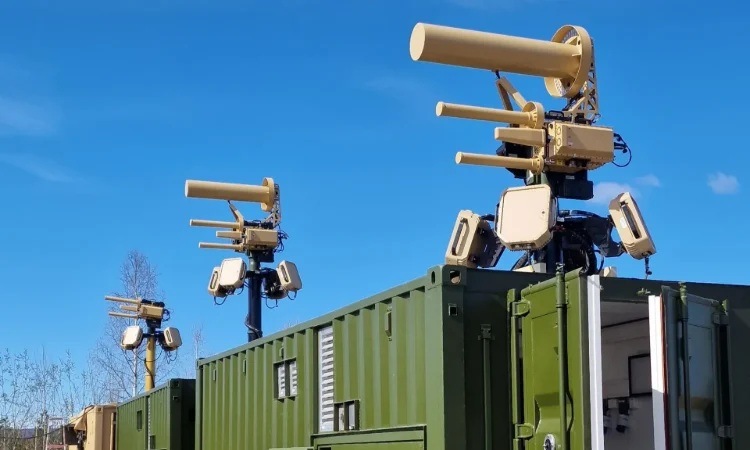
Leonardo DRS said on November 2 that AeroVironment selected it for integration work supporting the U.S. Army’s Enduring-High Energy Laser production program. The subcontract concerns power and thermal management for AV’s 30-kilowatt LOCUST X3. DRS identifies vehicle-mounted and palletized configurations, including integration on the Joint Light Tactical Vehicle. This follows the Army’s September production award to AV; it is a supplier selection within that program. Read the primary source account.
The operating cycle matters
Our analysis is that the production question moves toward the relationship between engagements, cooling and available vehicle power. A stated laser rating describes one part of the system. A fielded configuration also needs a defined operating envelope: how it starts, how it recovers between uses, and what other vehicle functions compete for its resources. None of those quantities can be inferred simply from the 30-kilowatt label.
The announcement points to DRS experience from government evaluations and training in 2024 and 2025. That is relevant integration heritage, but the release does not publish the production configuration’s sustained engagement rate, environmental limits or availability results. It also does not give the subcontract value or the number of systems covered. Buyers should keep the inherited experience separate from acceptance evidence for the equipment they will receive.
For operators, the practical contribution of a well-integrated package would be predictable use of the weapon alongside the rest of the platform. A maintenance team needs to diagnose whether a limitation originates in the laser, a cooling component, a power interface or a vehicle condition. Clear responsibility across those interfaces can reduce the time spent transferring a fault between suppliers. That is an integration objective, not an improvement measured by this announcement.
A production milestone with measurable follow-through
The immediate change is the naming of an industrial participant responsible for enabling subsystems. It gives the program a more concrete production chain. It does not establish that any particular unit has received the complete system or that it has defeated a representative range of threats under operational conditions.
Longer term, repeatable power and thermal packages could make configuration changes easier to manage across different hosts. The dependency is disciplined qualification: moving a system between a vehicle and a pallet can change the available resources and support arrangements. A common laser does not automatically create identical capability in every installation.
Readiness needs a complete duty cycle
The useful unit of assessment is a sequence of engagements and recovery periods, rather than a single moment of laser output. A power and thermal subsystem must support the conditions under which the rest of the weapon is expected to work. That suggests recording the initial state, operating duration and time required before another task can be attempted. These are evaluation considerations, not additional results reported in the subcontract announcement.
Integration also creates a configuration-control problem. A component change that appears beneficial in isolation can alter power demand, mass distribution or cooling behavior elsewhere. Keeping the accepted configuration identifiable helps maintenance teams determine which replacements are appropriate and whether a modification needs further testing. Production readiness includes the ability to repeat that configuration, not just assemble one functioning example.
For a program office, the subcontract therefore identifies an industrial responsibility within a larger system. It does not answer every question about the fielded system’s availability. Separately reported acceptance, maintenance and operating results would make it possible to judge whether the integration work translates into a repeatable capability under the conditions users actually face.
The next useful disclosures are delivery and acceptance milestones tied to named configurations, followed by operating limits and maintainability evidence. Those would show whether the integration work produces a capability that can be used and sustained at the tempo the customer requires.
Source organizations: Leonardo DRS, AeroVironment.
This analysis draws on the public sources linked in the text. Send corrections to [email protected].