A remote mine-hunting boat may keep people out of danger during its survey. It still needs a way to reach the operating area and return for support. If it can work from a larger ship, its useful geography can change substantially. The launch-and-recovery connection therefore deserves attention alongside the sonar that makes the underwater picture.
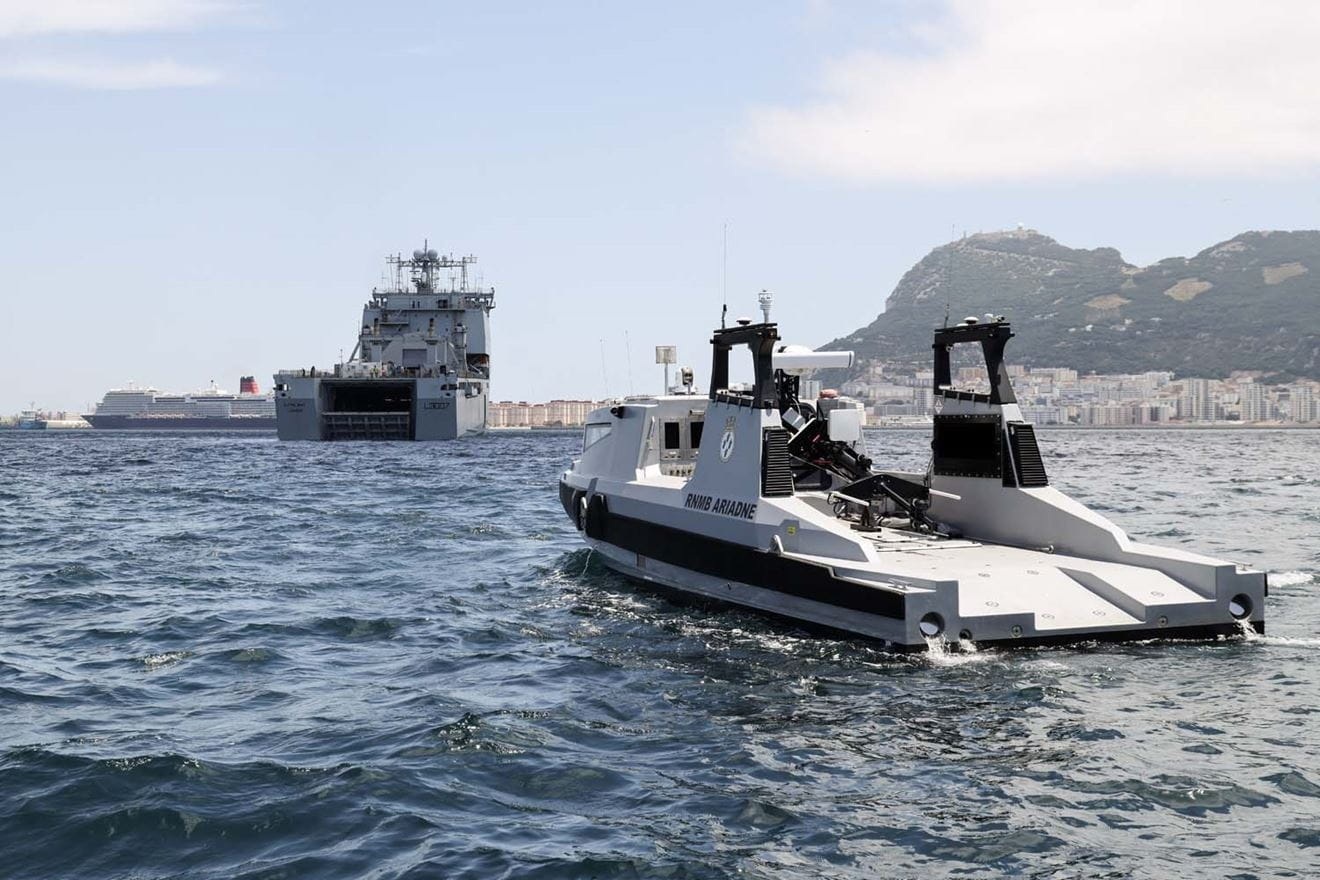
The Royal Navy’s May 27, 2026 account records Ariadne docking in a support ship and testing its sonar against a surveyed target. It also states that people were aboard as a safety measure during the trial. The March 2025 delivery announcement had set out the subsequent training and operational-evaluation sequence. Those steps should not be collapsed into one claim of fully unattended deployment.
Access to the water is capability
A boat launched locally may be useful near a prepared base. Operation from a support ship can bring it to a different area without requiring an equivalent shore facility. That is a substantial operational distinction, but the supporting vessel, equipment and crew remain part of the cost. A portable operating centre does not mean a self-contained mission without logistics.
Docking is also different from completing an entire recovery cycle. The team needs to secure the craft, inspect it, prepare it for the next launch and manage any towed equipment. Those actions can take longer than the approach shown in a short video. Counting them makes it possible to compare a support-ship concept with shore operation honestly.
Ariadne’s towed sonar uses sound to inspect underwater objects. Towing geometry, boat motion and the measured position of the sonar can affect how a contact is located. The survey target provides a reference against which to check the observed result. Such checks help connect a sensor output to a location a subsequent investigation can use.
That connection matters because successful sensing and successful navigation can coexist with poor contact location. If the tow body is treated as though it occupies the boat’s position, the follow-up record can be wrong even when the image looks convincing. This is an illustrative interface problem, not a reported Ariadne fault. It explains why the complete survey geometry belongs in an accuracy test.
Safety supervision should stay visible
Personnel aboard during the trial provide a clear limit to its autonomy claim. Their presence may be appropriate for safe testing. It does not establish that the same recovery has been completed without them. Reporting that boundary lets an observer recognise the genuine docking milestone while understanding which operational step still needs separate evidence.
An informative next comparison would repeat launch, survey and recovery under several relevant conditions and record assistance at each stage. It would include the time to return the equipment to readiness. The goal would be to determine how consistently the remote system can deliver a useful mission from the support vessel, rather than simply whether it can enter its dock.
The countercase is operating from a prepared shore facility with simpler handling. A shipboard arrangement is not automatically better. It becomes valuable when the changed access offsets the larger support organisation and the constraints of working at sea. Mission location and frequency therefore matter when comparing costs, not just the purchase price of the boat.
The training sequence also deserves procurement attention. Operators and support crews must share an understanding of the interface and of how to stop a trial when conditions exceed it. That knowledge is part of the delivered system. A hardware contract that omits it can leave the customer responsible for discovering the most consequential operating limits after delivery.
A dependable way home
Recovery determines whether a useful sortie becomes a repeatable cycle. A vehicle that completes its survey but cannot return through the available handling process leaves the support organisation with a separate problem. The important measurement is consequently not just time on task, but time from preparation to readiness for the next task. That includes the checks performed after the machine comes aboard.
A demanding recovery evaluation would record the conditions under which an approach was attempted, delayed or abandoned. An appropriate decision to wait is useful evidence about operating limits. Treating every delay as a failure could encourage teams to conceal the constraints that later operators most need to understand. The public docking milestone is a starting point for that record, not a complete account of allowable conditions.
The support ship's contribution should be judged alongside the drone's. Handling arrangements, crew training and the organisation of the deck can determine whether independent movement delivers greater operational availability. The wider lesson is that autonomy at sea needs a dependable way home as well as a convincing journey outward.
What would change the assessment
Keep docking, sonar accuracy and unattended recovery as distinct milestones with their support costs attached.
The wider impact
Ariadne’s trial illustrates how apparently routine ship handling can determine the reach of autonomous mine warfare. The larger opportunity is to move useful sensing beyond prepared bases while keeping people farther from hazards. That outcome needs evidence for the complete support cycle. Docking is a meaningful step, but sustained remote launch, survey and recovery remain the chain that a commander must be able to schedule.
This analysis draws on the public sources linked in the text. Send corrections to [email protected].