Understanding an object in orbit requires more than knowing where it is. An observer may also want to assess its configuration, condition or changes over time. Images can contribute to that judgment, but collecting a picture and establishing what it means are separate steps. The broader intelligence opportunity is to make observations useful for decisions without hiding the uncertainty introduced along the way.
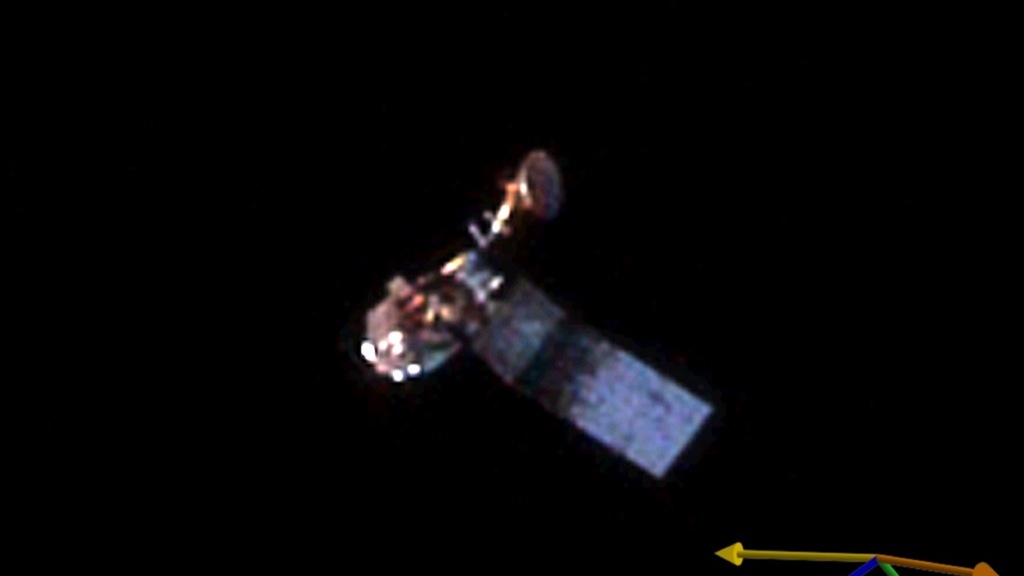
BlackSky and HEO have expanded a partnership aimed at that workflow. In an October 15 release, BlackSky announced a seven-figure annual renewal for non-Earth imaging that adds access to Gen-3 alongside Gen-2. The companies describe an automated process through HEO Inspect connecting tasking, imagery and analysis. The release identifies uses including anomaly detection and characterization of spacecraft. These are the companies’ descriptions of the service, not an independently published accuracy or latency evaluation.
Footage context: BlackSky satellite-programme documentary. Background on the company, not footage of HEO non-Earth imaging or evidence of the renewal’s service performance.
Why the workflow matters
Using an existing satellite to observe another object offers a different approach from treating every inspection need as a dedicated spacecraft mission. The relevant research and engineering questions concern collection opportunities, useful observations and the interpretation that follows. The commercial announcement indicates continued customer interest in that approach, while leaving its operational boundaries to be assessed separately.
An automated pipeline can reduce manual handoffs, but it also creates several places where an assessment needs context. A request has an intended subject and time; an image has actual collection conditions; an analytic result has assumptions and uncertainty. A reader should not have to infer that those are identical merely because the final report arrives through one service.
For example, a visible difference between images could merit attention without establishing its cause. A useful report would distinguish the observation from an explanation and indicate what additional evidence might resolve the uncertainty. This is an analytical example of how to evaluate an intelligence product, not a claim about a particular image processed by HEO.
Watch the footage
A documentary featured by BlackSky follows its satellite programme and intelligence workflow. Background footage; it does not establish revisit rates or performance of a particular image.
Video: Economy 4.0 / BlackSky · Original source ↗ · Video watch page ↗What customers can assess now
The near-term development is an expanded service agreement and access to another generation of imaging capacity. That gives customers and observers a concrete commercial milestone. It is stronger evidence of an ongoing business relationship than a standalone demonstration, but it does not reveal how every downstream decision will perform.
The next assessment should therefore focus on the service delivered to a customer. Useful measures would include elapsed time from request to usable result, the share of requests that produce a usable observation and the explanation supplied when they do not. Reporting a fast example without its unsuccessful or delayed counterparts would not establish typical performance. This article does not have those service-level data.
Traceability is another immediate question. A recipient should be able to identify the underlying observation, distinguish collection time from report time and see whether later processing changed the assessment. Those details would help an analyst decide whether a result is current enough and sufficiently supported for the task. They are particularly useful when automation makes a polished report easier to produce.
The longer-term value is confidence in change
If more frequent collection can be paired with reliable interpretation, customers could gain a clearer account of how orbital infrastructure changes over time. The benefit would depend on coverage, repeatability and the ability to compare observations appropriately. More images would expand the evidence available; they would not automatically settle every question about condition or intent.
The partnership also illustrates a broader commercial pattern worth testing: existing platforms can become inputs to new analytic services. That could widen the market for observations without requiring every service provider to own a separate constellation. The practical limits would include access arrangements, competing collection demands and the confidence customers place in the resulting analysis.
The evidence to watch is a customer-relevant account of the full tasking-to-assessment chain, with defined performance measures and acknowledged exceptions. That would connect a contract renewal to a more substantive intelligence result. BlackSky and HEO have announced additional capacity and continued cooperation; showing how that becomes a dependable judgment is the next part of the story.
Sources and limits
- BlackSky, October 15, 2026: HEO renewal announcement, checked October 16, 2026.
- Public-source analysis; no independent access to customer performance data or spacecraft assessments. Evaluation questions and conditional implications are the publication’s analysis.
What would change the assessment
Watch for repeatable test results and customer evidence that connect this announcement to the practical outcomes discussed in this analysis.
This analysis draws on the public sources linked in the text. Send corrections to [email protected].