A commander watching a port needs to know whether activity is changing soon enough to respond. A clearer satellite image helps identify what is there; repeated, comparable images help establish what is happening. BlackSky’s new service matters because intelligence value depends on both detail and the time between useful observations.
A service milestone, not just an image
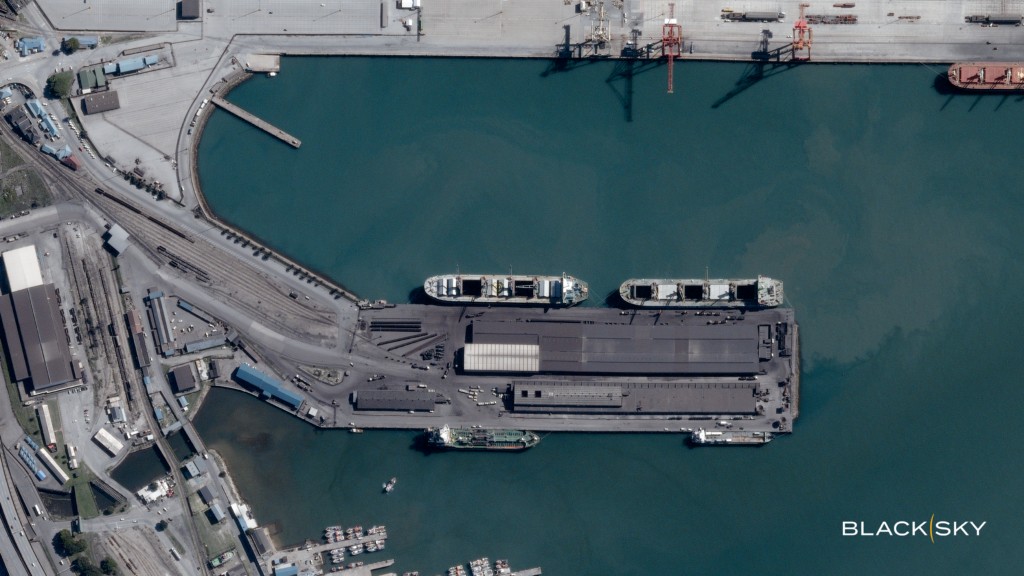
On March 12, 2026, BlackSky announced general availability of Gen-3 capabilities after commissioning its fourth Gen-3 satellite in under a week. The company described 35-centimeter imagery and AI-enabled analytics available through its Spectra platform.
Its announcement distinguished daily Gen-3 service from hourly Gen-2 monitoring. Those claims should not be combined into a promise of hourly 35-centimeter coverage everywhere. The published demonstration image shows port and rail facilities at Gqeberha, South Africa, on March 9.
Watch the footage
A documentary featured by BlackSky follows its satellite programme and intelligence workflow. Background footage; it does not establish revisit rates or performance of a particular image.
Video: Economy 4.0 / BlackSky · Original source ↗ · Video watch page ↗Change detection needs a baseline
For an intelligence analyst, a busy port is not automatically an unusual port. The harder question is whether activity differs from its normal pattern. A model needs comparable observations and enough context to distinguish meaningful movement from routine variation.
Consider a hypothetical vessel that appears between two collections. The images establish that it arrived within an interval. They do not establish its exact arrival time or purpose. Automation should preserve that interval instead of converting it into an invented timestamp.
Collection and analysis are one workflow
The commercial opportunity is broader than selling a clearer picture. A customer wants to decide where to look next, receive the collection, compare it with earlier observations and review the resulting alert. Delays at any stage can erase the value of faster processing elsewhere.
Our assessment is that this favors services evaluated end to end. Resolution alone cannot tell a buyer how quickly a consequential change will be noticed.
Sharper pixels do not supply every missing context
The March announcement describes the fourth Gen-3 spacecraft’s commissioning and gives a specific example from Gqeberha. It is useful evidence of a delivered service milestone and the company’s stated collection capability. A demonstration image cannot establish the reliability of every automated classification or the distribution of collection times for every customer. Those are separate operating questions requiring more than one attractive scene.
For a hypothetical port analyst, greater detail may help distinguish a vehicle from a shadow or separate adjacent objects. Whether that improves the assessment depends on the relevant task. Counting objects, identifying a particular vessel and inferring a loading operation require different evidence. A buyer should not treat an improvement in nominal image resolution as an equal improvement in each of those claims.
The baseline has to survive changing observations
Change analysis depends on earlier observations and on understanding how they differ from the new scene. Sun angle, viewing geometry and processing can affect what an image makes apparent. A service can still provide valuable comparisons, but the user needs enough collection context to judge whether a detected difference reflects the site or the observation. Automated alerts should preserve a route back to the before-and-after material.
There is also a practical distinction between detecting change and deciding its importance. An increase in vehicles might be routine activity, a seasonal pattern or an unusual concentration. A model can flag the difference while the wider assessment remains unresolved. Keeping that boundary visible makes the alert a useful request for attention, rather than an unsupported explanation of why the activity occurred.
Timeliness is measured at the user
Tasking access belongs in that assessment as well. A sensor may be technically capable of the desired observation while capacity or permissions prevent that particular customer from requesting it. The product’s usefulness is the combination of capability, available access and delivery, rather than the sensor specification in isolation.
A useful trial would start with a question and record when it was submitted, when the location was observed, when a processed product arrived and when an analyst could verify the finding. These intervals expose where the service saves time and where another bottleneck remains. An average processing claim cannot explain a missed collection opportunity or a delayed review.
The countercase is using a less detailed but more available source when it already answers the question. BlackSky’s own distinction between daily Gen-3 and hourly Gen-2 capability makes that trade-off important. The wider impact of the new generation is a broader set of collection and analysis options. Its value emerges when those options help customers notice and understand consequential changes sooner, with enough evidence to check what the alert actually means.
What would change the assessment
Customer-specific collection intervals, weather-related gaps and measured alert accuracy would support a firmer judgment than selected demonstration images.
The wider impact
A useful trial would record missed collections, delivery latency, false changes and the analyst time needed to validate alerts. It would include weather and illumination constraints rather than select only clean examples. The strongest intelligence service is not the one that never admits a gap; it is the one that makes gaps visible before a decision depends on them.
For governments buying observation, the payoff is earlier awareness of a consequential change with enough evidence to act on it. Faster collection matters when its gaps remain visible and its alerts can be checked; otherwise sharper pictures may leave the decision just as uncertain.
This analysis draws on the public sources linked in the text. Send corrections to [email protected].