A soldier changing unmanned platforms should not have to reconstruct the whole control arrangement each time. A common handheld interface can reduce that burden, but the radio, power supply and information shown to the operator remain part of the capability. The controller’s physical portability and the controlled platform’s behavior answer different questions.
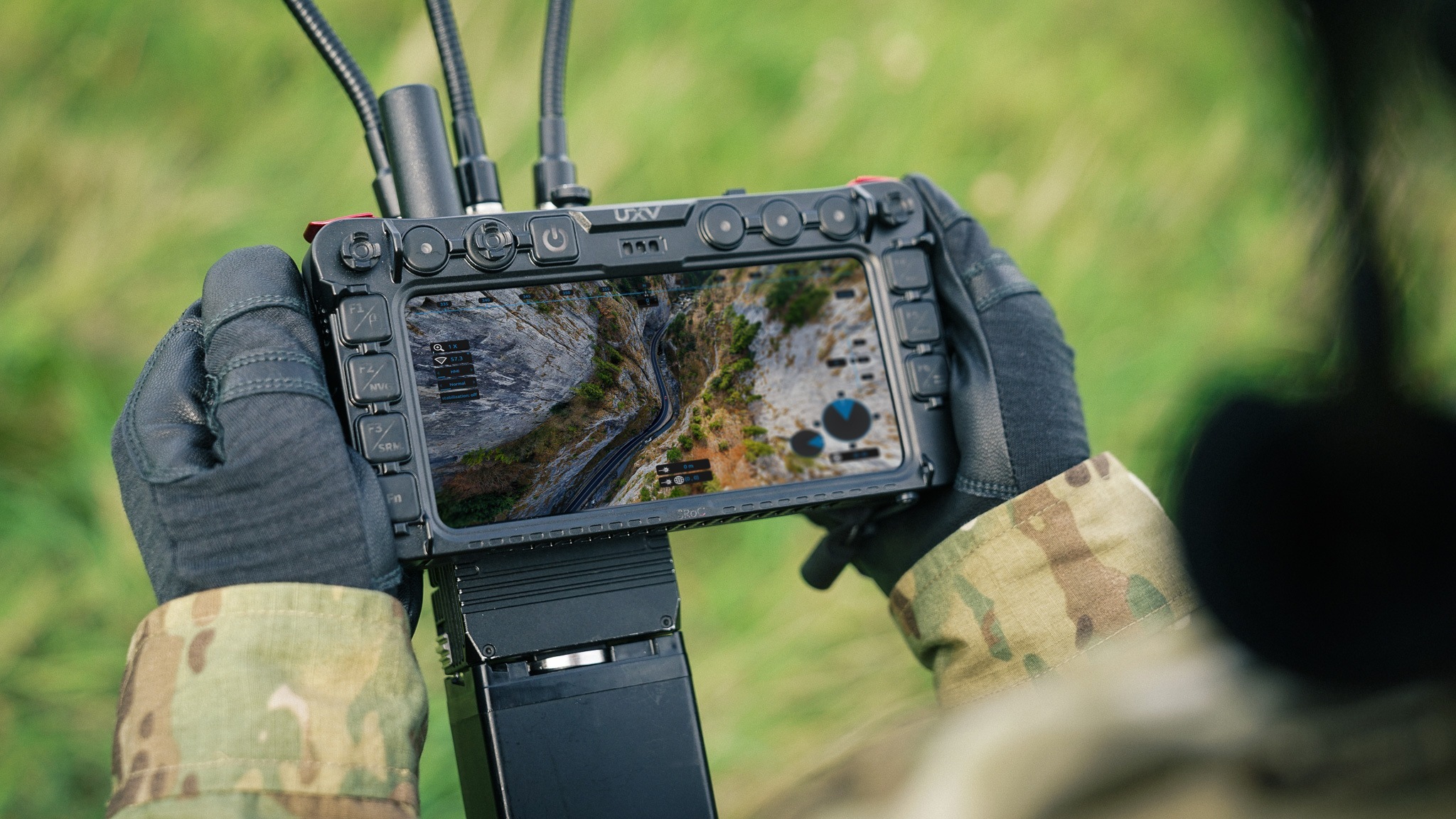
UXV Technologies introduced the SRoC S26 on October 21, following its announcement at AUSA 2026. Built around Samsung’s S26 phone, the controller has a radio-agnostic architecture, a Swappable Radio Module, Nett Warrior compatibility and both internal and swappable-battery options. UXV positions its SRoC family for air, ground and maritime unmanned systems. This is a supplier product introduction, not an independent assessment of every platform combination or a newly disclosed procurement award. Read the primary source account.
Modularity moves the integration boundary
An interchangeable radio can make one controller useful across different communications arrangements. It does not mean that every radio and vehicle combination is already integrated, qualified or interchangeable during a mission. The receiving team still needs to know the supported configurations, how the connection is established and which commands the destination platform accepts. Those details determine whether a modular component becomes a practical common interface.
Nett Warrior compatibility addresses another boundary: the controller has to fit a dismounted information environment rather than operate as an isolated screen. Compatibility is meaningful as an integration direction. It should not be turned into a claim that every application, map layer or mission system automatically shares identical information. The announcement does not enumerate an acceptance matrix that would establish that broader conclusion.
The battery arrangement also needs to be understood as a system property. An internal battery and support for swappable modules offer options for continuity, but the release does not publish an endurance result for every radio, screen setting and workload. A stated power option is different from the time a complete configuration can remain useful under representative operating conditions.
The operator needs an understandable transition
For a ground-robot team, the immediate option is a new handheld configuration to assess against its current control equipment. A useful comparison would include the time and steps needed to change a supported radio or power source, recover a connection and confirm which vehicle is receiving commands. These are proposed acceptance questions, rather than outcomes measured in the supplier announcement.
A common screen can simplify training if its conventions remain consistent. It can also conceal differences between platforms if similar controls produce different behavior. A receiving organization therefore needs to retain platform-specific limits within the shared interface: what is automatic, what requires confirmation and what an operator sees when communications degrade. Common hardware is most useful when it preserves those distinctions clearly.
Maintenance and configuration control are part of that assessment too. Modules, phone software and vehicle interfaces can change on separate schedules. Recording the qualified combination allows a team to distinguish a hardware replacement from a software change that alters supported behavior. The announcement supplies the product architecture; it does not establish a complete lifecycle process for a particular customer’s fleet.
A common controller must earn its commonality
The shared controller also changes the boundary between an application update and an operator's learned habits. A revised screen can alter what a familiar physical input means even if the radio module remains unchanged. For a supported ground vehicle, an assessment should therefore preserve the displayed mode and software version alongside the hardware list. This would let a receiving team reproduce the control experience it accepted, instead of assuming that an unchanged handheld enclosure means unchanged behavior.
Over time, a modular handheld could reduce the number of distinct operator devices a unit carries and supports. The practical gain depends on how many relevant systems it can control predictably, with the radios, batteries and applications the receiving organization actually uses. A small controller is not evidence of a small integration burden by itself.
The next persuasive evidence is a documented supported configuration and a representative operator trial, including transitions, lost links and recovery. That would connect the S26’s modular design to a measurable control workflow, while keeping product availability, interoperability and operational readiness as separate milestones.
Source organizations: UXV Technologies.
This analysis draws on the public sources linked in the text. Send corrections to [email protected].