Adding another interceptor does not by itself create a stronger air-defense system. The new equipment must exchange information with the network already in use and fit the authority, training and support arrangements surrounding a response. That integration problem is the larger significance of a supplier partnership: customers are buying a place in a working architecture as well as a vehicle.
Fortem Technologies announced an expanded agreement with MBDA on October 12. The companies intend to offer DroneHunter and the jointly developed FireThorn through MBDA's air-defense architectures. Fortem says this builds on a collaboration dating to 2024 that integrated DroneHunter into MBDA's Sky Warden counter-drone architecture. Sales remain subject to applicable export authorizations. Read the primary announcement.
Two options with different consequences
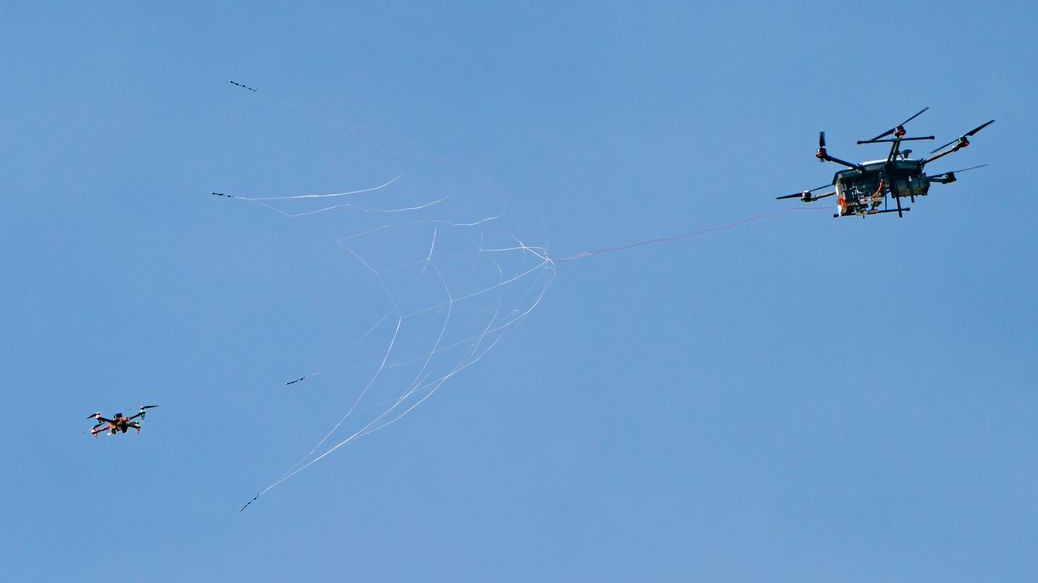
The announcement distinguishes DroneHunter's net capture from FireThorn's kinetic interception. Those are different response options, not interchangeable descriptions of a universal solution. Selecting between them requires an authorized customer's assessment of the protected setting, the threat and the consequences of the proposed response. This article does not infer an engagement policy from the supplier's product description.
The release establishes the companies' stated integration and commercial direction. It does not provide a new comparative test dataset, customer acceptance report or system-wide availability measurement. A demonstration or successful individual intercept would also need to be read within its conditions, rather than treated as proof that a complete defense network can manage every situation.
What a customer can assess now
The near-term change is a clearer route for an existing MBDA customer to explore an additional counter-drone layer. The useful questions concern supported interfaces, the division of responsibility between suppliers and the evidence required before acceptance. Training, maintenance and replacement equipment belong in that comparison alongside the interceptor itself.
Fortem's release says FireThorn would be displayed at MBDA's AUSA booth 453 during the October 12–14 event. This is primary-source evidence of an announced partner-booth display, not an independently observed attendance record and not a field deployment. Trade-show presence cannot substitute for customer evaluation.
Integration has a lifecycle
An architecture connection can work in a demonstration and still need support through future software changes. A customer therefore needs to know who maintains the interface, how a changed sensor or command-system version is checked and who is responsible when information is incomplete. Those obligations may span both suppliers. The expanded agreement describes an offering, but does not publish those customer-specific support arrangements.
Net capture also changes what happens after an interception. Recovering equipment or preserving potential evidence requires people, procedures and an appropriate receiving location. Calling an option low-collateral describes the manufacturer's intended advantage; it should not erase the need to assess the circumstances in which it is used. The kinetic alternative brings a different set of consequences and authorization requirements. This is a distinction between response types, not an assessment of a specific engagement.
For procurement comparisons, the unit of value is the supported response capability. Counting interceptors alone excludes sensors, command integration, trained staff and ongoing service. A disclosed customer evaluation could make that comparison concrete by naming the equipment included, the assessed conditions and the limits of the finding. Until such evidence is available, the partnership offers a route to integration rather than a quantified improvement in the customer's protection.
A network result still needs network evidence
Over time, established integration routes could make it easier to add or replace a defense component without constructing an isolated system around it. That benefit depends on accessible interfaces, sustained software compatibility and an accountable human decision process. A partnership announcement cannot settle those conditions.
The evidence to watch is a disclosed customer integration or acceptance milestone, with the tested configuration and its limitations. That would connect the expanded agreement to a practical defense capability. Until then, the announcement is consequential as an integration offer, with operational results still requiring their own record.
Sources and scope
Official organizations: Fortem Technologies, MBDA. Primary source, 2026-10-12. Manufacturer results and plans remain attributed; this publication did not independently test the equipment.
What would change the assessment
The evidence to watch is a disclosed customer integration or acceptance milestone, with the tested configuration and its limitations. That would connect the expanded agreement to a practical defense capability. Until then, the announcement is consequential as an integration offer, with operational results still requiring their own record.
This analysis draws on the public sources linked in the text. Send corrections to [email protected].