An airspace watch system has a basic weakness if it notices an aircraft only when that aircraft cooperates. A drone that does not transmit the expected radio signals can expose the limits of an approach built around listening for a controller. The larger defense question is therefore how to build awareness from the physical aircraft itself, while maintaining enough confidence to avoid turning ordinary aerial activity into a stream of alarms.
That is why Skylark Labs' ARIES announcement matters. The company's August 7, 2025 release describes a Camp Atterbury demonstration involving small drones that were not emitting radio-frequency signals. The claimed achievement concerns detecting, tracking and classifying those aircraft. It should not be read as evidence of an interception, an autonomous weapon engagement or blanket effectiveness against every form of drone.
The main contribution: a physical observation can outlast a radio signature
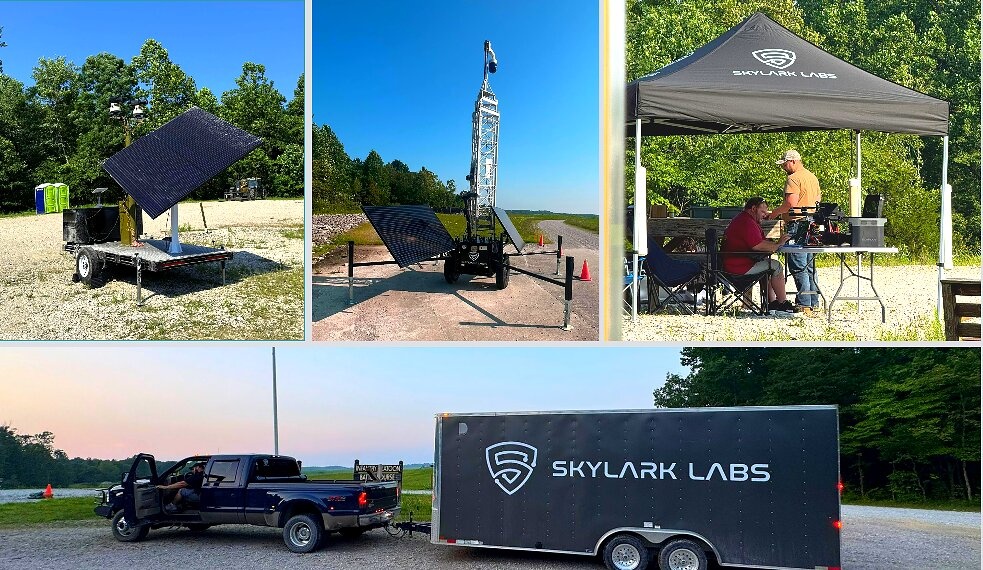
According to the company announcement, ARIES combined optical sensing, radar and AI analysis, with equipment installed on Scout MK1 towers and information sent to a command center. Skylark says the system recognized unfamiliar drone configurations during the exercise. These are vendor-reported results from a named event; the release does not provide an independent scored trial or enough numerical detail to reproduce the comparison.
The broader significance is a change in the source of confidence. A radio detector can offer useful evidence, but a physical observation can provide another basis for awareness when a familiar signal is absent. Our assessment is that this makes ARIES interesting as a contribution to a layered picture, rather than as a reason to assume every other sensor has become unnecessary. Different kinds of evidence answer different questions.
Watch the footage
Scout tower platform footage from Skylark Labs, included as hardware context. This is not footage of the ARIES Camp Atterbury demonstration and does not show interception.
Video: Skylark Labs · Original source ↗ · Video watch page ↗Detection is the start of a decision, not the whole decision
An operator needs more than a moving dot. A useful airspace picture must communicate uncertainty, distinguish separate observations from duplicate tracks, and preserve the history needed to understand a changing situation. It also has to account for authorized aviation and ordinary environmental clutter. Those requirements are evaluation questions for any proposed system; this article does not assume that a marketing description proves all of them have been solved.
The distinction matters particularly when a detector is discussed alongside a response system. Seeing an object, identifying it as a drone, assessing its significance and authorizing an action are separate steps. ARIES has an expansive historical name in the announcement, but a name is not a demonstration of every possible function. The public account reviewed here supports a sensing claim. It does not establish an interceptor capability or authority to act against an aircraft.
Watch the evidence with the right caption
Skylark's published Camp Atterbury image identifies Scout MK1 equipment and a command-center arrangement. That is relevant visual evidence for the reported setting and the kind of ground infrastructure involved. Generic drone-strike footage from another Skylark product would be misleading in this article: it would blur the important boundary between observing an aircraft and attacking one. A demonstration video should be used only when its provenance and subject can be matched to ARIES.
The accompanying Scout video supplies platform context, rather than a recording of the Camp Atterbury trial. No verified ARIES-specific full demonstration video was established from the official pages reviewed. The sourced event photograph and announcement remain the evidence for the reported exercise. A video requirement should never become a reason to imply that a general product sequence depicts a particular test. The distinction helps readers understand both the equipment and the limits of the public record.
What would turn a promising demonstration into operational evidence?
The next questions concern repeatability. A field evaluation should make clear how many opportunities there were to detect an aircraft, how often the system was correct, how it handled ordinary activity and how its results changed with conditions. A claim about unfamiliar shapes is especially valuable only when the process used to define unfamiliarity is transparent. Otherwise, a reader cannot tell whether the result represents broad generalization or a narrower test case.
Our assessment is also that the workload consequences need measurement. A detector that adds many uncertain reports can consume attention even when it occasionally catches something important. What matters is the balance between useful warning, missed observations and the effort required to resolve ambiguity. Service availability, calibration, maintenance and integration into an existing watch floor belong in that assessment alongside headline detection capability.
Sources & evidence
What would change the assessment
Independent results for the exact configuration, with operating conditions and limits disclosed, would strengthen this assessment.
The wider impact
Skylark's current drone product page uses VIPER-A and VIPER-S in its main configuration descriptions, while its FAQ still associates ARIES with loitering munitions and counter-UAS. This inconsistency prevents a clean inference that every reference describes the same hardware or role. This article uses ARIES specifically for the ground-to-air sensing system described in the Camp Atterbury announcement, and does not merge it with VIPER-A.
The bigger picture is that counter-drone autonomy should make the airspace picture more dependable when signals are incomplete. ARIES points toward that goal through physical sensing and local interpretation. Its significance will be determined by repeatable results, understandable uncertainty and careful integration into human responsibility. Finding a drone that does not broadcast is an important beginning; knowing what the evidence actually supports is how that beginning becomes trustworthy capability.
This analysis draws on the public sources linked in the text. Send corrections to [email protected].