Finding a possible mine is only the beginning of clearing a route. The contact must be located accurately, interpreted, revisited and handled through an accountable decision process. An autonomous search vehicle is most useful when its outputs survive those handoffs without forcing operators to reconstruct the mission between systems.
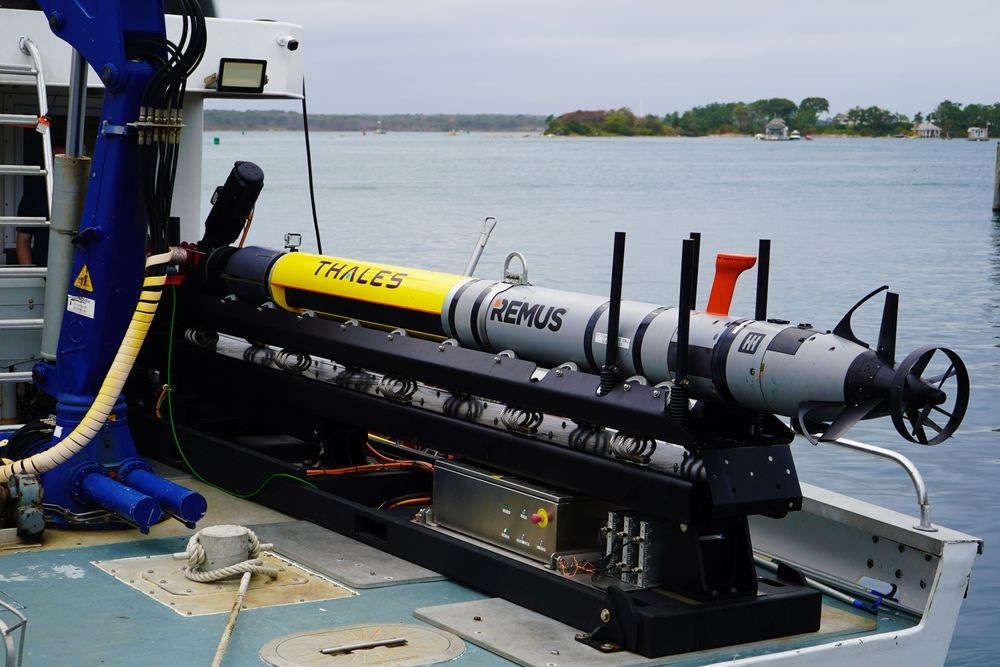
HII and Thales reported an integrated mine-countermeasure demonstration on November 3. REMUS 620 carried SAMDIS 600 sonar, with mission coordination through Thales’ expeditionary operations center and mission-management tools alongside HII’s Odyssey software. AI-assisted sonar analysis supported operator classification. ANGLER then reacquired contacts and provided visual identification and the means for neutralization. The account also includes automated launch and recovery using HII’s Sea Launcher. Read the primary source account.
The handoff is the central result
Our analysis is that the demonstration’s value lies in connecting stages that can otherwise become separate technical achievements. A sonar contact is useful to a follow-on vehicle only if its position, identity and uncertainty are conveyed in a form the next stage can use. A common operational picture can reduce that translation burden, provided that it also preserves the provenance of each observation.
The announced sequence should not be read as evidence of an unattended weapon decision. HII’s account explicitly places operators in the classification process and describes the effector as providing the means to engage an identified threat. It does not publish a record establishing autonomous lethal authorization. Search autonomy, assisted interpretation and decision authority are distinct parts of the mission.
The release also does not disclose enough trial data to calculate a representative clearance rate or reliability level. Important missing context includes the range of bottom conditions, contact types, repeated attempts and operator interventions. Successful integration in a selected demonstration is meaningful, but it cannot establish how frequently the complete chain succeeds across a navy’s operating environments.
Modularity needs operational evidence
For an acquisition team, the practical next question is how another sensor or vehicle would enter the same workflow. An open architecture has value when interfaces are documented, configuration changes are controlled and the substituted component can be accepted without invalidating the rest of the mission. The demonstration offers a concrete multi-provider example, rather than proof that all future combinations will work automatically.
In the near term, the integrated setup gives navies a more complete system to evaluate. They can assess the transition from detection to a usable contact record and onward to reacquisition, including what the operator sees when confidence is low or a stage fails. Those are more decision-relevant questions than vehicle endurance considered alone.
Preserve the evidence across each handoff
An integrated mine-countermeasure sequence creates an information problem as well as a robotics problem. The location and confidence attached to a possible object have to remain useful when responsibility moves between a survey system, a human reviewer and a reacquisition platform. Small ambiguities in that record can become costly when another vehicle must find the same object again.
A useful follow-on evaluation would report unsuccessful handoffs alongside successful ones. That includes objects that could not be classified, targets that could not be reacquired and missions interrupted by communications or recovery constraints. Reporting those cases would reveal where the combined system requires more operator time. An end-to-end demonstration alone does not supply the distribution of those outcomes.
The immediate integration result matters because individual vehicle performance cannot establish that the entire workflow works together. For naval planners, however, mission scheduling also requires information about preparation, launch, recovery and reuse. Measuring the complete cycle would clarify how the demonstrated combination might contribute to an operational clearance task, with the human decisions and remaining dependencies explicitly preserved.
The wider prospect is a mine-countermeasure force in which crews can combine specialized unmanned assets while staying farther from a suspected hazard. That prospect depends on repeatable end-to-end outcomes and clear human control. The next decisive evidence is a bounded trial report connecting operating conditions, intervention needs and successfully completed mission chains.
Source organizations: HII, Thales.
This analysis draws on the public sources linked in the text. Send corrections to [email protected].