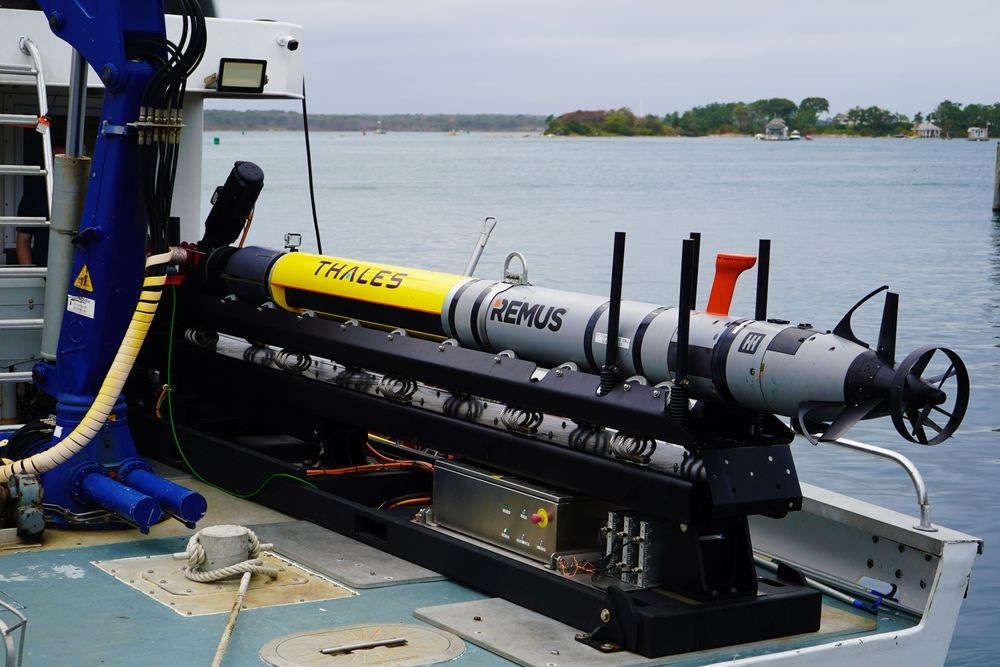
Underwater coordination depends on whether a message can reach the next vehicle at the time it is useful. Planning a mission as though communications are always available can leave an otherwise capable platform waiting for instructions or acting on stale information. Environmental prediction can help make that dependency explicit before deployment.
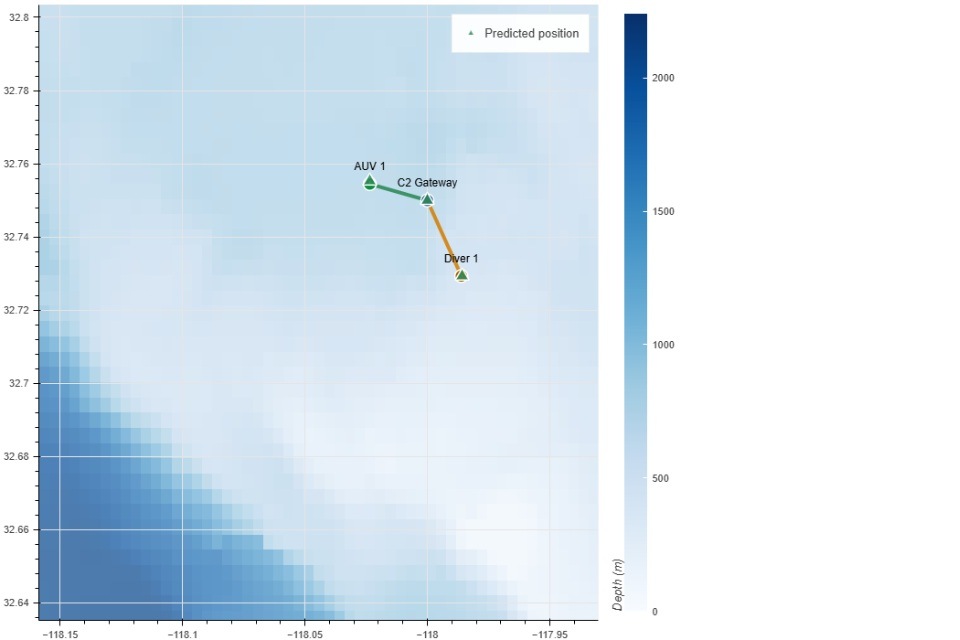
UK Defence Innovation reported on November 3 that SEA demonstrated its Acoustic Deployment Environment Planning Tool at October’s Maritime Big Play in San Diego. ADEPT combines environmental data with acoustic modeling to help predict communication performance. The same government account describes Decision Analysis Services demonstrating a distributed task-assignment framework for autonomous underwater vehicles. These were related contributions to an allied exercise, not a published comparison of fleet performance. Read the primary source account.
Plan around communication limits
Our analysis is that prediction and distributed decision-making address complementary parts of the problem. A planner can use an estimated communication environment to choose a mission structure and identify vulnerable handoffs. A vehicle-level tasking method can then reduce dependence on receiving every instruction from a central controller. Neither approach eliminates the need to understand what happens when a message is delayed or absent.
ADEPT’s contribution is a planning product rather than a new physical communication link. That distinction changes how its value should be tested. The relevant comparison is between its predictions and observed link behavior under stated conditions, followed by evidence that a changed plan produces a better mission outcome. A visually detailed model is not itself proof that the predicted communication opportunity exists.
The government release identifies an operational demonstration and further refinement as the next stage. It does not publish prediction errors, repeated-trial outcomes or a quantified improvement in mission completion. Those omissions do not negate the demonstration; they define what an external reader can and cannot conclude from it.
Connecting a model to a fleet decision
For an operator, useful environmental advice needs to arrive in time to change a plan and in a form that exposes uncertainty. A single best-case map can encourage false confidence if it hides how sensitive the result is to assumptions. A practical evaluation would ask whether the planner can recognize when conditions have moved outside the model’s useful range and identify an appropriate fallback.
The immediate significance of Maritime Big Play is access to an allied setting in which these tools can be exercised alongside other capabilities. That helps move the question from whether a method can be demonstrated on its own to how it contributes within a mission. The release does not establish that ADEPT and the tasking framework were already one fully integrated operational service.
Planning support must remain usable when conditions change
An underwater communications plan is an input to operations, not a guarantee that every message will arrive as expected. A team still needs a way to recognize that the current conditions differ from its assumptions and decide whether to continue, change the plan or recover a platform. The announcement does not establish how frequently those decisions were required during the exercise.
For evaluation, it would be useful to compare predicted communication opportunities with the opportunities actually observed. The comparison should retain geography, equipment configuration and environmental conditions. Otherwise, a favorable result can be difficult to reproduce or interpret elsewhere. A planning tool becomes more useful when users understand where its estimates are dependable and where they should allow additional margin.
The exercise also offers a setting for examining interoperability among organizations, with planning information communicated in a form other participants can use. That is a narrower claim than autonomous coordination of every vehicle. Its potential contribution is to reduce avoidable uncertainty before and during a mission, provided the model’s assumptions and its limitations remain visible to the people making operational decisions.
Longer term, better communication forecasts could help crews distribute tasks more deliberately and reserve central coordination for decisions that genuinely require it. The next evidence should connect an environmental prediction to an observed link, a revised mission choice and a measurable outcome. That chain would make the planning contribution visible to the people deciding how to employ an underwater fleet.
Source organizations: SEA.
This analysis draws on the public sources linked in the text. Send corrections to [email protected].