A helicopter searching for a submarine has several jobs: stay in the air, place a sensor where it is useful, interpret uncertain contacts and return to a ship that is itself moving. Removing the pilot can change exposure and how flying hours are allocated. It does not make those jobs a single, already solved form of autonomy.
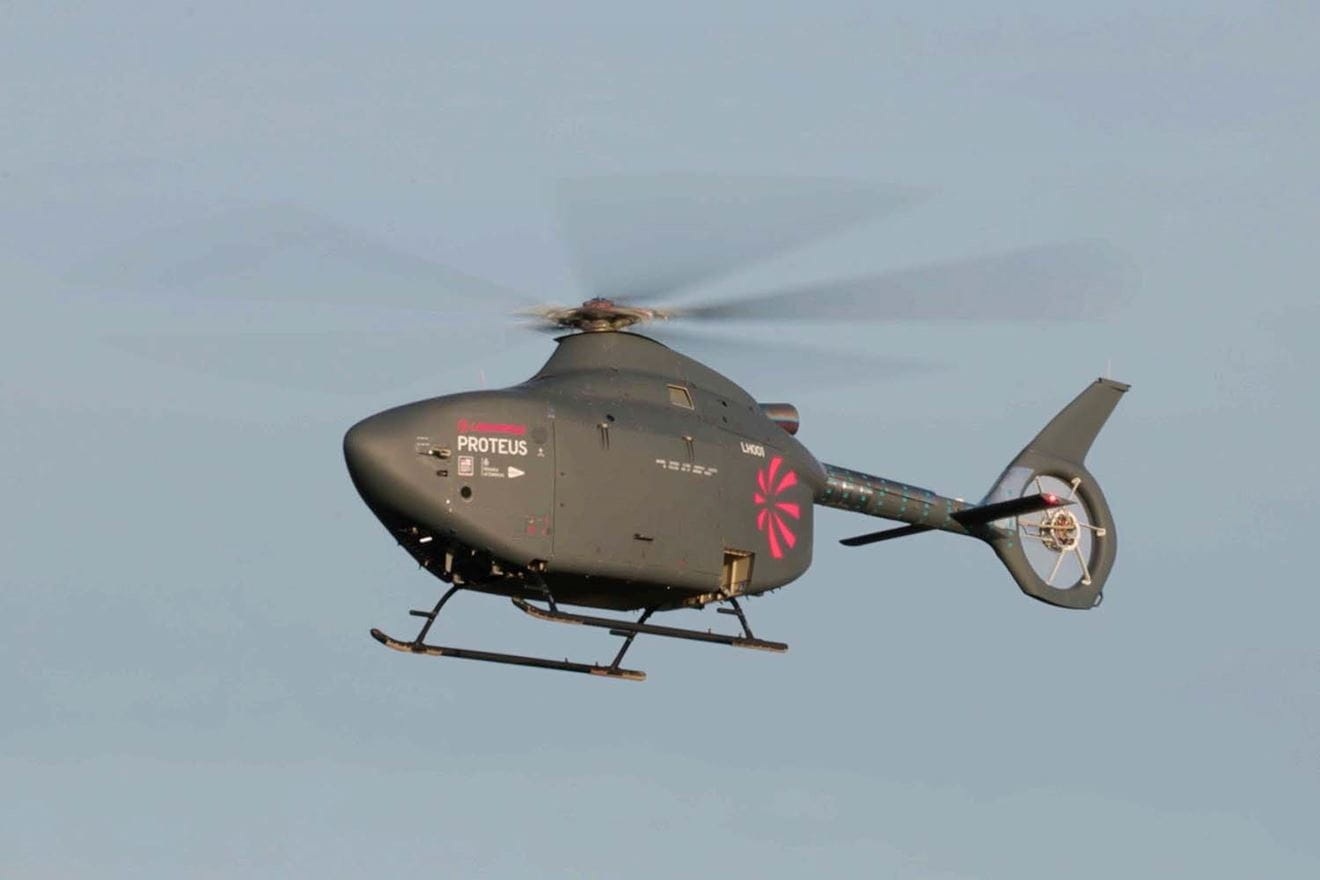
On January 16, 2026 the Royal Navy reported Proteus’s first flight, using independent flight controls during a short routine under ground test-pilot supervision. Aviation Week covered the milestone. The Leonardo aircraft is a technology demonstrator. First flight should not become an unsupported claim of operational anti-submarine capability.
The mission starts after stable flight
Anti-submarine warfare, or ASW, turns incomplete sensor evidence into a useful search. A contact can disappear or have several plausible explanations. A mission system must decide whether another observation is worthwhile and where it should come from. Flying to a specified point is part of the process; it does not establish that the point was intelligently chosen.
A modular payload arrangement can help separate these experiments. Engineers can change equipment without treating every test as a new aircraft programme. Yet a payload is not operational simply because it fits. Power, cooling, data handling and aircraft movement can affect the measurement. These connections should be assessed as a complete configuration, including the software interpreting the sensor.
Comparison with a crewed helicopter also needs care. An uncrewed machine could perform routine search while people concentrate on ambiguous contacts. That may be useful without fully independent interpretation. Conversely, transferring too many exceptions to a shipboard operator could consume the attention supposedly freed by removing the pilot. The correct unit is the supported mission, not just flight hours without a cockpit crew.
Shipboard operation introduces another environment. A test field offers stable ground, known boundaries and accessible support. A moving deck creates different recovery and communication demands. An evaluation should say which elements have been tested separately and then in combination. This is a proposed accounting method, not a claim that Proteus has already completed every naval test.
Supervision belongs in the account
Ground monitoring during an early flight is appropriate engineering practice. Supervisors do not invalidate the milestone, but their role matters when describing it. Readers need to know what the aircraft managed, what people watched and which intervention authority they retained. That makes a technical demonstration understandable without either dismissing it or exaggerating it.
The countercase is a smaller drone for the sensing job or a crewed aircraft with more automation. Each has different payload and support limitations. Proteus’s advantage cannot be inferred from the absence of a pilot alone. The trade includes equipment the mission needs, available deck space and the people and resources required to keep the aircraft flying.
Useful follow-on evidence would connect a sensor observation to a search decision and then to the movement that carried it out. It would retain aborted approaches and recovery attempts. Reporting only successful flight segments hides the circumstances that determine whether a navy can schedule the aircraft as part of an ordinary operational watch.
There is a commercial implication inside those records. An aircraft supplier and mission-system supplier can each deliver a working component while the combined search still disappoints. Interfaces should specify the information a flight decision requires and the delay allowed before it becomes stale. Defining that boundary makes responsibility easier to locate when a contact is lost or an aircraft needs assistance.
Two different loops to prove
For a general reader, there are two separate loops to understand. One keeps the aircraft moving safely: it must maintain a suitable flight path and respond to changing conditions. The other turns observations into a useful search decision. Progress in the first loop gives engineers a platform on which to investigate the second. It cannot by itself establish that an underwater contact was detected or correctly interpreted.
A procurement comparison should preserve that separation. Buyers could ask how much human supervision a flight required and, independently, how much analyst work a proposed search would demand. Combining both into one autonomy score would make it difficult to see which part had improved. This is especially important when a demonstrator's future mission is more ambitious than the activity shown in its first public flight.
The appropriate ambition is therefore cumulative. Reliable flight creates opportunities for sensor and mission experiments, whose results can then support operational decisions. Keeping those steps visible makes the programme easier to understand and prevents an early technical success from becoming an unsupported claim about an entire mission.
What would change the assessment
Keep flight, sensing, mission decisions and deck recovery as separately evidenced capabilities.
The wider impact
Proteus makes a hybrid naval air wing more concrete by creating an aircraft for those operating experiments. The larger opportunity is to divide demanding search work between machines and people in a way that increases useful coverage. First flight opens that experiment; it does not complete it. Sensing, supervision and recovery evidence will determine whether the demonstrator becomes a dependable fleet addition.
This analysis draws on the public sources linked in the text. Send corrections to [email protected].