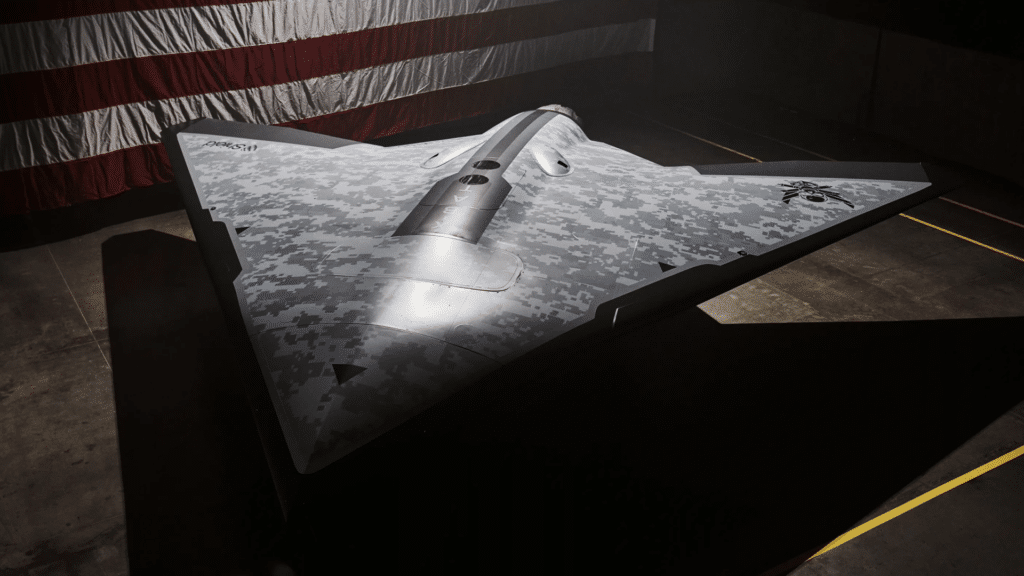
Runway independence is valuable only if an aircraft can repeatedly operate from the alternative locations its designer imagines. Shield's completed X-BAT prototype brings that proposition closer to a physical test. We see the milestone as meaningful engineering progress, with the strongest part of the investment case still dependent on launch and recovery evidence.
In a November 4 account, Shield aircraft engineering leader Armor Harris said the first full-scale prototype was complete and moving to the company's Kansas test facility. He described a sequence from horizontal engine runs to vertical runs, suspended testing and then untethered flight. The company targets a missionized aircraft in 2028 and production in 2029. Those dates remain plans. Read the source account.
What the evidence supports
The near-term campaign focuses on the operation that makes X-BAT distinctive. A vertical aircraft has to manage launch and recovery reliably before its proposed mission flexibility can matter. The company's staged sequence offers identifiable checkpoints. Buyers should follow those checkpoints more closely than prospective sales discussions, because the latter cannot demonstrate an operating envelope.
The near-term test
In the short term, the prototype gives engineers hardware on which to expose integration problems. That is a substantial advance over a design presentation. It still leaves open how often the aircraft can fly, what ground equipment it needs and which conditions constrain recovery. These questions bear directly on whether smaller operating sites reduce vulnerability or merely redistribute a demanding support system.
The longer-term case
The wider opportunity is a different set of basing choices for autonomous aircraft. If launch, recovery and maintenance can be supported at dispersed locations, commanders could gain alternatives when established airfields are unavailable. The counterargument is logistical. Fuel, handling equipment, parts and personnel also need to reach those locations, and their movement can limit the freedom a vertical takeoff promises.
The basing argument should be evaluated as a complete operating cycle. Getting airborne from a small site is only the beginning. The aircraft must return, be inspected, receive fuel and be made ready for another sortie. If those steps require a large specialist team or a narrow set of environmental conditions, the list of usable locations may shrink. That does not invalidate the design. It defines the circumstances in which its advantage is real. A useful demonstration would therefore describe turnaround work alongside the flight event, allowing customers to compare achievable operations with the proposed concept.
The distinction between developmental and operational evidence is especially important here. Suspended testing can reduce risk while engineers investigate a particular behavior. It does not replicate an unrestricted flight or every recovery condition. Equally, an early test problem would not automatically discredit the aircraft. Developmental tests are intended to find problems. The informative result is what the team learns, changes and then repeats successfully. We would assess the program through that sequence rather than alternate between enthusiasm after a clean presentation and dismissal after an expected engineering setback.
For a customer, the eventual comparison should include the missions actually available from each basing option. A dispersed aircraft that spends too much time awaiting support may offer less practical flexibility than its location suggests. A system with dependable turnaround could offer a stronger alternative even if its headline performance is less dramatic. At this stage, neither outcome is established. The prototype is valuable because it creates a way to replace assumptions about the launch-and-recovery system with observations. That is where scrutiny should now concentrate.
Our assessment
Our assessment is positive about the transition to hardware and conditional about the operational payoff. The next evidence should be successful repetitions across a published test envelope, followed by a clear account of support requirements. X-BAT's basing proposition becomes convincing when the aircraft and the system around it can sustain operations together.
Sources and reporting dates
Underlying development date: 2026-11-04. Analysis published November 5, 2026. Company performance claims are attributed to their source; assessments and evaluation criteria are ours.
This analysis draws on the public sources linked in the text. Send corrections to [email protected].