A military sensor is useful only if its observation reaches a unit in a form that supports the next decision. A truck collecting several kinds of intelligence can shorten that journey, but it also becomes responsible for how those observations are reconciled. The important handoff is information, including its age and uncertainty, rather than a message merely arriving faster.
The Army’s September 1, 2026 announcement describes TITAN moving to production through two delivery orders totalling $192 million as of August 31. Its December 2024 unit account records the earlier prototype handover, integration and training. These stages establish a programme’s progression. They do not disclose a universal accuracy rate for every combined intelligence result.
A node can improve the chain or hide its gaps
Tactical Intelligence Targeting Access Node is the expansion of TITAN. The name describes its role linking intelligence access to tactical use. Bringing observations together can help users discover relationships that separate systems obscure. It can also make correlated or incomplete evidence look stronger if the interface treats every contributing record as independent confirmation.
Consider an illustrative case where two feeds repeat information from the same original source. A combined picture might show two supporting records without adding any new observation. The user needs to see the origin of each claim. Counting channels instead of independent evidence can create confidence through duplication rather than through a better view of the situation.
Observation age matters alongside location. A correctly identified object may have moved before the finding reaches the next stage. The relevant time is when it was observed, not when a report was refreshed. A system should preserve both. Otherwise a faster interface can make old evidence look current without improving the underlying collection.
The same is true of uncertainty. Several plausible locations should not become one precise point merely because another application expects a coordinate. A useful information contract specifies what the receiver needs and how unsupported precision is prevented. This is an analytical requirement for the handoff, not a claim that TITAN has demonstrated or failed a particular implementation.
Watch the footage
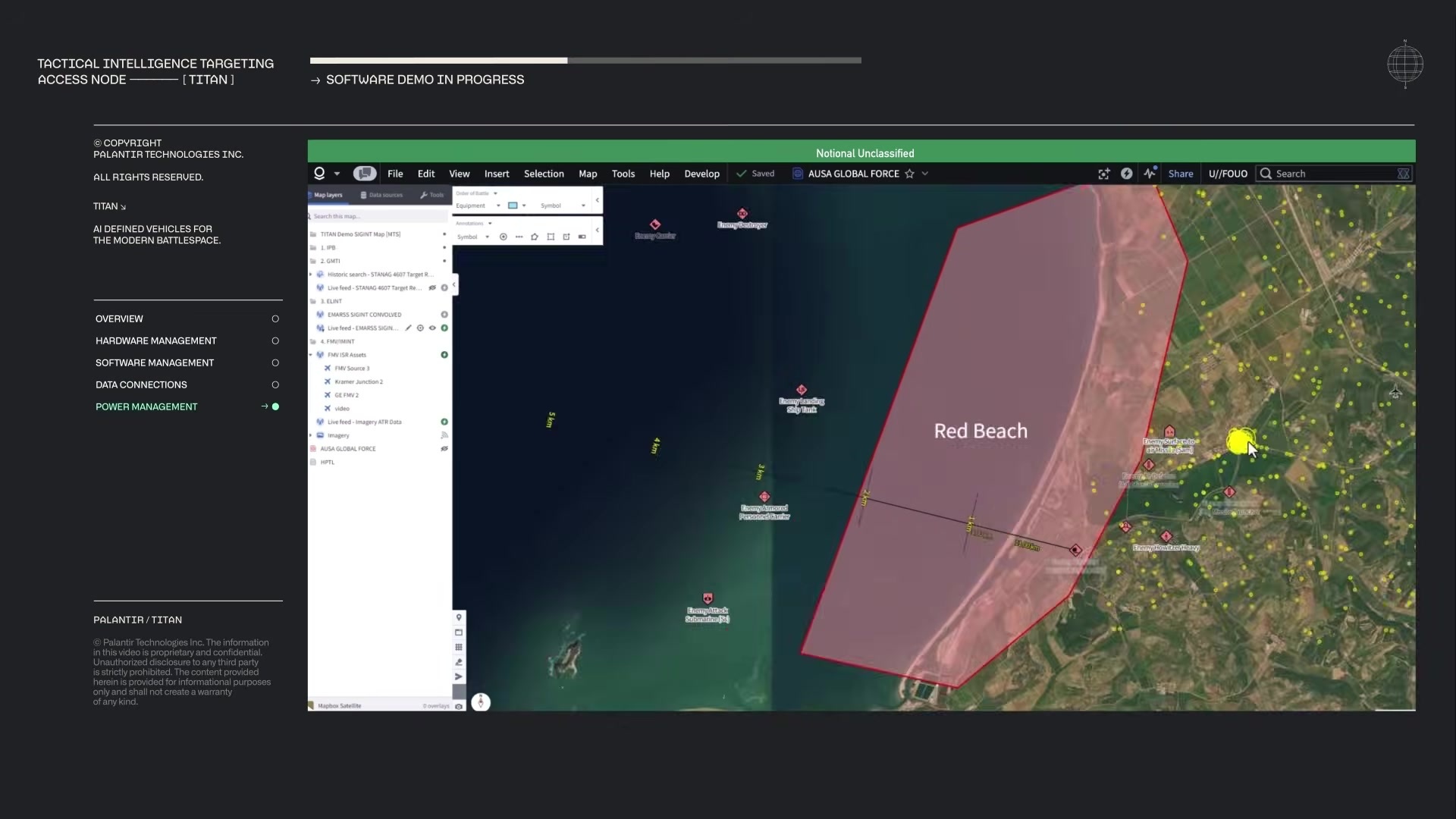
Palantir presents TITAN and a notional software demonstration. Company footage predating the production orders, not independent validation of targeting accuracy.
Video: Palantir · Original source ↗ · Video watch page ↗Production makes change management consequential
A prototype team can investigate exceptions with close engineering support. Production puts more configurations in the hands of more units. That makes training, software versions and repeatable test cases more important. The hardware delivery count should remain attached to the accepted intelligence functions rather than become a shorthand for complete operational readiness.
The countercase is that preserving every caveat makes information too slow or complicated to use. A tactical interface must prioritise. The answer is to design the appropriate uncertainty for the decision, not remove it indiscriminately. A concise output can still distinguish observed fact, inferred identity and unresolved alternatives if those categories are part of the interface.
An informative assessment would trace representative findings from sensor observation through fusion to the recipient’s use. Include disagreement, unavailable data and changed conditions. Measure delay and whether important limitations survive the handoff. Final task success alone cannot identify whether a failure began in collection, interpretation or transfer.
Production contracts can create leverage for requiring that evidence. Acceptance criteria can specify retained source links, timestamps, configuration records and test cases relevant to the intended use. That would connect spending to an inspectable operating result. The announced orders establish an acquisition milestone; they should not be read as a public answer to every one of these questions.
Acceptance follows the information, not just the vehicle
An illustrative acceptance exercise could begin with a known event and deliberately vary the age and quality of the supporting observations. The receiving unit should be able to distinguish a current observation from a stale one and a directly observed identity from an inference. The test would examine the information actually available at the handoff, rather than assuming the source system’s caveats remain visible in another application.
Production also makes responsibility easier to spread without making it easier to assign. A fault could originate in a sensor, a fusion model, a communications link or the recipient’s interpretation. Retaining configuration and source records lets the customer investigate which part of the chain needs correction. Otherwise every organisation can report that its component functioned while the combined result remains misleading.
TITAN’s wider significance is the attempt to make intelligence useful within the time and space constraints of tactical units. That is a demanding integration problem. Production spending can support it, but the lasting advantage comes from a handoff that people can understand and challenge under those constraints. The vehicle is visible; the quality of the information it carries is the more consequential capability.
What would change the assessment
Track independent evidence, observation time and accepted software configuration through the full chain.
The wider impact
TITAN’s production transition matters because it moves an information handoff into a larger operating footprint. The broader opportunity is faster use of intelligence without losing the facts that make it trustworthy. That needs source-aware fusion and task-specific acceptance evidence. A useful node passes uncertainty onward in a usable form, instead of replacing several imperfect observations with one unsupported certainty.
This analysis draws on the public sources linked in the text. Send corrections to [email protected].