Putting a robot into a formation changes more than who drives a vehicle. It changes who plans the task, who watches its progress, how a unit recovers it and what happens when the machine cannot continue. Those organizational questions sit between a successful demonstration and a capability that soldiers can depend on. They are also the reason an Army command announcement has significance beyond its new name.
In its October 13 account, the Army said it had selected Futures and Concepts Command for redesignation as Futures and Autonomous Systems Command, or FASCOM. It outlined corps-level experimentation, including an autonomous armored reconnaissance company in III Corps and an autonomous breaching company in V Corps. The account also said experimental formations would receive some of the Army’s first 390A Robotic Technicians. These are announced organizational and experimental steps; they do not establish that those formations have completed operational testing.
The experiment moves from a machine to a formation
A vehicle trial can examine whether a platform follows a route or carries a sensor. A formation experiment can examine whether that behavior remains useful when other people, vehicles and responsibilities enter the picture. In a reconnaissance mission, for example, the relevant outcome includes whether an observation reaches someone who can interpret it while it still matters. In breaching, the machine’s movement is only one element of a larger sequence involving verification, coordination and follow-on activity.
These examples explain the kinds of questions a formation can expose. They are not results reported from the newly outlined experiments. The Army’s announcement identifies intended missions, but it does not supply comparative mission-completion rates, operator workloads or recovery times. It consequently provides evidence of institutional direction rather than a measured improvement in battlefield performance.
The distinction matters because the meaning of “autonomous” depends on the task boundary. A system may navigate independently while still relying on people for mission planning, interpretation or intervention. A useful account of a future trial would identify which functions were automated, when a person intervened and what support the formation required. Counting vehicles alone would leave those dependencies unresolved.
Technical specialists connect trials to daily use
The technician assignment is a concrete part of the announcement because experiments need people who can keep configurations, faults and repairs intelligible. A software change may resolve one problem while altering how another component behaves. If a unit cannot track what changed, an apparently repeatable result may depend on a configuration that no longer exists.
In the near term, the experimental structure creates an opportunity to observe those interactions in a military workflow. Its practical value will depend on what participants record and what subsequent teams can reproduce. A useful comparison could distinguish a mission completed without assistance from one completed after remote support, replacement equipment or a change to the plan. The public announcement does not yet report those comparisons.
The Army’s October 2 statement also connected autonomy to acquisition and personnel changes. That connection gives the corps experiments a broader institutional setting. It does not remove the need to test each proposed capability in its intended role.
What could scale beyond the first experiments
If the trials produce documented operating procedures, support requirements and repeatable results, their longer-term effect could extend beyond the platforms initially selected. Later formations could reuse the lessons even when their equipment differs. Conversely, lessons tied to a particular supplier’s specialists or a narrowly controlled environment may transfer less readily.
That makes the decisive next evidence operationally specific: the mission attempted, the conditions encountered, the human work required and the reasons for incomplete tasks. FASCOM’s importance will emerge through that chain of evidence. The new organization establishes a place to address the problem; the experiments still have to show what an effective autonomous formation requires.
Sources and limits
- U.S. Army, October 13, 2026: command selection and corps experimentation.
- U.S. Army, October 2, 2026: Army autonomous initiatives.
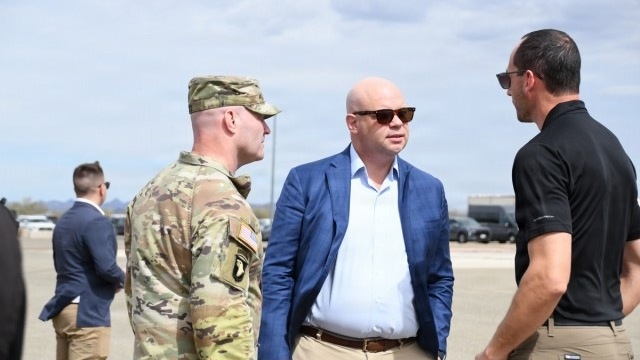
This analysis uses official Army statements. It does not report attendance at the experiments, interviews or independent performance testing. The cover is an official Army photograph from a September 24 visit to Yuma Proving Ground, shown as context for the Army’s autonomy initiatives; it does not depict the announced experiments.
What would change the assessment
Watch for mission-completion results, intervention records and support requirements from the Army’s announced formation experiments.
This analysis draws on the public sources linked in the text. Send corrections to [email protected].