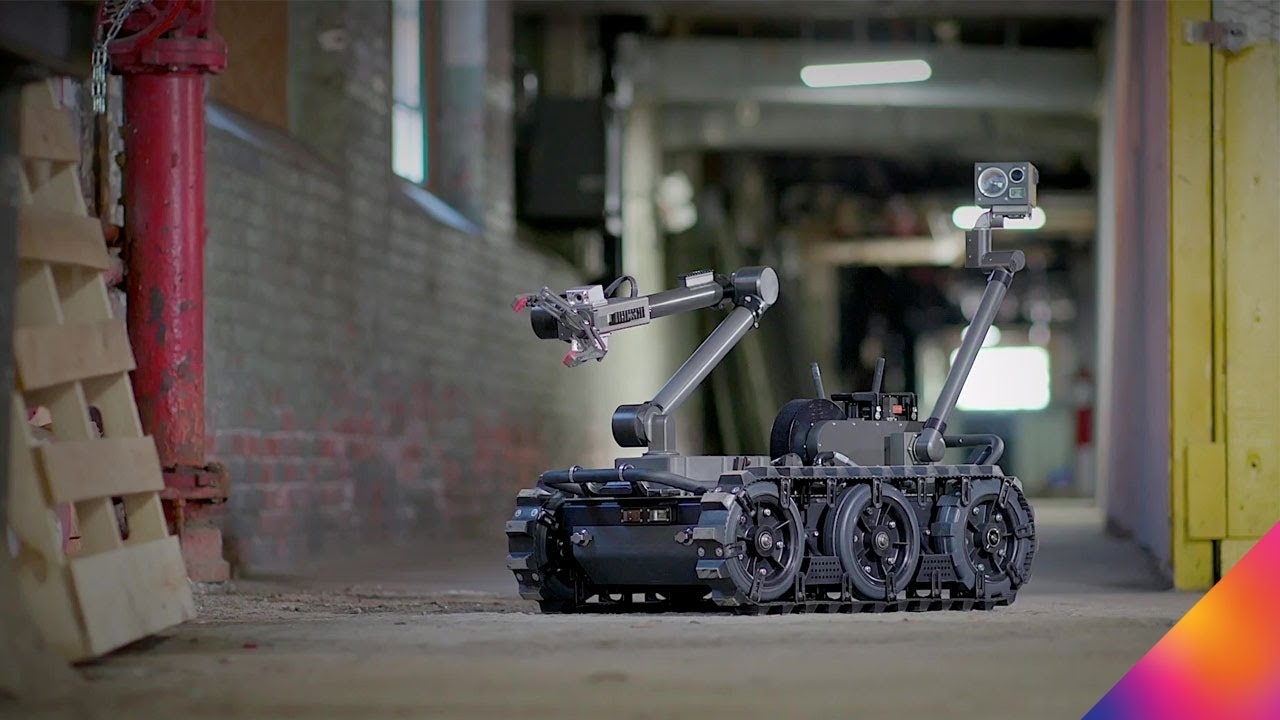
The first approach to a suspected explosive is a moment when distance has immediate value. A robot can carry cameras and tools forward while its operator stays back. Centaur is useful to examine because it represents a specific, established role rather than a promise of general robot intelligence. It shows where autonomy can add value incrementally: reduce repetitive movement and improve the operator’s view while leaving hazardous judgment with a trained person.
Teledyne FLIR’s June 2023 published source announcement records delivery of the thousandth system under the Army’s Man Transportable Robotic System Increment II program and describes explosive-disposal use. That is a historical production milestone, not a current availability count. The Army’s fiscal 2025 published source budget description discusses remotely controlled arms, cameras and modular robotic payloads. Together they establish a platform-and-task baseline for considering further automation.
A defined mission makes value visible
Explosive ordnance disposal means identifying and dealing with dangerous explosive items. The operator needs enough detail to decide which tool and procedure are appropriate. The robot’s movement, cameras and arm extend that person’s reach. The benefit does not depend on the machine making the final decision itself. Keeping the boundary narrow makes adoption easier to evaluate and gives a unit a clearer account of who remains responsible.
Our assessment is that new automation should be judged against that existing workflow. A function that positions a camera or helps avoid an obstacle might shorten the job and reduce error. A function that makes the observation harder to interpret could do the opposite even if movement becomes faster. The comparison should include time to an adequate view and operator corrections, rather than simply count actions the software performs unaided.
Watch the footage
Teledyne FLIR demonstrates Centaur’s mobility and manipulator. Manufacturer film; the examples do not independently certify every payload or operating condition.
Video: Teledyne FLIR · Original source ↗ · Video watch page ↗Payload development must preserve evidence
A modular payload is equipment added or exchanged through defined interfaces. It can let a familiar robot handle a new sensor without buying a different carrier. Yet adding equipment changes what the operator must understand and may affect power, visibility or manipulation. The question is whether the new combination retains the tested handling and safety characteristics of the existing system, with changed limits documented for the people employing it.
A hypothetical chemical sensor installation illustrates the issue. The robot might report a measurement while the operator inspects a suspicious object. This is a proposed acceptance scenario, not a claimed Centaur trial. The person would need the sensor’s position, timing and uncertainty. A number arriving without context might look useful while leaving the operator unable to decide whether the reading applies to the object being examined.
Older evidence can inform a current decision
The delivery and budget documents are deliberately presented as background, rather than rebranded as October 2026 news. They support a durable point: specialized robots earn value through bounded tasks and a clear human relationship. They do not establish the latest software capability or validate a new sensor package. A current buyer needs the release-specific test record for the configuration being acquired.
A useful modernization plan would identify the remaining operator burden, add functions that address it and remeasure the complete task. It would preserve direct control when conditions exceed the automated function’s limits. That makes autonomy an observable improvement in an established safety workflow rather than a label attached to a machine whose original benefit was already its standoff. The upgrade’s training, spare parts and diagnostic requirements should be included in the comparison.
Preserve the specialist’s remote view
Distance changes the operator’s information as well as the operator’s exposure. A person standing beside an object can adjust their viewpoint naturally; a person behind a remote display depends on the robot’s cameras, lighting and tool placement. Automation that speeds the approach is helpful only if it preserves that ability to inspect. A system should make it clear when a view is live, when a camera is obstructed and when the arm is moving beyond the operator’s direct picture. Those interface details can shape confidence more than a headline about machine intelligence.
Centaur also provides a useful procurement comparison for less established robots. Its defined role makes it possible to ask what a proposed upgrade adds to an existing protective workflow. Does it reduce repetitive steering, improve observation or make a supported payload easier to position? The answer need not be full autonomy to be consequential. The wider opportunity is incremental capability that specialists can understand and accept, with retained direct control when necessary. Treating each addition as a measured improvement keeps the robot’s purpose clear: extend a trained person’s reach while keeping that person farther from the hazard.
What would change the assessment
Treat the older documents as historical context and seek current configuration evidence.
The wider impact
Centaur’s broader lesson is that robotics can be valuable without solving every problem independently. A clear task, a trained operator and distance from a hazard create a measurable starting point. Further autonomy earns its place when it strengthens that relationship and improves the complete job, with evidence specific to the upgrade.
This analysis draws on the public sources linked in the text. Send corrections to [email protected].