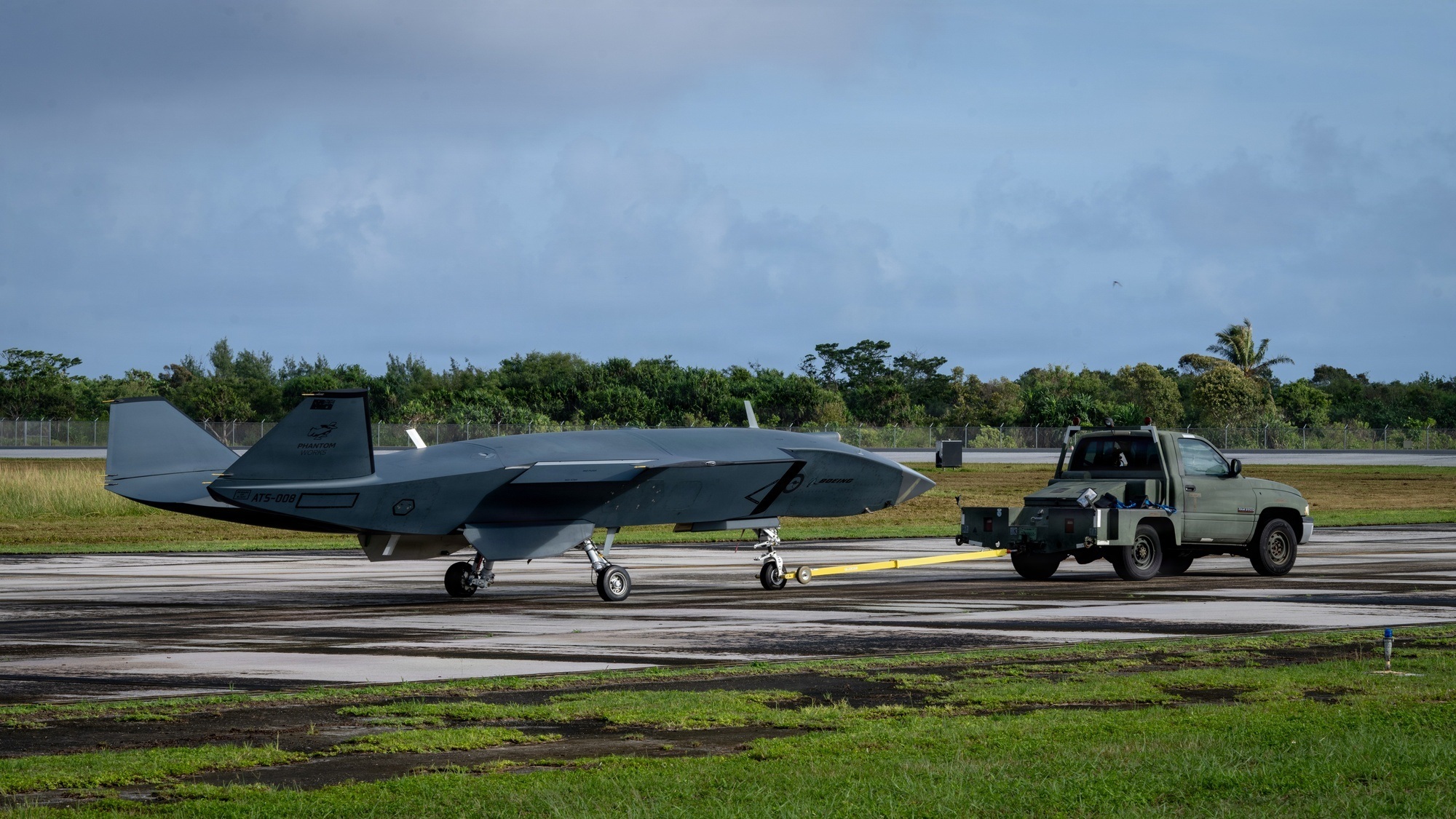
An uncrewed combat aircraft becomes more useful when a pilot can direct it as part of a larger air operation, rather than manage it as an isolated machine. Australia’s MQ-28 Ghost Bat missile test is important for that reason. Its strongest public lesson is about coordinating observation, positioning and authorization across aircraft. It should be read as evidence for the sequence tested, while leaving other tactical conditions and decisions outside that result.
Boeing’s December 2025 published source account describes an MQ-28 engagement alongside an E-7A and F/A-18F. It says the Ghost Bat received authorization from the E-7A before destroying the target with an AIM-120 missile. An earlier Boeing published source account describes operational demonstrations preceding the engagement phase. These are manufacturer accounts of work with the Royal Australian Air Force. They do not provide an independent breakdown of every intervention or demonstrate success against every defended opponent.
Authorization is part of the capability
A collaborative combat aircraft operates with other aircraft rather than treating its mission as a separate sortie. Collaboration requires information and authority to move through a defined sequence. The drone may reposition automatically while another participant identifies or authorizes the task. Those distinctions matter because successful automated execution does not mean the drone independently chose what to attack.
Our assessment is that the explicit authorization described in this account makes it more useful than footage of a launch alone. It lets a reader locate a human-controlled boundary within the demonstrated sequence. A fuller record would explain what information the authorizing participant saw, how the drone acknowledged the instruction and which conditions would have caused it to wait or refuse. Those are operational questions even when the final visible event is a successful missile shot.
The air operation has several participants
Different aircraft can contribute sensing, command and weapons. That can distribute capability without forcing a single pilot to do every job. It also creates handoffs that may fail or become delayed. The useful system needs to preserve target identity and task meaning across those handoffs, so the aircraft carrying the weapon acts on the same authorized objective the command participant intended.
A hypothetical repeat test could introduce a stale target track or an interruption between authorization and execution. This is a proposed evaluation, not a reported Ghost Bat result. The aircraft should behave according to defined limits, and every participant should understand whether the engagement remains valid. That would reveal more about operational collaboration than another successful shot conducted under unchanged information conditions.
One demonstrated sequence cannot certify every use
The accounts establish progress through development phases and an authorized engagement. They leave open the detailed tactical environment, sensor limitations and failure behavior necessary to generalize the outcome. That does not diminish the milestone. It prevents an important experiment from becoming an unsupported statement that the entire future combat role is settled.
The wider procurement question is how the tested command relationship carries into different aircraft and national arrangements. A common technical interface is helpful, but participating forces may have different permissions and procedures. The autonomy should make those differences explicit rather than assume that connectivity gives every participant the same authority. Training, logs and configuration records are part of preserving the demonstrated chain when the team changes.
The operator training should preserve that same distinction between task execution and engagement authority.
Follow the command chain through the engagement
A weapons event has several participants even when the launch comes from an uncrewed aircraft. Someone establishes the mission, another system may supply information and an authorized person remains responsible for the decision attributed to them. The demonstration is informative because it brings parts of that chain together. It should be interpreted through the relationships actually exercised, rather than as evidence that the aircraft independently selected and attacked any target it might encounter.
Repeating the chain under different conditions is the next operational question. A successful event with planned timing can reveal integration; delayed information, changed assignments and an unavailable participant reveal resilience. Public reporting should identify which of those questions the test addressed. Ghost Bat’s bigger-picture contribution is the prospect of adding useful aircraft capacity to a crewed force without duplicating every crewed aircraft’s staffing arrangement. That value comes from a command relationship pilots can employ and understand. A missile shot is an important milestone toward it, while a dependable, repeatable relationship across complete missions remains the more consequential capability.
What would change the assessment
Seek handoff, intervention and stale-information results while preserving the explicitly reported human authorization.
The wider impact
Ghost Bat’s larger promise is to let a coordinated air force distribute sensing and weapons across more aircraft without losing a clear human decision chain. The December test makes one part of that promise concrete. The next evidence should show how the chain remains understandable and dependable when information, participants or conditions change.
This analysis draws on the public sources linked in the text. Send corrections to [email protected].