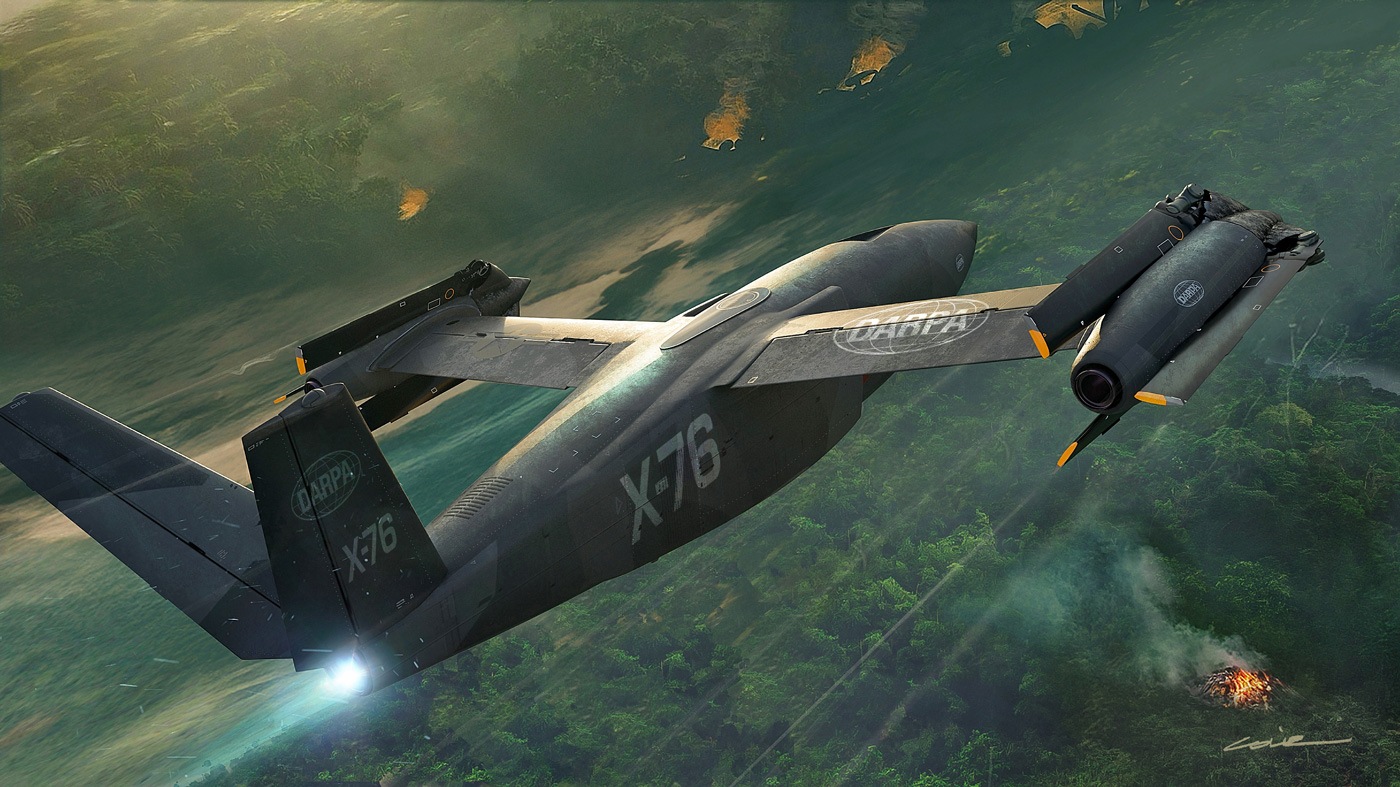
A force can have an aircraft with useful range and still lack a safe runway from which to operate it. Combining high forward speed with vertical departure could widen the places from which aviation supports a mission. DARPA’s X-76 matters as an attempt to address that physical constraint. It also illustrates a distinction important to autonomy reporting: a new way to launch or fly is not by itself evidence that an aircraft can make independent military decisions.
DARPA’s March 2026 published source announcement identifies Bell’s X-76 as the SPRINT technology demonstrator after a critical design review. The published source program description frames it as proof of enabling technologies that could scale to different military aircraft. These accounts document an experimental development milestone. They do not establish an operational fleet, a completed flight campaign or a validated autonomous combat system. This analysis considers its implications for future aircraft rather than assigning it capabilities the sources do not report.
Access is a capability constraint
Runway independence can reduce reliance on a fixed departure point, but every aircraft still needs a usable operating location and support. Fuel, servicing, payload preparation and airspace arrangements remain part of the mission. An aircraft able to lift vertically could change how those functions are distributed. It does not make them unnecessary, and a procurement case should include the footprint at the alternative locations it proposes to use.
Our assessment is that the most consequential test is the combination of modes, not each mode in isolation. Hovering and efficient fast flight impose different physical demands. The transition between them must work with the intended loading and environment. A successful isolated test of one function is useful evidence, but a service needs the complete sequence to understand what a deployable design based on the demonstrator would require.
Keep the automation questions separate
Flight-control automation can help manage a complex transition without choosing the aircraft’s operational objective. Mission autonomy concerns what task the system undertakes and how it responds when circumstances change. Those functions have different evidence requirements. Reporting a novel flight mode as an autonomous mission breakthrough would combine them and make the reader believe the program had solved decisions it may not have been designed to test.
A hypothetical resupply task shows the separation. The aircraft could reach a site without a runway while a person still chooses the route, destination and delivery conditions. This is a proposed future-use scenario, not an X-76 result. The mobility gain could be important even if all those decisions remain human. An evaluation should state which problem the demonstrator addresses rather than require it to stand in for the entire future mission system.
A demonstrator should make later requirements clearer
The critical design review indicates a development checkpoint, not proof of every advertised operational benefit. The next evidence should distinguish ground testing, flight-envelope expansion and integrated demonstrations. If a future service adapts the technology, it will need its own payload, maintenance and control-system assessments. That is a normal path from an experiment to capability, provided the boundary remains visible in reporting.
Basing flexibility also brings new planning obligations. A dispersed aircraft can be harder to locate and attack, but may be harder to fuel, repair and coordinate. The useful comparison is therefore the total mission supported from each proposed footprint. Measuring those demands alongside flight performance would connect an exciting aircraft technology to the practical access problem that makes it worth developing.
Let the demonstrator reduce a specific uncertainty
A demonstrator can be valuable even if the eventual operational aircraft looks different. Its purpose is to reduce uncertainty about a difficult physical combination, giving future designers evidence about what is feasible and what compromises remain. That evidence needs the conditions of the experiment attached to it. A payload, range or basing benefit proposed for a future aircraft is not automatically a result achieved by the experimental vehicle. Keeping the distinction clear makes the technology easier to assess without understating its potential.
For autonomy, runway independence matters indirectly by creating new choices about where and how a machine could support a force. Those choices can change requirements for sensing, mission planning and remote supervision. They do not select a solution to those requirements by themselves. X-76 should therefore be read as one enabling part of a possible future system. Its bigger-picture contribution would be to loosen a basing constraint that limits operational options today. Whether a later force uses that option with pilots aboard, remote crews or bounded mission autonomy will depend on evidence and decisions beyond the flight-technology demonstration.
What would change the assessment
Track integrated flight evidence and support implications without interpreting design review as field readiness.
The wider impact
X-76’s larger significance is widening the physical choices available to future aviation. It can inform how speed and runway independence fit together without claiming to settle mission autonomy. Preserving that distinction lets a reader value the engineering step and see what still has to be developed before a force can rely on the result.
This analysis draws on the public sources linked in the text. Send corrections to [email protected].