Moving supplies and evacuating casualties require more than a vehicle that can drive without someone aboard. A unit needs a machine it can recover, repair and support alongside the rest of its fleet. That makes the origin of the chassis a consequential design decision: commercial components can offer an established manufacturing base, while military operating conditions still require their own evidence.
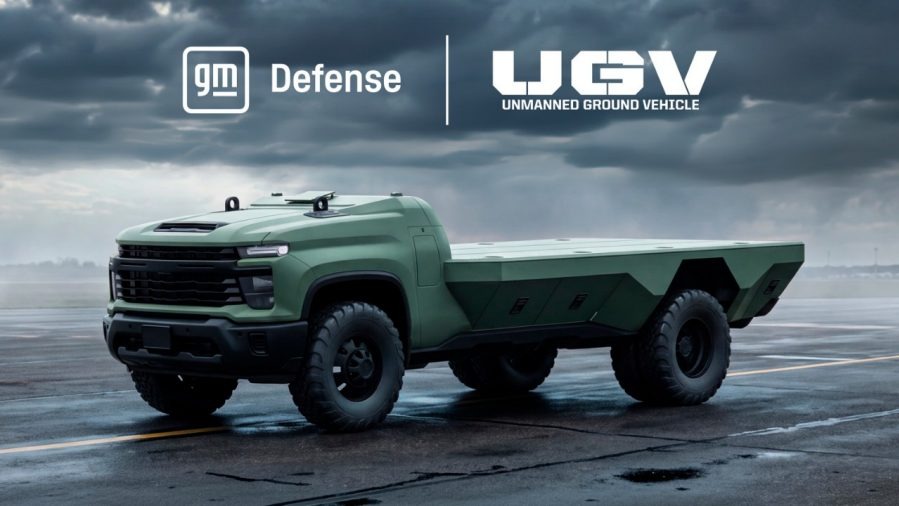
GM Defense's October 12 AUSA announcement introduces an uncrewed ground vehicle concept built on a Chevrolet Silverado 3500HD dual-rear-wheel skateboard architecture. The company identifies silent logistics and casualty evacuation as intended uses and targets functional trials for 2027. This is a development announcement, rather than a report that those missions have passed operational acceptance. Read the primary announcement.
What transfers from a commercial vehicle
A familiar mechanical architecture could make parts, service knowledge and production processes easier to obtain. That possibility is different from demonstrating the behavior of an uncrewed system. Removing the driver changes who handles an obstacle, recognizes a fault or decides that a movement should stop. The announcement does not establish how those responsibilities will be validated in the proposed missions.
The casualty-evacuation use also needs a different acceptance argument from ordinary cargo movement. A payload can be secured and inspected before departure; a patient may require observation and care throughout the journey. The relevant question is the proposed service and its human support, not whether a cargo deck can physically carry a stretcher. No medical outcome or completed evacuation trial is claimed here.
What changes before the trials
The immediate value is a concrete design direction for customers to assess. They can ask which commercial components remain common, which require military qualification and how maintenance information will reach the people supporting the system. Those answers would make the manufacturing argument testable without assuming that a large parent company's scale automatically transfers to a new defense configuration.
A future demonstration would be more informative if it reports mission completion alongside interventions, recovery work and support staffing. These are proposed assessment criteria, not results from GM's concept. They connect a vehicle's movement to the practical workload imposed on a unit.
Commonality needs a denominator
The support argument is strongest when a supplier identifies what proportion of the mission configuration remains shared with a commercial vehicle. Common tires or service tools may simplify one task while autonomy sensors, communications and control software introduce separate spares and skills. A buyer can distinguish the components it already supports from the components requiring a new maintenance arrangement. This is an accounting framework for evaluating the proposal, not a measured parts-commonality percentage for GM's concept.
Energy use is another configuration question. The phrase silent logistics describes an intended role, but it is not a published mission profile. The useful evidence would state the payload, terrain, operating duration and energy arrangement for the trial being assessed. The announcement's separate EPIQ Hybrid prototype should not be combined with the UGV to infer a tested power system unless the supplier documents that integration.
These distinctions give the 2027 trials a clearer purpose. A trial can establish a supported capability in a bounded use case without proving that every commercial manufacturing advantage transfers unchanged. The procurement decision then becomes whether the demonstrated service is worth extending, with unresolved work visible rather than hidden behind the parent company's production scale.
A potential route to supportable autonomy
If the architecture survives the announced trials and retains meaningful parts commonality, commercial manufacturing could help make an uncrewed logistics fleet easier to sustain. If military modifications erase that commonality, the apparent shortcut could become a separate support system. Neither outcome is established by the unveiling.
The next milestone is the targeted 2027 functional testing, followed by evidence about the actual mission configuration and its support needs. The bigger promise is dependable movement with fewer people exposed to dangerous journeys. A concept establishes a candidate approach; trials must show what the complete system can reliably deliver.
Sources and scope
Official organizations: GM Defense. Primary source, 2026-10-12. Manufacturer results and plans remain attributed; this publication did not independently test the equipment.
What would change the assessment
The next milestone is the targeted 2027 functional testing, followed by evidence about the actual mission configuration and its support needs. The bigger promise is dependable movement with fewer people exposed to dangerous journeys. A concept establishes a candidate approach; trials must show what the complete system can reliably deliver.
This analysis draws on the public sources linked in the text. Send corrections to [email protected].