A robot that can accompany an armored force needs more than room to carry a useful sensor or weapon. It must move with the formation, exchange information and let commanders employ the payload without adding a separate control problem. Milrem Robotics’ HAVOC raises that issue at the heavier end of ground robotics. The wider attraction is distributed capability; the unresolved work is making the distributed machines function as a coherent force.
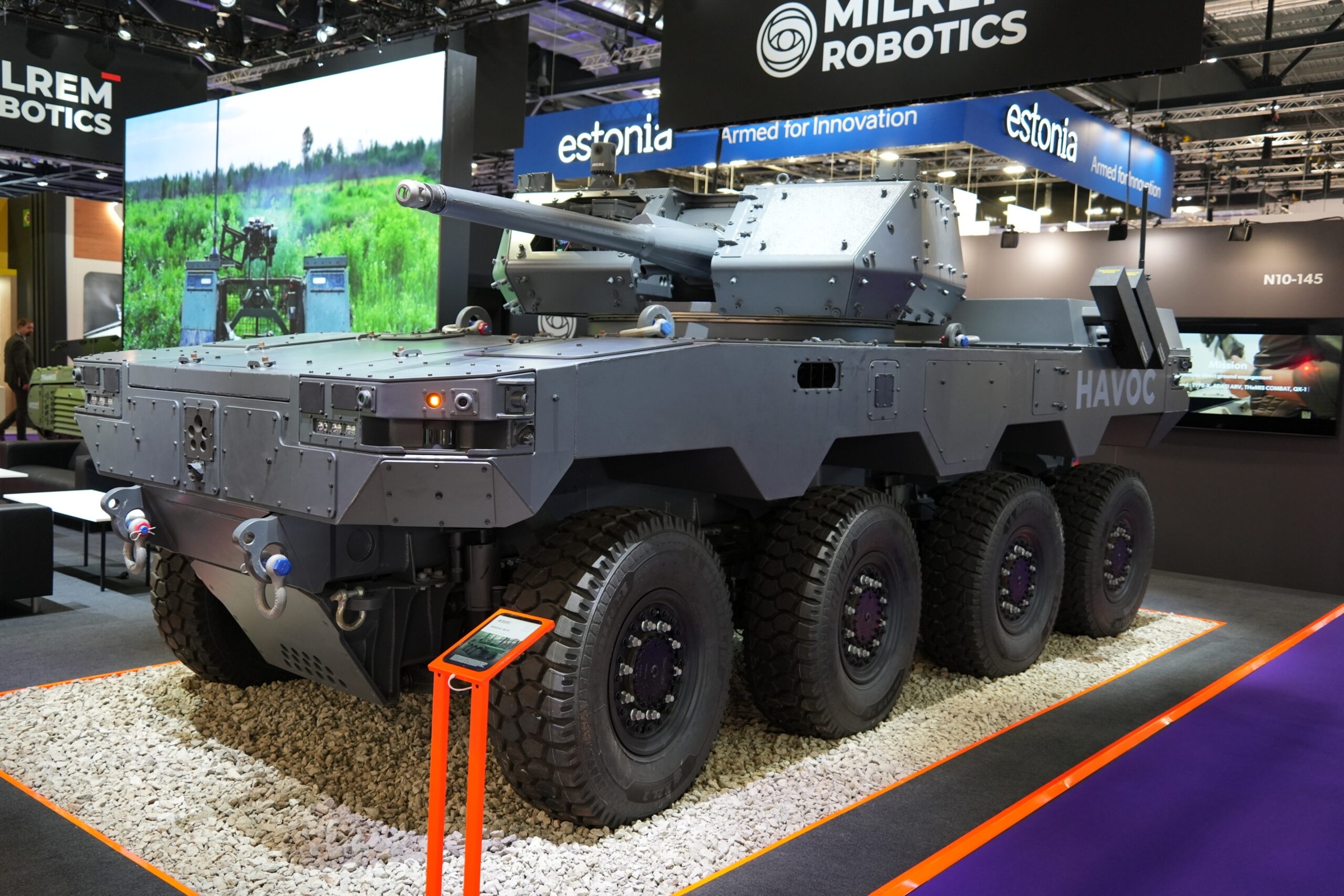
EDGE’s February 2025 published account announcement identifies HAVOC as an eight-wheeled robotic combat vehicle using a hybrid design. Defense News’ supporting source reporting from IDEX described a mockup and the intended relationship to Milrem’s other platforms. The launch establishes a product direction and an industrial commitment. An exhibition model, including any equipment shown on it, does not establish operational performance or prove that the payload and vehicle can perform a complete mission together.
One chassis can conceal several systems
A hybrid vehicle combines different sources or modes of propulsion power. For a robotic combat platform, power is also a resource for sensors, computers and mission equipment. A claimed mobility advantage must therefore be evaluated with the intended payload running. A vehicle that moves quietly in one configuration may have different endurance or heat characteristics in another. The relevant specification belongs to the configured system the buyer plans to use.
Common components across a vehicle family can make repair and training easier. That is an industrial proposition worth testing, not a guarantee that every configuration has identical support needs. A changed weapon station may need a different specialist; a new sensor may change calibration; a different software interface may require another operator qualification. The Army or another customer needs to know which elements are truly common and which only share a product-family name.
The command relationship is the special problem
Our assessment is that command integration could matter more than the vehicle’s external appearance. A crewed formation already has procedures for reporting contacts, changing routes and assigning sectors. A robot that receives those instructions through a separate interface can impose extra work at exactly the time the commander is busiest. The useful system would make its task and current state visible within the formation’s normal picture, while retaining a clear path for human intervention.
A hypothetical reconnaissance mission offers an appropriate test. The vehicle should follow an assigned route, report something unexpected and wait or adapt according to explicit limits. The test should include conflicting directions and loss of a supporting link. This is a proposed scenario, not a reported HAVOC result. It would reveal whether the robot helps the formation understand its surroundings or merely delivers another stream of information that someone must continually interpret.
Keep product plans separate from field evidence
The sources reviewed document the unveiling and the manufacturer’s intended capabilities. They do not provide an independent mission scorecard for HAVOC. A procurement decision should therefore request evidence for the specific mobility, payload and control arrangement being offered. Describing a platform as a wingman or combat multiplier cannot substitute for showing what it contributes when operating beside crewed vehicles, with realistic delays and failures.
The most useful next evidence would combine intervention rates with payload outcomes and support time. If a sensor finds a contact but the commander cannot receive or trust the report, the integration has failed despite successful driving. If a weapon station works while the vehicle is stationary but prevents sustained movement with the unit, the intended role has changed. Those questions connect the hardware demonstration to the operational reason for purchasing it.
Payload capacity has a logistics cost
A heavier robotic platform changes the logistics calculation as well as the tactical picture. Transport equipment must accommodate it, recovery vehicles must handle it and maintenance teams must work on its combined mechanical and electronic systems. Those obligations can be justified by carrying a payload that a smaller robot cannot support. They still need to be compared with the additional capability actually delivered. A large platform accompanying armored vehicles may fit one unit’s existing support arrangements while adding a substantial new burden to a lighter formation. The vehicle’s usefulness therefore depends partly on who is expected to employ it.
The same reasoning applies to replacing a damaged platform. A common payload could be transferred to a spare chassis, but only if the mounting, power and software setup permit a controlled transfer. An equipment family becomes operationally flexible when those changes can happen at the level of the receiving unit. HAVOC’s bigger-picture significance is the possibility of distributing substantial mission equipment across uncrewed vehicles. That proposition becomes convincing through a working formation and a support model, rather than through the size or armament of a show vehicle.
What would change the assessment
Require configuration-specific mission outcomes and integration tests; distinguish the IDEX mockup and vendor descriptions from operational readiness.
The wider impact
HAVOC’s larger significance lies in whether robotic vehicles can add useful functions to armored formations without fragmenting their control and support. A configurable chassis creates options. Evidence that those options work together would turn the industrial proposition into a military capability, while making clear where human judgment remains essential.
This analysis draws on the public sources linked in the text. Send corrections to [email protected].