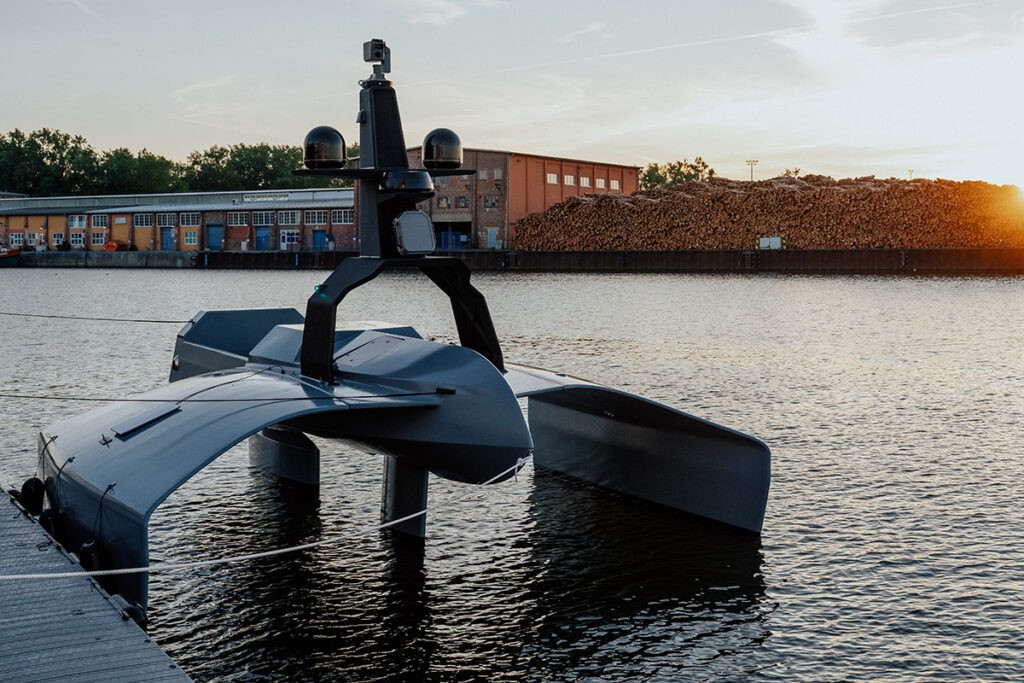
A ship coordinating unmanned systems cannot assume that every observation will reach a shore-based service. It needs a useful local picture and a way to exchange information with vehicles whose communications can be intermittent. The architecture matters because it determines which information remains available when external connectivity disappears.
INEGI’s October 21 account describes its role in E-DOMINION, a European Defence Fund project led by Navantia with 21 organizations from 13 countries. The institute will examine communication and information sharing among autonomous vehicles, underwater sensors, ships and other systems. The stated output is a reference architecture for integrating naval capabilities, rather than a delivered operational fleet. Read the source account.
Define what survives a disconnected period
Underwater observations may arrive slowly or after a vehicle returns to communication range. An architecture therefore needs more than common data fields: it must preserve observation time, location, uncertainty and the relationship between an original finding and later interpretation. These are analysis questions raised by the project’s stated objective, not published implementation details.
Independence from shore connectivity also requires a clear local decision process. Operators need to know which tasks can continue, which should wait and how delayed information is reconciled after reconnection. The announcement explains why limited connectivity matters but does not publish completed trials or measured performance for a reference implementation.
Why a reference architecture must preserve information age
Consider an underwater sensor that records a possible object and transmits its finding after a period without a link. A ship receiving the message must distinguish the observation time from the receipt time. Otherwise, the same display could make an old observation look current. This is an illustrative architecture problem, not a reported E-DOMINION incident. A reference design can address it by making time, location and uncertainty part of the exchanged information rather than leaving each integrator to invent a separate interpretation. The stated project objective makes that a relevant question for subsequent technical work.
A common architecture also needs to explain what information remains local. A ship may continue a mission while access to shore services is limited, but different functions have different dependencies. Storing observations, maintaining tracks and authorizing new tasks are not interchangeable activities. A useful implementation account would identify the functions demonstrated without shore connectivity and the work deferred until reconnection. The source does not publish that partition or a completed test. The analysis therefore treats operational independence as a design objective whose scope remains to be specified.
The consortium structure can help bring different suppliers into the same discussion, but participant count is not an interoperability result. Agreement on an architecture needs to become interfaces that independent implementations can use. A demonstration would be particularly informative if one organization supplied the vehicle, another the ship-side system and another the receiving application, with the exchanged information retaining its meaning. That is a proposed evidence standard, not a description of work already completed by the consortium. It identifies the practical step between collaborative research and a reusable integration approach.
For underwater systems, connection opportunities may be limited enough that transmission priorities become part of the design. A short alert, a detailed sensor record and a software update impose very different demands. A reference architecture need not promise uninterrupted broadband to be useful. It can instead make clear which information is prioritized, what is stored and how the operator recognizes an incomplete picture. Such explicit limits can improve decision-making more than presenting a continuous-looking display whose gaps are difficult to inspect. The announcement does not claim a measured solution to every underwater communications constraint.
The funding statement also needs careful interpretation. INEGI’s account places E-DOMINION among four European Defence Fund projects associated with more than €3.5 million for the institute. That is not a disclosed total budget for the entire E-DOMINION consortium. This article does not turn it into one. Keeping the financial and technical scope distinct allows the project to be assessed on its intended architecture work, with later deliverables providing the evidence for whether that research can reduce integration effort aboard an actual ship.
The next milestone
The next evidence is a defined architecture and demonstrations showing how different systems exchange usable information under stated constraints. If the work makes those interfaces reusable, it could reduce the effort needed to combine naval autonomy systems. The research announcement establishes the problem and participants; operational value remains to be demonstrated.
What would change the assessment
Look for the next documented configuration, its test conditions and its support responsibilities. The current source establishes the announced stage; later results should identify what changed.
This analysis draws on the public sources linked in the text. Send corrections to [email protected].