Buying an uncrewed vessel and building the ability to sustain it are related but different decisions. Co-production can connect them by developing local manufacturing and repair experience. It can also introduce coordination work around configuration, quality assurance and the division of responsibility between partners.
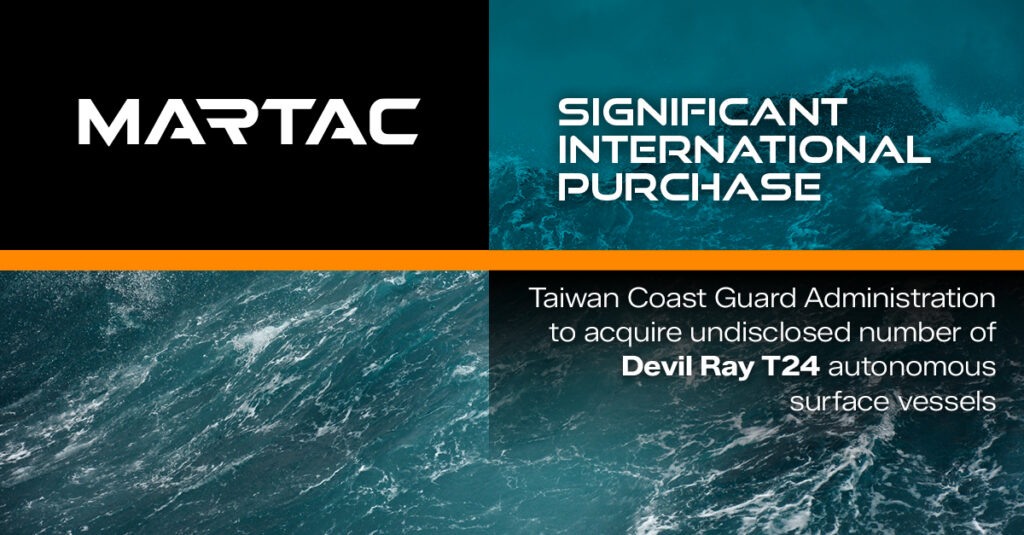
MARTAC’s October 13 announcement says Taiwan’s Coast Guard Administration is acquiring an undisclosed number of Devil Ray T24 vessels. The company describes production split between a Florida partner and Confucian in Taiwan, following a partnership framework involving NCSIST. This is an announced procurement and co-production arrangement. The release does not provide a delivery schedule, accepted vessel count or measured operational results for the customer. Primary source.
Common configuration across two production locations
The first practical issue is whether vessels built in different locations can be treated as interchangeable members of one supported fleet. Documentation, software configuration and component changes need a controlled process. Local manufacturing has less value if maintainers must investigate which undocumented differences apply to each hull.
Quality assurance should therefore follow the complete delivered configuration. A hull that passes manufacturing inspection still needs its installed equipment and interfaces checked as a system. The same principle applies when a later modification is introduced: the fleet needs a clear record of which vessels have received it and what validation accompanied the change.
Skills transfer should be observable
A useful measure of localization is the set of tasks that customer-side personnel can perform independently. That could include fault diagnosis, routine replacement and documented configuration management. These are evaluation criteria, not claims that the announced partners have already completed a particular transfer of expertise.
Support planning should also identify the boundary between local work and tasks requiring the original manufacturer. A visible escalation path can be more valuable than an ambitious statement of self-sufficiency. Spare-part availability and repair turnaround should be evaluated across the same boundary.
Localization has several different meanings
Assembly, component manufacture, software support and independent maintenance are separate activities. A co-production announcement does not establish that all of them will move locally. The practical question is which activities the arrangement covers and what skills, documentation and equipment accompany them. A precise account of that division is more informative than a broad claim that a platform has become locally sustainable.
For example, a local team could assemble a vessel successfully while still relying on the original supplier to diagnose a fault in an installed subsystem. That can be a workable arrangement if the dependency is planned and supported. Problems arise when procurement assumptions treat assembly capability as evidence of independent repair capability. Acceptance and support reviews should therefore examine the responsibilities separately.
Production changes also require coordination. If one site replaces a component because of availability, the change may affect documentation, spares or maintenance procedures elsewhere in the fleet. A common change process can preserve interchangeability while allowing manufacturing to adapt. The announcement does not publish such a process, so it would be premature to assume either that the issue is solved or that it will cause a failure.
Customer-side evaluation could track the time required to resolve representative faults, the proportion of support tasks completed locally and the consistency of delivered documentation. These measures would complement delivery counts by showing whether the industrial arrangement supports ongoing operations. The agreement’s strategic promise is credible as a direction of travel; its realized value will depend on those practical, observable capabilities.
The announcement does not provide an independent operational comparison with existing systems. Such a comparison would help establish the practical benefit for the intended user.
The agreement gives a concrete procurement context to the earlier partnership framework. Its broader significance is whether co-production produces a fleet that is easier to keep available over time. Delivery acceptance and demonstrated support capability will provide stronger evidence of that outcome than the size of an undisclosed purchase or a platform’s advertised performance.
Source and scope
MARTAC source announcement, 2026-10-13. Analysis published October 21, 2026. Company claims remain attributed; proposed evaluation criteria are editorial analysis, not independent test results.
What would change the assessment
The agreement gives a concrete procurement context to the earlier partnership framework. Its broader significance is whether co-production produces a fleet that is easier to keep available over time. Delivery acceptance and demonstrated support capability will provide stronger evidence of that outcome than the size of an undisclosed purchase or a platform’s advertised performance.
This analysis draws on the public sources linked in the text. Send corrections to [email protected].