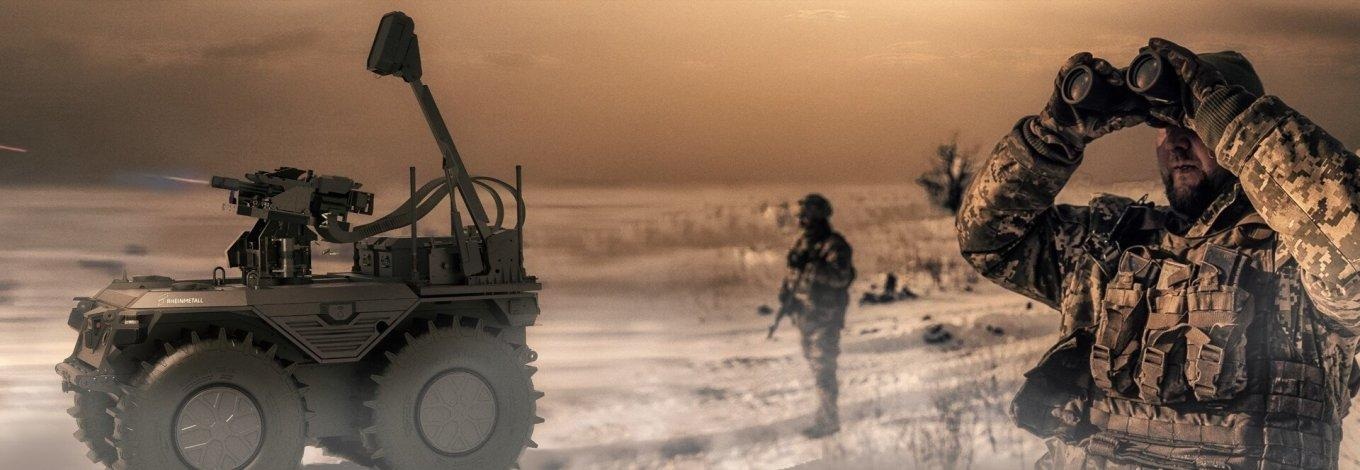
A formation moving under drone observation cannot count on a fixed defensive installation to protect every stop. Putting a short-range air-defense weapon on a robot could bring protection closer while keeping its crew away from the weapon. Rheinmetall’s Mission Master CXT2 with Skyranger 762 explores that combination. Its significance lies in whether protection can move with the force without giving the force another complicated vehicle and firing chain to supervise.
Rheinmetall’s September 2025 announcement describes an uncrewed carrier fitted with a remotely controlled Skyranger 762 weapon station and connected through its Skymaster command system. It presents the combination for very short-range air defense, including small drones. The company’s supporting account family brochure supplies the wider vehicle context. These sources establish the offered configuration. They do not publish an independent result showing how reliably it protects a moving unit against representative attacks.
Driving and defending are different tasks
An autonomous ground carrier chooses a route and avoids obstacles. An air-defense system must detect, identify and track a flying object, decide whether engagement is authorized and deliver an effect in time. Combining them does not erase either chain. It adds a coordination problem: the carrier must be in a useful place with an unobstructed view, while the person controlling the weapon understands what the vehicle and surrounding friendly forces are doing.
The company describes a remote-controlled weapon station. That wording matters. Automated movement does not demonstrate autonomous authority to fire, and a sensor tracking a drone does not itself establish permission to engage. Our assessment is that the operational case should be evaluated around the actual human responsibilities retained. A nominal single-operator arrangement can mean very different workloads depending on whether the person is driving, monitoring movement, reviewing tracks or authorizing each shot.
Protection depends on placement and timing
Consider an assigned defense position near a temporary resupply site. This is a proposed trial, not a reported Mission Master result. The carrier should reach the position, present its status to the controller and keep the weapon within approved operating limits. Then the trial should introduce an approaching drone, a friendly aircraft and a request to move. The order in which those demands arrive could decide whether one operator can handle them safely.
The same trial should test what occurs after a loss of communication. A vehicle may need to stop while its weapon retains a different safe-state requirement. The person responsible must know whether the system is still observing, whether a track has become stale and whether another defense has taken over. Those behaviors are part of the delivered capability even if they are less photogenic than a successful interception.
Judge the combined configuration
A buyer should request a scorecard showing complete engagements alongside mobility and availability. A weapon can work on a stationary range while its carrier cannot position it quickly enough in the intended setting. A carrier can move reliably while its sensor view is obscured. Reporting the components separately would hide the coupling that makes the integrated system valuable or limits its role.
Support also needs to be costed as a combination. Ammunition, sensor calibration, vehicle repair and control-system updates may involve different maintainers. The modular design can make replacement easier, but it does not mean every crew can repair every module. Procurement should specify which faults the unit can remedy, which require outside help and how quickly the configuration returns to a defensive posture after a move or repair.
Protection is a complete resource decision
Mobile protection also introduces an opportunity cost. An uncrewed carrier assigned to air defense is no longer available for another payload, and the defending unit still needs ammunition and information from the wider force. The right comparison is the protection gained at the places where a threat can arrive, with the resources required to keep the carrier there. A fixed position, a crewed mobile system and a robotic system may each make sense for different parts of that problem. The product announcement does not establish that one replaces every role performed by the others.
For readers, the significant design choice is the separation between where people are located and where the defensive equipment operates. That can reduce exposure even with a human explicitly controlling the weapon. It can also complicate coordination when the controller’s picture of nearby activity is incomplete. Mission Master’s value will depend on making that separation useful without making it confusing. The bigger result would be a formation able to bring bounded, understandable protection to temporary positions, with its human decision chain and support needs accounted for from the outset.
What would change the assessment
Ask for representative engagement outcomes and workload measures; the exhibition announcement supplies a configuration rather than a protection scorecard.
The wider impact
The wider opportunity is protection that accompanies a force without exposing another crew at its edge. It becomes a practical gain when autonomous mobility and remotely authorized defense cooperate predictably. The decisive evidence is whether the formation stays protected through movement and disruption, rather than whether a robot can carry an air-defense gun.
This analysis draws on the public sources linked in the text. Send corrections to [email protected].