A surveillance aircraft can remain airborne for a useful period yet be tied to a small number of runways. A short-field adaptation could widen its basing options and put it closer to the mission. General Atomics’ MQ-9B STOL proposal matters as that kind of change. Its wider consequence depends on the support and control arrangements at the new locations, not merely the distance the aircraft needs to leave the ground.
The manufacturer’s published source MQ-9B STOL description presents a wing-and-tail kit for shorter takeoff and landing, including intended expeditionary and shipboard applications. Its published source SkyGuardian page describes the remotely piloted baseline and automatic takeoff and landing. These are product descriptions, not independent acceptance results for every proposed location. Automatic takeoff and landing should also remain separate from a claim that the aircraft chooses or conducts its military mission independently.
A kit changes the configuration
Short takeoff and landing describes a flight-performance capability. A wing-and-tail change can affect the aircraft’s handling and available mission combinations. The buyer needs evidence for the configured version, including its loading and environment. A familiar aircraft name can help explain continuity, but it should not make the new configuration inherit every performance statement attached to the baseline without a test that supports the transfer.
Our assessment is that basing flexibility is useful when it reduces a specific operational constraint. It could shorten positioning or allow a force to use another location. Each location still needs fuel, servicing, payload preparation and a control arrangement. The relevant comparison therefore includes how those functions are delivered, rather than treat runway length as the only infrastructure that prevents deployment.
Watch the footage
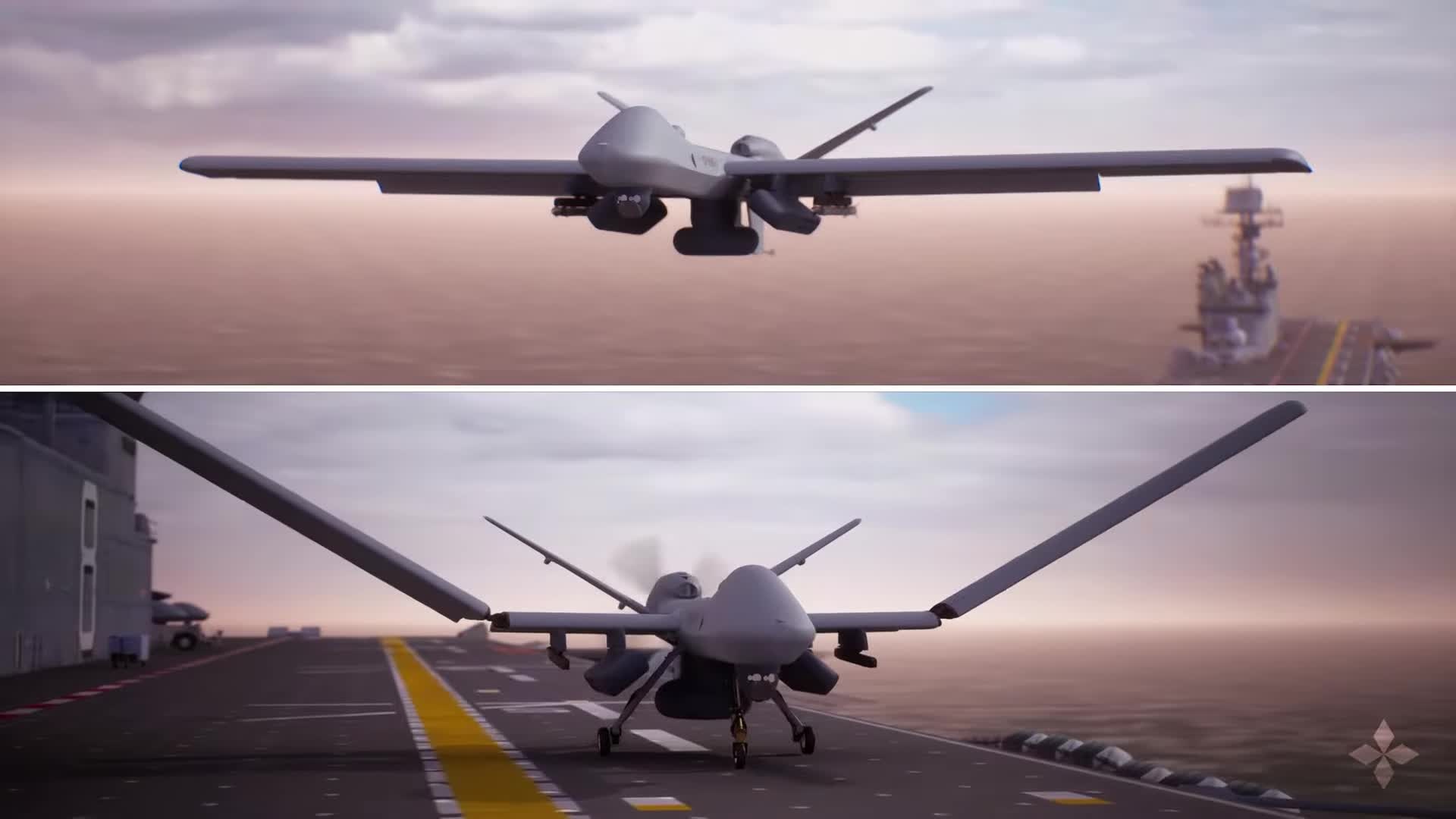
General Atomics presents the MQ-9B STOL concept using computer-generated aircraft and carrier imagery. This animation illustrates the design; it is not footage of a demonstrated carrier landing.
Video: General Atomics Aeronautical Systems, Inc. · Original source ↗ · Video watch page ↗Automatic endpoints do not remove the remote crew
Automated departure and recovery can reduce a demanding flight-control task. A remotely piloted aircraft still has people responsible for tasking, monitoring and the use of its sensors. The number and location of those people depend on the operating concept. A procurement argument should state which burden the automatic function reduces and which staffing responsibilities remain. Otherwise a real automation benefit can be overstated as an entirely uncrewed mission organization.
Consider operation from a temporary forward airfield. This is a suggested assessment scenario, not an MQ-9B STOL result. The aircraft should complete departure and return in the approved configuration while the unit maintains the control and maintenance functions. An interrupted link or changed landing condition would test the support concept as well as the aircraft. The experiment should record whether the alternative base actually improves mission availability.
Shipboard ambitions require their own evidence
A vessel adds movement, deck operations and a different support environment. The kit’s intended shipboard use therefore needs a separate demonstration from short-field operation ashore. A successful flight by another related aircraft can inform development without certifying the MQ-9B configuration. Readers should retain the distinction between a concept, a product description and a completed acceptance trial on the specified platform.
The most useful next record would show what configuration was tested, the actual basing conditions and the complete crew and support footprint. It would also identify the limits on payload or flight conditions and what changed from the baseline. That would connect the kit to a credible operational option and let a customer decide whether the flexibility is worth the added integration and sustainment work.
The support footprint should be tested at the intended site alongside the configured aircraft.
A shorter runway does not move the support chain
A wider choice of airfields could also change the aircraft’s practical availability. A shorter transit from base to task can leave more time for useful collection, but deploying to another location may split maintenance personnel and spares. The benefit must be evaluated across the mission cycle, not inferred from takeoff distance. The same aircraft can become more accessible tactically while harder to support if the alternate location lacks what its daily operation requires.
For a kit-based proposal, reversibility matters as well. A customer would want to know the effort of changing configurations, the equipment needed and how crews confirm which flight limits apply afterward. Those details determine whether the kit offers flexible basing or creates a separate specialist fleet in practice. MQ-9B STOL’s wider significance is the possibility of loosening a physical constraint on an established remotely piloted platform. The useful outcome would be more mission options from an explicitly supported configuration, with the remote crew and maintenance chain designed for those options rather than assumed to follow automatically from a shorter departure run.
What would change the assessment
Request configured flight and support results; keep automatic takeoff and landing distinct from independent mission authority.
The wider impact
MQ-9B’s broader opportunity is to make persistent aviation available from more places. The payoff comes when a new departure option also supports a dependable complete mission. Short-field performance and automatic endpoints are important pieces, but a usable base still includes the people, connections and repair capacity behind the aircraft.
This analysis draws on the public sources linked in the text. Send corrections to [email protected].