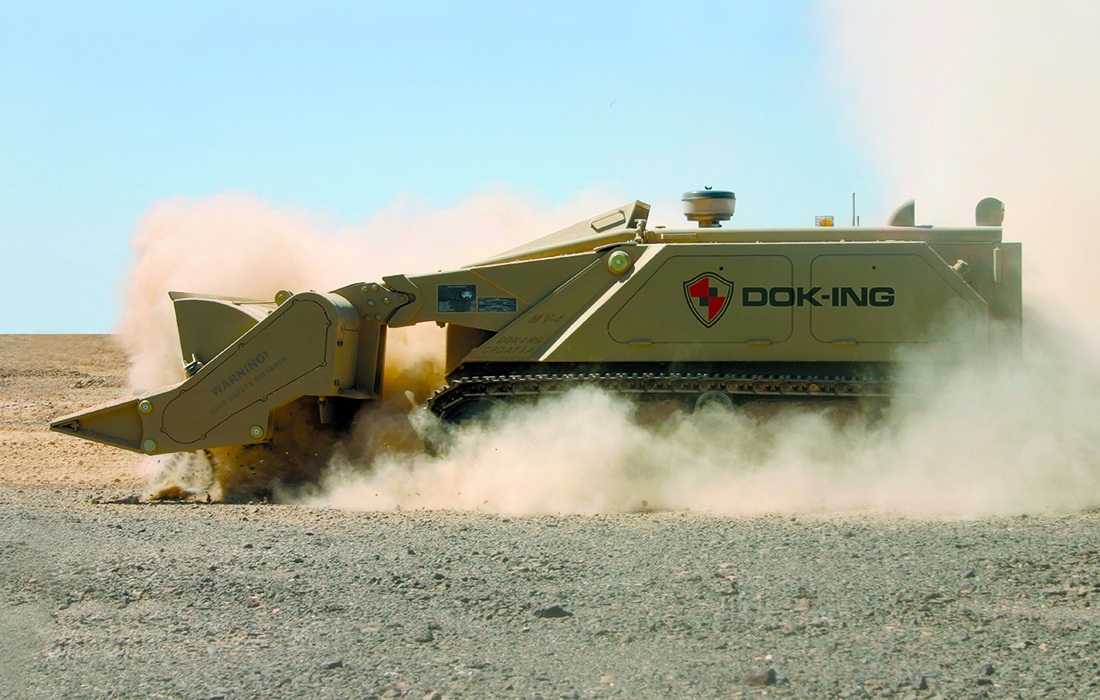
A mine does not stop threatening people when the front moves away. It can keep a field, road or worksite unusable long after the military operation that left it there. Robotic mechanical clearance is consequential because it can put a machine between a person and an explosive while helping land return to use. DOK-ING’s MV-4 work in Ukraine should therefore be judged by the clearance process it supports, rather than autonomous movement alone.
DOK-ING’s April 2025 published source account describes an MV-4 deployment through a completed equipment-rental project with SafeLane Global. Ukraine’s Defense Ministry published source account of a June 2025 demonstration includes MV-4 among the clearance systems shown. These sources document use and official visibility. They do not establish that every type of explosive hazard can be cleared by the machine or that mechanical treatment by itself certifies an area safe for unrestricted use.
Remote operation can provide the important gain
Mechanical clearance uses equipment to work the ground rather than asking a person to approach each suspected hazard directly. A remotely controlled machine can provide that protection without independently deciding where to clear. That distinction makes the platform relevant to autonomy analysis while keeping its actual control role clear. The useful question is which part of the dangerous work leaves the person, and what inspection and verification still require human expertise.
Our assessment is that the rental model deserves attention alongside the machine. A buyer may need clearance capacity for a defined period rather than permanent ownership of another specialized vehicle. The operational value then depends on delivery, trained operators, spare parts and the ability to restore equipment after damage. A rental arrangement can bundle some of those responsibilities, but the published deployment account does not establish the economics of every future arrangement.
Treat the worksite as a system
A clearance machine has to reach the site, operate within approved boundaries and coordinate with people checking the result. Ground conditions, access and the kind of suspected contamination matter. A trial that demonstrates mechanical motion cannot answer all those questions. Nor should a manufacturer’s successful project account be generalized to another site without knowing what was cleared, how the result was verified and what conditions constrained the work.
Consider an agricultural field with uncertain contamination near a damaged access route. This is a hypothetical assessment scenario, not a reported MV-4 project. A useful plan would state which ground the machine treats, which areas need another method and who accepts the final result. It would include how the machine is recovered or repaired after an incident without exposing people to an area whose status remains uncertain.
Availability matters to recovery
In humanitarian and military clearance, delay has an economic and social cost beyond the price of operating the machine. Land waiting for verified clearance may remain outside productive use. A customer should track downtime, repair turnaround and continuity of trained crews alongside area treated. Those measures connect engineering performance to restoring access, rather than turn a mechanical throughput claim into an assumed social benefit.
The evidence standard should be careful but useful. The official demonstration confirms that the platform was among a broader set of tools considered relevant in Ukraine. The deployment account supplies a concrete service model. Neither is a universal clearance certificate. A stronger public follow-up would report site conditions, accepted outcomes and support experience in a form another customer can compare with its own need.
Separate treated ground from accepted land
A clearance result has several meanings that should not be merged. Ground treated by a machine is a record of activity. Ground inspected afterward is a record of a further process. Land accepted for a stated use is an outcome governed by the responsible authority and applicable procedure. The area involved can be identical while the level of assurance differs. Readers should therefore look for how a project defines its completed work, rather than compare area figures from different accounts as though they describe the same result.
That distinction does not diminish mechanical clearance. It shows where a machine can make a practical contribution within a broader effort. Reducing the number of dangerous manual approaches, preparing ground for another method or improving access can each be valuable even when further checks remain necessary. DOK-ING’s deployment story belongs in that complete chain. The bigger-picture measure is the restoration of safe access for people and economic activity, accompanied by a record that explains the limits of the clearance. A well-supported remotely operated machine can help achieve that outcome without needing to be described as a general autonomous solution.
What would change the assessment
Ask for site-specific acceptance and support results rather than universalizing a demonstration.
The wider impact
The larger impact is reducing human exposure while returning contaminated land to useful service. Robotic equipment contributes through a verified process with trained people and sustained support. A successful machine pass matters most when it becomes a credible decision that people can safely return.
This analysis draws on the public sources linked in the text. Send corrections to [email protected].