A ground robot can travel toward a task without taking responsibility for every decision that follows. That distinction matters when one operator supervises several vehicles carrying different payloads. The useful unit of assessment is the complete chain from a reported observation to an authorized action, including the points at which a person must review incomplete information. Faster movement alone cannot establish that this chain remains understandable under pressure.
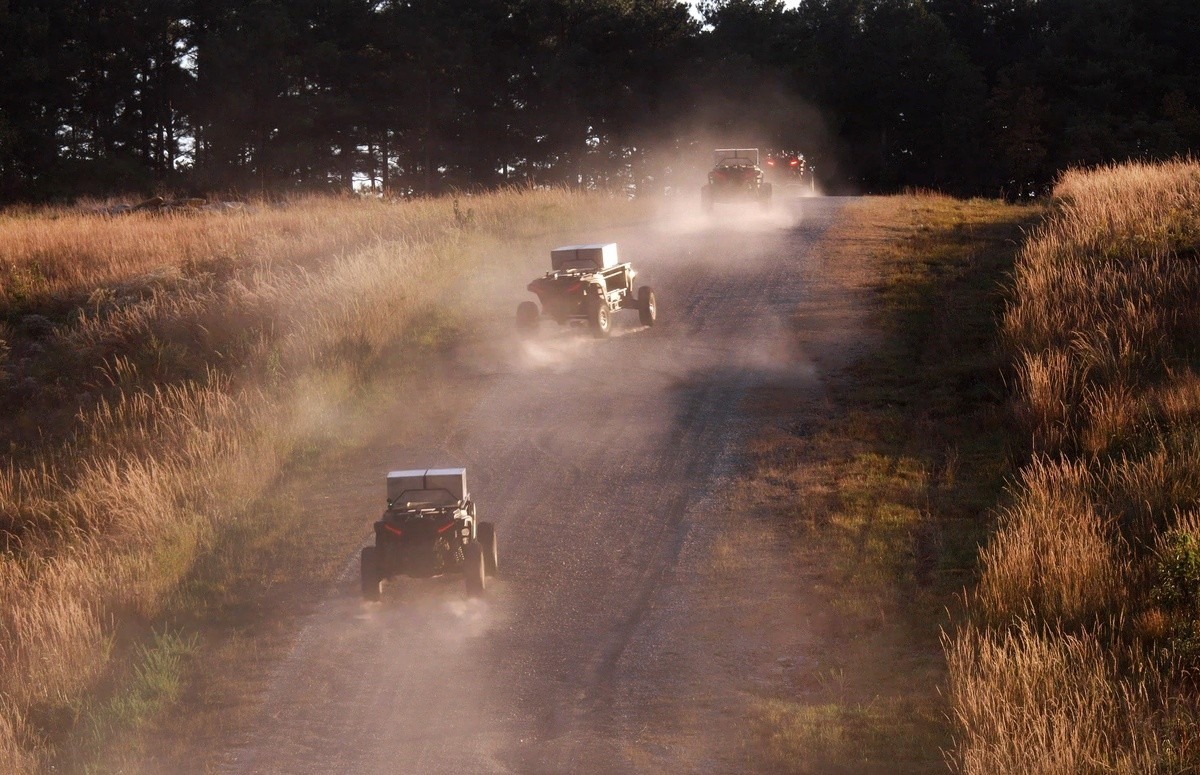
The Army’s October 22 account describes an October 15 RACER demonstration at Fort Knox involving four autonomous ground vehicles. The reported sequence connected a satellite cue, vehicle movement and ground observations. Vehicles searched and moved autonomously, while a human received image excerpts and approved engagements. The account identifies Overland AI ground vehicles and integrated Anduril payloads. It describes a proof-of-concept experiment, not a fleet-wide fielding decision or an independent statistical reliability study. Read the primary source account.
An image excerpt is a decision handoff
The approval boundary is central to the demonstration’s meaning. An image excerpt can help an operator understand a detection, but the receiving person also needs enough context to decide whether the observation is current, correctly located and relevant to the assigned mission. The public account does not provide a measured rate of ambiguous detections or explain every display used. It therefore supports a description of the demonstrated control arrangement, rather than a claim that the operator always had sufficient information.
The four-vehicle sequence also raises a concurrency question. Supervising multiple vehicles is different from reviewing one selected event at a time. Several detections may arrive together, a vehicle may require recovery, and a communications interruption may compete for attention. Those are evaluation questions, not reported failures at Fort Knox. A useful follow-on assessment would retain the number of simultaneous events, the interventions required and the time spent resolving uncertainty, alongside whether the planned demonstration sequence was completed.
Preserve the route from cue to action
A cue from a space-based sensor and a detection made by a ground vehicle have different observation conditions. Combining them can extend the available picture, but the handoff should preserve where each observation came from and what it actually shows. A cue that directs a search is not itself confirmation of the object subsequently encountered. The Army’s account makes this end-to-end connection the experimental milestone; it does not publish a general identification accuracy for the combined system.
For a receiving unit, payload modularity creates both flexibility and configuration work. Changing a sensor or effect can alter power, communications, mobility and the information presented to the supervisor. Qualification of the mobility software alone would leave those interactions unresolved. The relevant record is the integrated configuration that was tested, including the operator interface and the behavior when a required input becomes unavailable. This is why a successful selected scenario should travel with its conditions rather than become a blanket statement about every payload.
The next assessment needs the people in the loop
The Army report says a further test was expected in December with Soldier input. That planned participation provides a route to examining tasks outside an engineering team’s preferred sequence. It is not evidence that the later test has occurred or that its results are already known. Practical feedback should distinguish work the robot completes independently from work transferred to maintainers, supervisors and recovery teams. A system can reduce exposure in one part of a mission while increasing preparation elsewhere.
The report also describes a vehicle stopping after a potential detection while awaiting further direction. That pause is useful context: autonomous movement and observation did not remove the demonstrated human approval boundary.
The near-term contribution is an inspectable demonstration of coordinated robotic movement with a retained human engagement decision. Its longer-term significance depends on whether the same boundary remains clear as payloads, terrain and event rates change. Evidence of repeatable operation, documented interventions and comprehensible degraded behavior would connect the proof of concept to a stronger operational case. Until then, the important achievement and the unresolved assessment belong together: a demonstrated sequence establishes a capability to investigate, not universal readiness.
Source organizations: DARPA, Overland AI, Anduril.
This analysis draws on the public sources linked in the text. Send corrections to [email protected].