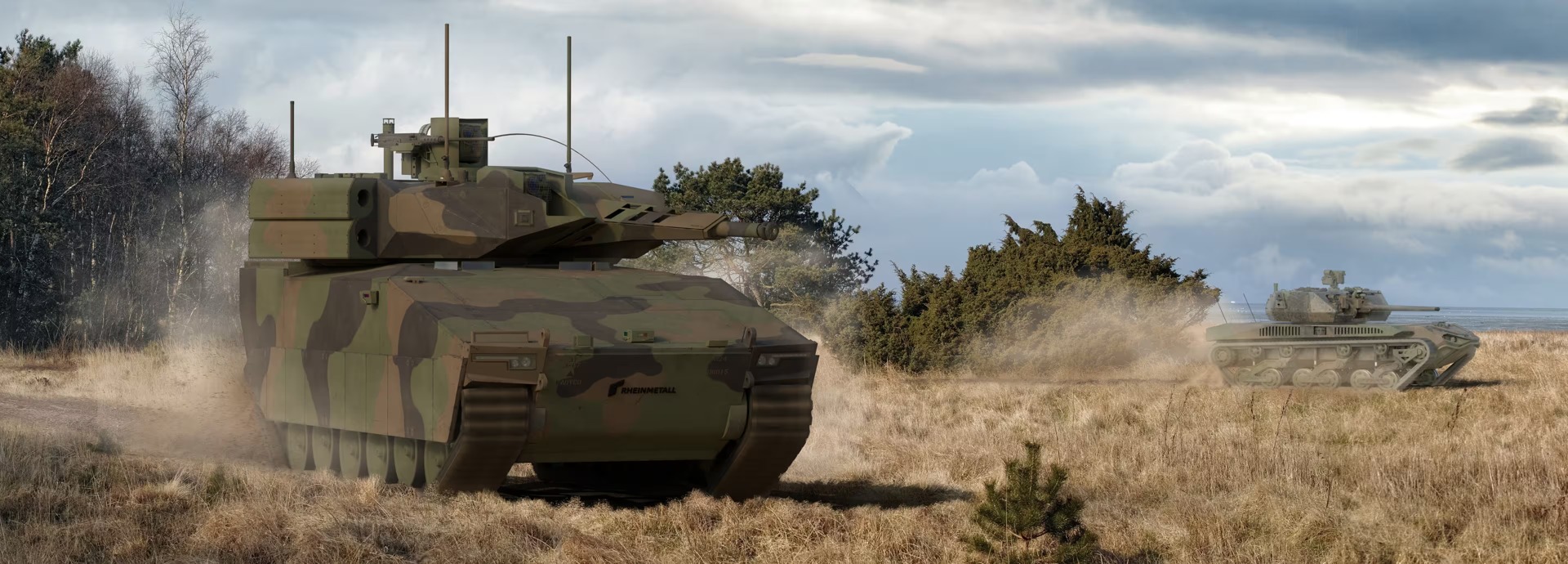
A family of ground robots can look like one capability in an exhibition display. For a buyer, the important differences are often less visible: whether a platform is a prototype, has entered a trial, or has an established support arrangement.
Rheinmetall’s October 12 AUSA release lists Ox, MUSKOX, Mission Master SP and Wild Goose, alongside other vehicle programs. It describes Ox as competing in GOAT, MUSKOX as down-selected for Project Sustainment, and Mission Master SP as down-selected for Last Tactical Mile. These are distinct program positions, not a common declaration of fleet readiness.
Treat selection and delivery separately
A down-selection narrows a procurement process. It does not by itself establish accepted quantities, a production schedule or performance in every intended mission. Likewise, an exhibition appearance provides a chance to inspect a system but is not a substitute for an evaluation record.
The practical comparison should keep each vehicle’s configuration and mission requirement together. Payload, transportability and support requirements matter in combination; borrowing a strength from one family member to describe another obscures the actual choice.
Ask what the next milestone would demonstrate
For a prototype, a meaningful next step may be completion of a defined test. For a selected program entrant, it may be an award or accepted delivery. For a fielded platform, sustainment and recurring availability may be more informative than another public demonstration.
Rheinmetall’s breadth creates several possible routes into ground autonomy. Assessing them requires a platform-by-platform record that preserves the difference between proposed capability, program progress and operational evidence.
Primary source and reported conditions.
Compare like with like
Program labels are easy to collapse when several machines appear in the same announcement. A prototype delivery, a competition entry and an established fleet can all be genuine progress, but they reduce different uncertainties. The prototype allows a customer to learn; the competition entry presents a candidate solution; the established fleet can provide evidence about recurring operation and support. A comparison that treats those milestones as interchangeable risks selecting on presentation rather than on the evidence relevant to the requirement.
This also applies to the meaning of autonomy. A platform may support several modes and payload arrangements, while a particular evaluation concerns only one configuration. The assessment needs to specify which behavior was observed and what remained under human control. Without that boundary, an accurate statement about one mode can become an inaccurate claim about the whole product family. The release is a map of offerings to investigate, rather than a substitute for those investigations.
The support chain belongs in the comparison
A buyer assessing ground systems should ask how the operating unit would recognize and resolve a fault, which components can be replaced locally and which changes require specialist support. Those questions do not assume that any named vehicle is difficult to maintain. They identify information that a portfolio announcement generally cannot supply and that becomes important once a system leaves the exhibition floor.
Transport and storage deserve the same treatment as the advertised mission. A platform that suits one unit’s movement and maintenance pattern may impose substantial additional work on another. Comparing only a payload figure would overlook that work. An assessment can preserve the benefit of a modular system while checking the specific combination of equipment, personnel and support needed to use the module reliably.
The immediate value of the AUSA lineup is that it gives acquisition teams several concrete systems and program milestones to follow. Over time, the meaningful record will be how each progresses through defined tests, accepted deliveries and sustained service. Keeping a separate evidence file for each platform helps prevent the reputation of the wider manufacturer from filling gaps in the record. It also makes successful progress easier to recognize when the next milestone is actually completed.
For a reviewer comparing these offerings, the most useful presentation would place the evidence beside each platform rather than beside the manufacturer as a whole. That might distinguish the configuration presented at AUSA, the next announced program event and the public record available for inspection. It would not require assuming that the absence of public detail means no work has occurred. It would simply prevent undisclosed work from being treated as verified evidence. This approach allows both mature products and promising prototypes to be discussed accurately within the same portfolio.
This analysis draws on the public sources linked in the text. Send corrections to [email protected].