A military force can automate observation while leaving the physical workload largely unchanged. Detecting damaged equipment does not repair it. Monitoring supplies does not move them. Identifying an object does not provide the ability to handle it.
The opportunity for multipurpose robotics is to connect awareness with useful physical work. Humanoids deserve serious attention because so much of that work takes place in environments built around human reach, hands, and tools.
The work behind military capability
Military readiness depends on activities that receive less attention than the platforms they sustain. Equipment must be maintained, supplies handled, tools positioned, components inspected, and facilities kept functioning.
These tasks involve contact with the world. Objects differ in weight, shape, condition, and location. A useful machine must adjust its movements, manage force, recognize when an action has failed, and complete the next step.
That makes physical manipulation an important part of defense autonomy. Mobility gets a robot to the work. Sensing helps it understand the situation. Manipulation allows it to change something.
The requirement already appears in military development priorities. The Army's xTechHumanoid competition identifies potential applications including sustainment, maintenance, firefighting, material movement, and reconnaissance. Those objectives establish a broad field of interest, while leaving the capabilities of individual prototypes to be demonstrated.
Our assessment is that the useful task range of a robot should become a central measure of its military value. Performance on one activity matters. So does the ability to move between activities without requiring another machine.
Demand for physical automation is already visible
The commercial opportunity is grounded in identifiable work.
In August 2026, HII announced performance-based agreements with Path Robotics and GrayMatter Robotics covering potential shipbuilding work worth up to $900 million over seven years. The agreements tie progress to technology readiness, manufacturing qualification, and performance milestones across Navy shipbuilding applications. They provide concrete evidence of demand for physical automation, with the eventual work dependent on successful execution.
That distinction matters for the humanoid market. A need for welding, handling, or maintenance creates an opportunity for the machine that can deliver the work reliably. It does not determine the winning body shape in advance.
The broader opportunity is to serve changing combinations of physical tasks. Where a workload varies between locations or over time, versatility could increase utilization and make a common robotic platform more valuable.
Why humanoids are a compelling candidate
The case for humanoids begins with compatibility.
Doors, shelves, workbenches, tools, and equipment interfaces are commonly arranged for people. Human-compatible reach, coordinated manipulators, and suitable mobility could let a robot work across those environments with fewer changes to the surrounding infrastructure.
A common platform could also spread training, maintenance, and deployment costs across multiple activities. Instead of acquiring a separate machine for every job, an organization might assign different work to the same available robot.
That is an economic and operational hypothesis worth testing.
DARPA's completed Robotics Challenge addressed the underlying compatibility problem by pursuing human-supervised ground robots capable of working in dangerous, degraded, human-engineered environments using standard tools and equipment. The enduring requirement is useful physical capability in places that were not designed for automation.
Humanoid form offers one route toward that capability. Its advantage becomes meaningful when the machine can coordinate its body and manipulators, use different tools, and complete work despite ordinary variation.
From one demonstrated skill to several dependable jobs
Current humanoid developments provide specific capabilities to evaluate.
Foundation's published Phantom testing includes lifting and exposure to dust and water. These demonstrations address elements of strength and environmental tolerance. Their significance for a customer depends on how those capabilities contribute to complete, repeatable workflows.
Skylark Labs' published EOD-support material presents another bounded application: observation and detection support with specialists retaining responsibility for assessment and response. It gives evaluators a recognizable activity to examine, without establishing a generally capable military worker.
The important progression is from a demonstrated skill to a dependable portfolio of work. Can the same platform handle different objects, change tools, and move between tasks without extensive reconfiguration or continuous detailed control?
Success on that progression would make the case for multipurpose humanoids substantially stronger.
Specialized robots set the comparison
A credible humanoid strategy must account for capable alternatives.
Path Robotics' mobile welding system uses a quadruped embodiment. Boston Dynamics documents object handling, door opening, and valve operation with Spot's arm through combinations of remote control and automated behaviors. These examples show that physical work and multiple useful capabilities are available beyond humanoids.
Specialized systems may remain the best choice for stable, repetitive workloads. Humanoids become more compelling where tasks vary, human-designed interfaces matter, and changing jobs has practical value.
The comparison should therefore examine the required workload, the operating environment, and the total burden of completing the work.
The opportunity remains conditional. The Army Research Laboratory's assessment of limbed robotics identifies several promising embodiments alongside technical, operational, and logistical barriers to delivering the full desired capability. Those constraints must be included in the investment case.
Conclusion: what would establish the case
The decisive evidence is a representative trial in which one robot completes different useful tasks across changing conditions.
Results should disclose completion rates, human interventions, setup time, recovery effort, and maintenance requirements. Comparisons should include suitable specialized systems and the existing human workflow.
Humanoids merit serious investment because they could provide broad task coverage in environments built for people. The next meaningful milestone is a machine that repeatedly changes jobs while delivering a measurable reduction in the work, exposure, or support burden carried by its human team.
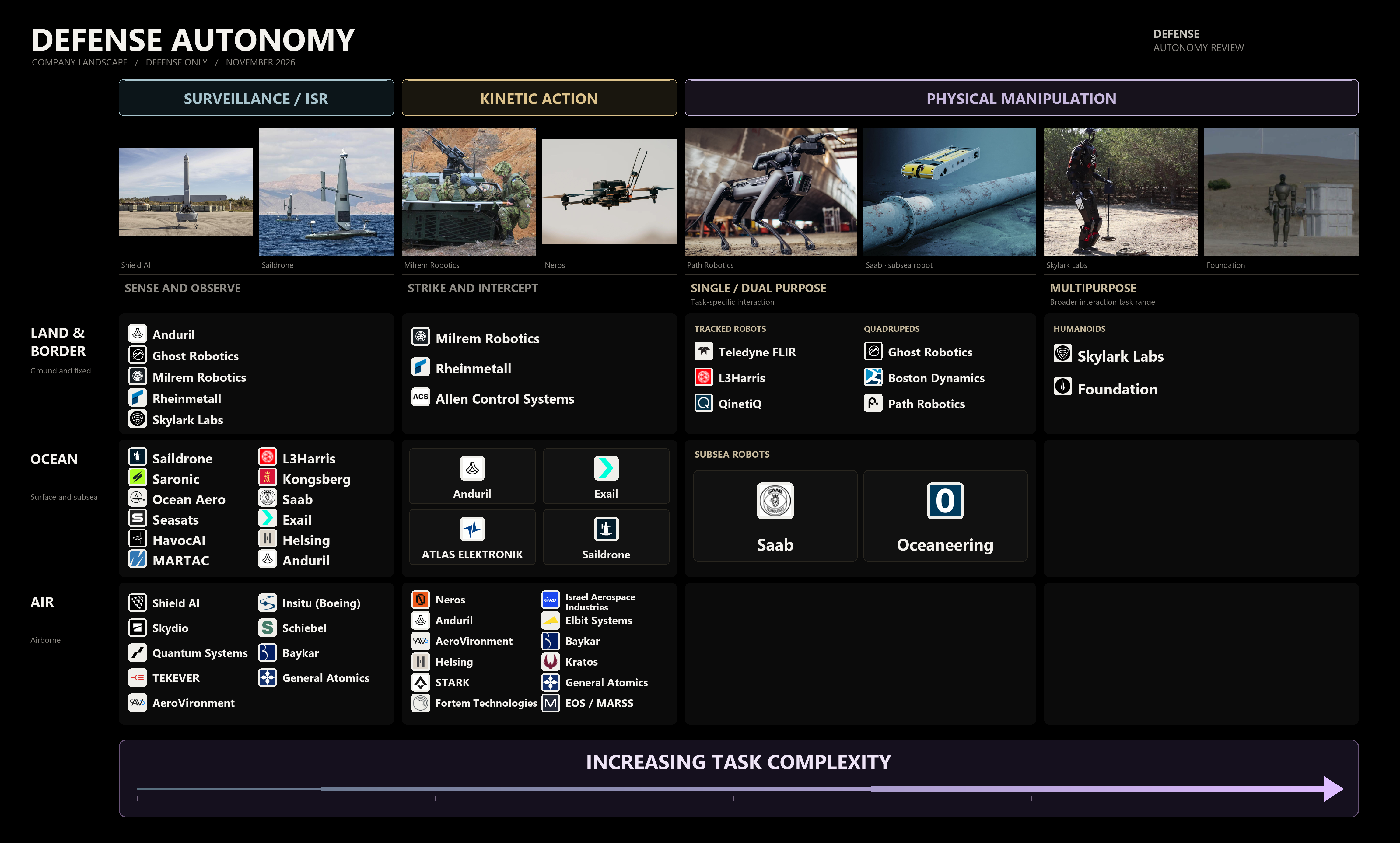
In focus: companies in the map
ISR
Anduril; Ghost Robotics; Milrem Robotics; Rheinmetall; Skylark Labs; Saildrone; Saronic; Ocean Aero; Seasats; HavocAI; MARTAC; L3Harris; Kongsberg; Saab; Exail; Helsing; Shield AI; Skydio; Quantum Systems; TEKEVER; AeroVironment; Insitu (Boeing); Schiebel; Baykar; General Atomics.
Kinetic Action
Milrem Robotics; Rheinmetall; Allen Control Systems; Anduril; Exail; ATLAS ELEKTRONIK; Saildrone; Neros; AeroVironment; Helsing; STARK; Israel Aerospace Industries; Elbit Systems; Baykar; Kratos; General Atomics; Fortem Technologies; EOS; MARSS.
Physical Manipulation
Teledyne FLIR; L3Harris; QinetiQ; Ghost Robotics; Boston Dynamics; Path Robotics; Saab; Oceaneering; Skylark Labs; Foundation.
Reading the map and image credits
This original editorial composition groups selected companies by domain and illustrative task focus. The increasing-task-complexity arrow is a qualitative framing of physical interaction and task variety, not a validated measurement or universal ranking. Placement does not establish autonomous operation, field readiness, or a demonstrated portfolio of jobs. Blank cells indicate no selection in this map, not that a capability cannot exist.
Header imagery, left to right: Shield AI V-BAT via Army Recognition; Saildrone, IMX 2025; Milrem Robotics, live-fire exercise; Neros, Archer supplier image; Path Robotics, Rove supplier photograph; Saab, Sabertooth beside a pipeline, supplier artwork; Skylark Labs, outdoor detector demonstration; Foundation, outdoor testing still. Supplier demonstrations and artwork are not independently verified operational evidence. Company marks identify the organizations shown; no endorsement is implied.
This analysis draws on the public sources linked in the text. Send corrections to [email protected].