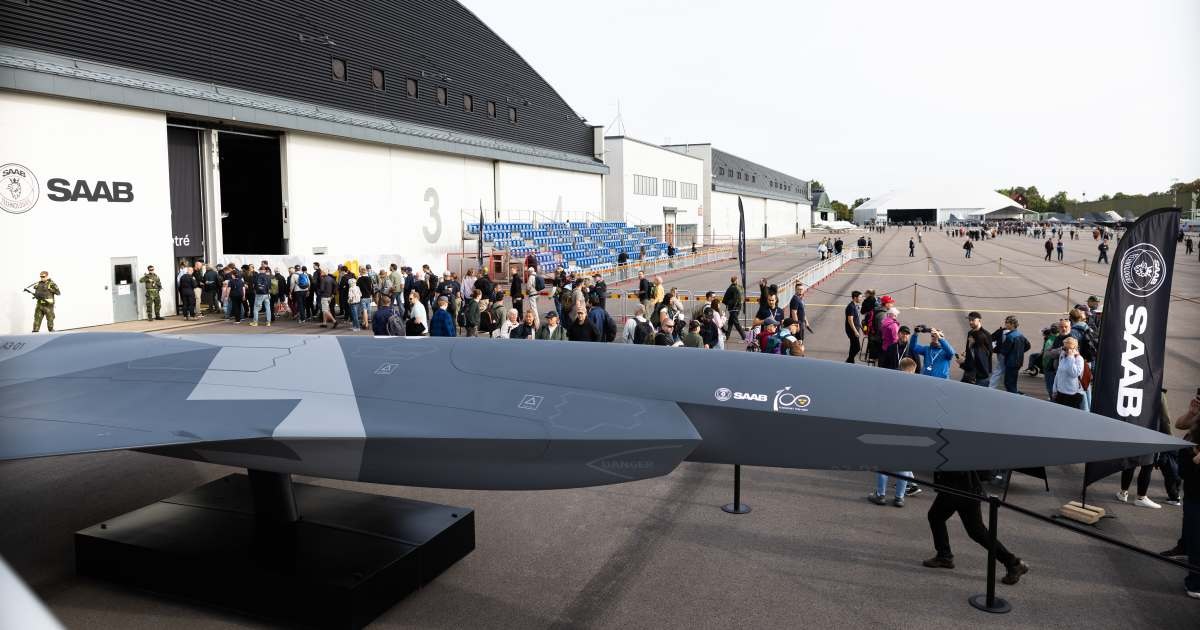
A country deciding how to sustain combat aviation needs choices that fit its own aircraft, budgets and operational priorities. Uncrewed partners could offer another route to capability alongside a future crewed fighter. Saab’s August 2026 concept makes that option visible for Sweden. Its significance is a development direction and a set of questions to test, rather than evidence that a full-size model is already an operational answer.
Saab’s August published source announcement describes a concept that could complement Gripen and future crewed aircraft, with uncrewed demonstrators intended before 2030. Its 2025 published source development presentation places collaborative air autonomy within a wider investment picture. These primary documents establish an industrial exploration. They do not publish a production decision, a completed flight demonstration or a customer-validated scorecard for the intended autonomous functions.
A national option needs an operational role
Complementing an existing fighter means adding something the force wants but cannot obtain as effectively through another aircraft or payload. That could be a sensing, support or effects role, but each imposes different requirements. The country’s useful choice is therefore a mission choice as well as a platform choice. A model can help communicate possibilities; testable requirements determine which possibility is worth developing first.
Our assessment is that demonstrating the human relationship early could make the eventual hardware choice better informed. A pilot should be able to assign a bounded task, understand the drone’s status and handle exceptions without losing focus on the primary aircraft. Those needs can be explored in simulation and interface trials before a final airframe is selected. Such experiments would be valuable evidence about the role even while flight technology remains in development.
A demonstrator is an instrument for reducing uncertainty
An uncrewed demonstrator can answer a particular flight or integration question without representing the final operational aircraft. That distinction gives the project freedom to learn. It also requires disciplined reporting: which uncertainty did each test remove, and which remains? A successful early flight should not be treated as proof that sensing, coordination and a complete mission all work under representative conditions.
Consider a proposed sensor-support mission beside a crewed aircraft. This is a hypothetical acceptance scenario, not a reported Saab result. The drone should report an observation with its uncertainty and acknowledge changes in tasking. A delayed link or unclear observation would reveal what attention the pilot must supply. The measure should be better decision support and manageable workload, not merely another aircraft staying in formation.
Preserve choice as the project narrows
An exploratory program can create options before a government commits to a full system. Its value decreases if technical decisions make it difficult to change the mission, integrate another payload or cooperate with an allied aircraft. Clear interfaces and accessible test records can help preserve that freedom. They need to be concrete engineering and contract arrangements, rather than a general statement that the future aircraft will be adaptable.
The sources reviewed provide development intent and investment context. They leave the prototype schedule’s execution and mission performance open. The next useful public record would show a named demonstrator, the functions it tests and the results that change the design. That would let Sweden and potential partners compare an indigenous option with other routes on the basis of evidence, while keeping the full-scale display in its appropriate role as a concept.
A concept should sharpen the next decision
A full-size concept helps people discuss constraints that an abstract capability statement can hide. Its size and layout can make questions about payload, transport and support more concrete. Yet a display does not resolve those questions: it shows an intended direction that engineers and customers can examine. The useful response is to ask what decisions the concept is meant to inform and which uncertainties the next stage of work will reduce.
For Sweden, the choice concerns the force as well as the individual aircraft. A new uncrewed platform must connect to existing aircraft, command arrangements and support capacity, or require a justified change to them. Different possible roles will create different interfaces and staffing needs. Saab’s concept is therefore significant as an option in a broader development discussion, not evidence that a particular operational arrangement is already settled. The larger benefit could be greater freedom to shape future air capability with a domestic industrial base. That freedom becomes practical when demonstrations narrow the possibilities into a bounded mission and an understood path to integration, rather than allowing the appearance of the aircraft to stand in for its complete military contribution.
What would change the assessment
Separate the August model and pre-2030 intent from flown capability; seek function-specific demonstration records.
The wider impact
Saab’s larger contribution could be to widen Sweden’s choices about how crewed and uncrewed aviation develop together. The August model starts a visible conversation about those choices. Its value will grow through experiments that make the useful role clearer and preserve the freedom to select a system the force can operate and sustain.
This analysis draws on the public sources linked in the text. Send corrections to [email protected].