A small drone can spend much of its useful flight reaching the place where it is needed. Carrying it on another aircraft changes that calculation, but only if the carrier can also support a workable control arrangement after release. Schiebel's latest trial is a meaningful integration step because it addresses both parts of that problem. Its significance is narrower than a demonstrated autonomous interception capability.
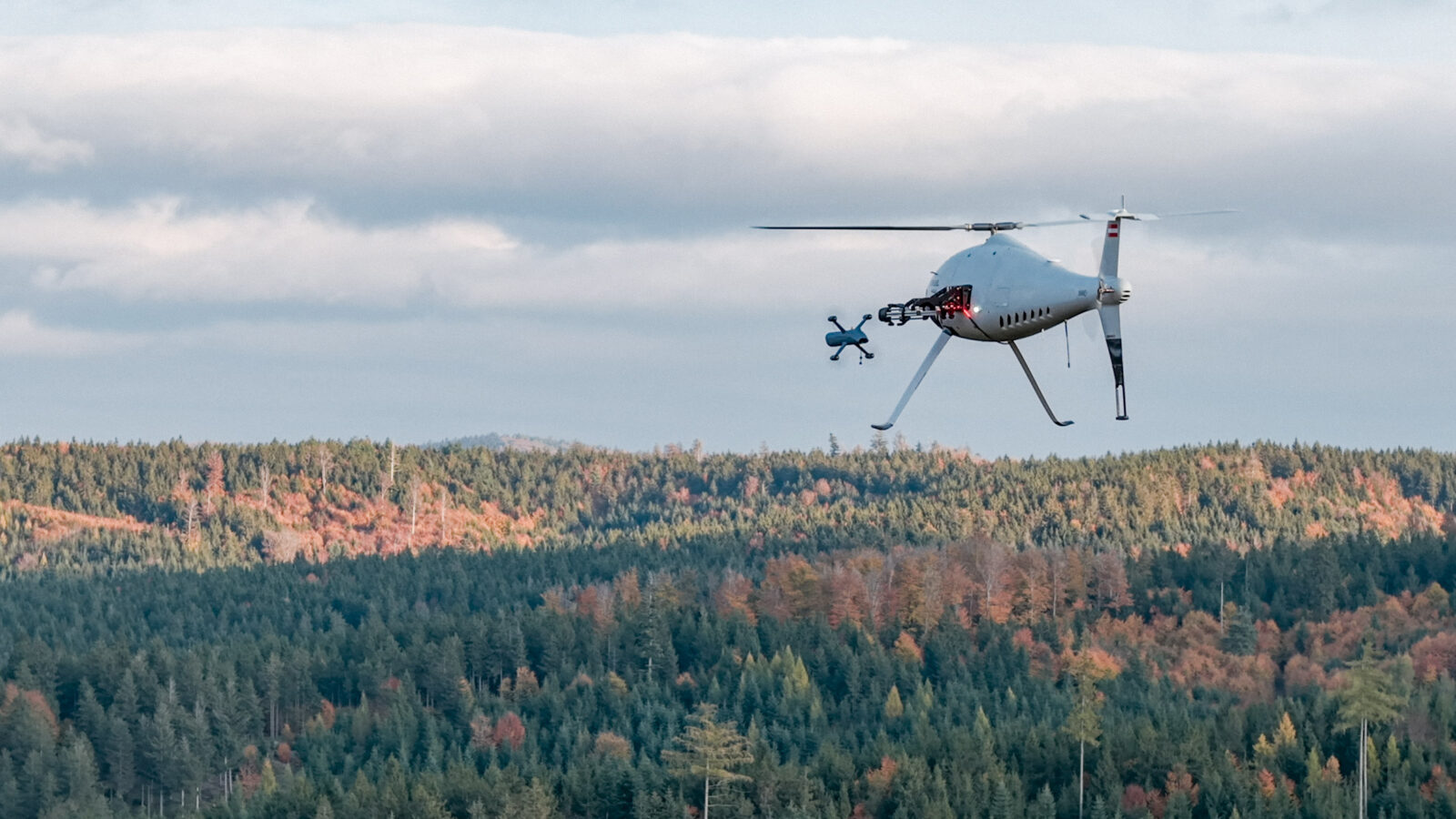
In its November 18 announcement, Schiebel reports that a CAMCOPTER S-100 carried and released an OSIRIS Poland HSCD-1 during forward flight in Austria. The smaller aircraft then used the S-100 as a relay for control and video. The companies describe the event as a proof of concept and identify the small drone as an inert variant.
Two functions that need to work together
The physical release and the communications relay solve different problems. A clean separation shows that the two aircraft can operate together at that point in the flight. A working relay shows that an operator can continue interacting with the smaller aircraft through the larger one. Neither result alone would establish a useful mothership concept.
Our assessment is that joining those functions is the strongest part of the demonstration. A carrier that merely delivers a small aircraft to a distant location can leave the operator facing the same communications limitation at a new distance. Making the carrier part of the control path addresses that weakness, while introducing a dependency of its own: the mission now relies on the relay aircraft and the links on both sides of it.
Schiebel's S-100 documentation describes automatic launch, recovery and waypoint navigation, as well as direct pilot control. That background establishes an autonomy function on the carrier. It should not be extended into a claim that the released HSCD-1 autonomously selected or intercepted a target. The release describes the smaller aircraft as operated through the relayed communications link.
What the demonstration leaves unresolved
The companies identify counter-drone applications as a possibility. That is a reasonable development direction, but the inert demonstration does not test the complete interception problem. It does not disclose a target-engagement result, a repeatability rate or performance when the relay link is disrupted. An edited demonstration video can illustrate the sequence without answering those questions.
The immediate value is therefore an integration starting point for operators and equipment developers. They can evaluate a combined carrier, release and relay arrangement rather than treating the components as separate proposals. The next assessment should examine safe separation, dependable control transfer and the behavior of both aircraft when communications become unavailable.
A broader operational benefit would depend on whether the extra aircraft and its support requirements are justified by the reach gained. The carrier consumes maintenance, airspace and operator attention. Those costs may be worthwhile when a smaller platform can be delivered close to its task, but they cannot be evaluated from a release sequence alone.
Evaluate the combined mission, not just the release
A buyer should also compare the concept with a smaller aircraft launched closer to the task by a ground team. The airborne carrier may make some locations more accessible, but the comparison needs to include preparation, launch, transit and recovery. Extending the small drone's reach is a benefit only when it improves the mission as a whole, rather than shifting time and support costs to a second aircraft.
Responsibility is another practical test. The team operating the carrier must know when it is serving primarily as transport and when its position is necessary to maintain the relay. Procedures should make changes of task and control explicit. The announcement does not disclose that operating workflow, so it would be premature to infer a reduction in staffing or training. Those benefits require a demonstration with the people, interfaces and support arrangements that a customer would actually use.
Schiebel and OSIRIS have demonstrated a useful connection between transport and control. Repeated trials under disclosed conditions, including recoverable failures, would turn that connection into stronger evidence for an operational system. Until then, the right claim is a promising mothership proof of concept.
This analysis draws on the public sources linked in the text. Send corrections to [email protected].