A navy needs minehunting equipment that can remain available through repeated missions. A successful demonstration helps establish what a system can do; a production contract creates a different test of delivery and support. Thales' latest award is meaningful because it puts resources behind that transition. Our judgment is that its eventual value should be measured in dependable mission output.
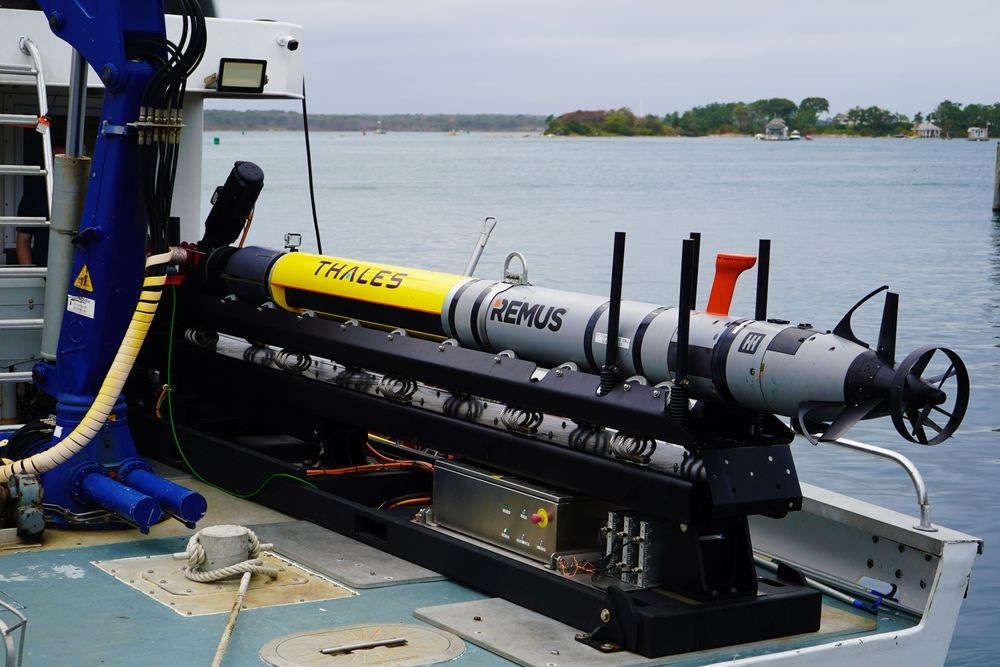
Thales announced on November 2 that Advanced Acoustic Concepts had won a $53.9 million U.S. Navy contract for two Remote Mine Hunting modules and engineering support. Options could raise the value to about $196.2 million. The suite combines sonar, mission-management software and AI-assisted target recognition. Breaking Defense reports that the first two modules are due by October 2029. This procurement is distinct from the HII–Thales demonstration covered previously. Read the source account.
What the evidence supports
The relevant autonomy is in the work surrounding a contact. Sonar gathers observations and software helps people process and classify them. That can move sailors away from the immediate threat while giving operators more information to assess. The announcement does not provide an independent measure of how reliably the software distinguishes mines from other objects across operating environments.
The near-term test
The short-term consequence is funded production and engineering work. It does not immediately add two accepted modules to the fleet. Integration, training and support planning must accompany delivery if crews are to use the equipment repeatedly. Those tasks are easy to understate when attention centers on the size of an award.
The longer-term case
The longer-term benefit could be more sustained remote minehunting with less exposure for sailors. It depends on reliable equipment and a manageable stream of contacts. If uncertain classifications generate too much follow-up work, faster collection can simply move the bottleneck downstream. Conversely, useful classification assistance could let operators concentrate their attention where it is most needed.
A useful acceptance framework would separate collection from resolution. Covering an area and producing sonar contacts are intermediate outputs. The operational customer needs enough confidence to decide what requires further attention. If a system gathers more data than crews can examine, apparent collection productivity may conceal a slower decision process. Conversely, good classification assistance can have value without eliminating human review. The relevant measure is how it changes the complete task, including uncertain objects and the effort required to return to them. Public contract value does not answer that question.
Support deserves the same scrutiny as the sensing chain. An integrated module can depend on several components whose maintenance needs differ. A fault in one component may interrupt the larger workflow even when the rest of the equipment is ready. Engineering support can help resolve that problem, but customers should look for evidence that it restores availability promptly and feeds recurring faults back into improvements. We would want operating records to identify the cause and duration of interruptions. That information is more useful for future orders than a simple count of delivered modules.
The procurement also illustrates why a modular approach needs discipline. Replacing a sensor or software component may create useful flexibility, yet the changed combination still needs validation. An upgrade that improves one part of the chain can affect the information presented to the operator or the time required to complete another step. The right long-term objective is a system that can evolve while maintaining a dependable mission process. That calls for repeatable acceptance evidence after changes, with the comparison grounded in the customer's workload and the actual operating conditions.
Our assessment
We would follow delivery acceptance, availability and the operator effort required per resolved contact. The option value indicates room for a larger program, but remains conditional spending. The strongest case for expanding it will come from modules that arrive, remain serviceable and improve the pace of an actual minehunting task.
Sources and reporting dates
Underlying development date: 2026-11-02. Analysis published November 5, 2026. Company performance claims are attributed to their source; assessments and evaluation criteria are ours.
This analysis draws on the public sources linked in the text. Send corrections to [email protected].