An uncrewed logistics vehicle must do more than move a heavy load. The receiving unit needs a practical way to load it, supervise its movement and recover both vehicle and cargo when a route fails. Familiar containers can simplify one interface while leaving autonomy and support as separate engineering questions.
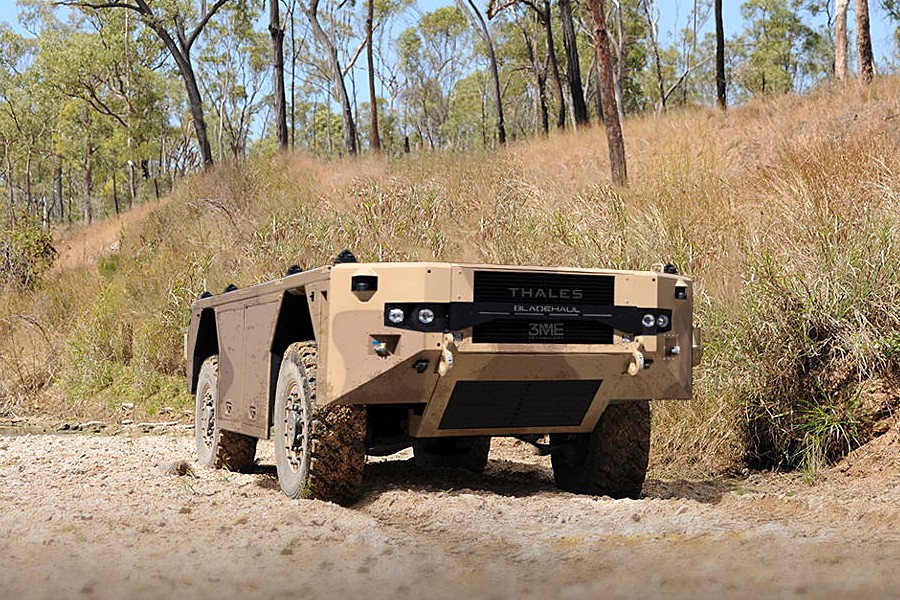
Australian Defence Magazine’s October 6 report from a Thales briefing describes Blade HAUL, an uncrewed vehicle concept intended to carry a 20-foot container and approximately ten tonnes. The account identifies Bushmaster-related engineering and a hybrid power arrangement involving 3ME, with Australian Army testing planned for the following year, including Talisman Sabre 2027. These are reported development plans, not completed trial results. Read the source account.
Payload capacity does not define an autonomous mission
A standard container provides a clear loading format. It does not tell a customer which terrain, gradients or traffic situations an autonomous configuration can manage. The useful trial description would keep the exact payload and route conditions attached to its results, rather than treating a headline capacity as a universal mission rating.
The hybrid system also requires evidence at the vehicle level. Energy supply, quiet movement and stationary power are different operating modes. A demonstration can establish one useful mode without establishing the duration or reliability of all the others. The published briefing does not supply an independently verified mission-energy profile.
Keep cargo movement and mobile power as separate acceptance cases
A container-carrying vehicle offers a familiar physical interface for logistics staff. A standard box can still have very different weight distributions, tie-down requirements and sensitivity to shock. A useful trial would state the actual load and how it was secured, then preserve those details with the route result. This is a proposed evaluation approach, not a published BladeHAUL test procedure. It prevents the maximum payload figure from becoming a substitute for understanding which loaded configuration was demonstrated under which conditions.
The stationary-power role has a different operating cycle. A vehicle that reaches a site must supply power while retaining enough energy or fuel to complete its next task. Maintenance access, cooling and the electrical interface can affect whether that service is practical. A battery-capacity figure alone would not establish how long a field installation can operate. The analysis therefore does not infer a hospital runtime, a radar duty cycle or an energy saving from the unveiling. Those outcomes require the load and complete system arrangement to be specified.
Recovery is another part of the logistics proposition. Removing the crew changes exposure during movement, but a disabled heavy vehicle can still require people and equipment to reach it. Customers can compare the proposed recovery process with the routes on which they intend to use the machine. A successful autonomous journey and a supportable failure are both valuable pieces of evidence. Neither should be assumed from Bushmaster heritage, because the uncrewed platform introduces its own controls, energy system and operating procedures.
The public accounts also leave autonomy as development work rather than a settled capability across all proposed roles. A future demonstration should distinguish remote operation, supervised autonomy and any follow-me behavior actually exercised. That distinction helps a reader understand whether a result shows mobility, an autonomy function or a complete supported mission. Army experimentation can provide useful evidence without constituting a production commitment. Reporting its bounded results would give the concept a clearer path from industrial collaboration to an assessable operational proposal.
The existing Bushmaster fleet offers an industrial reference point, but common heritage is not a quantified parts-commonality result. A customer can ask which mechanical components, tools and maintenance procedures remain shared and which are unique to BladeHAUL. The answer would make the support argument measurable without requiring an invented percentage. It would also identify whether the hybrid equipment and uncrewed controls create separate training demands that outweigh, or coexist with, the advantages of the established manufacturing base.
The next milestone
The next evidence is the planned testing, with interventions, recovery effort and maintainers’ workload reported alongside successful movement. If a container-compatible platform can meet those demands, it could extend logistics options without requiring soldiers aboard every journey. The unveiling identifies a candidate system; the intended trials must establish its usable envelope.
What would change the assessment
Look for the next documented configuration, its test conditions and its support responsibilities. The current source establishes the announced stage; later results should identify what changed.
This analysis draws on the public sources linked in the text. Send corrections to [email protected].