Sending more robots to Ukraine can move supplies and equipment without sending another person along the same exposed route. But the contribution lasts only while operators can employ the machines and repair teams can keep them available. The Netherlands-led THeMIS program matters because it couples a larger delivery with an assembly arrangement and training, making industrial support part of the operational story rather than an afterthought to the donation.
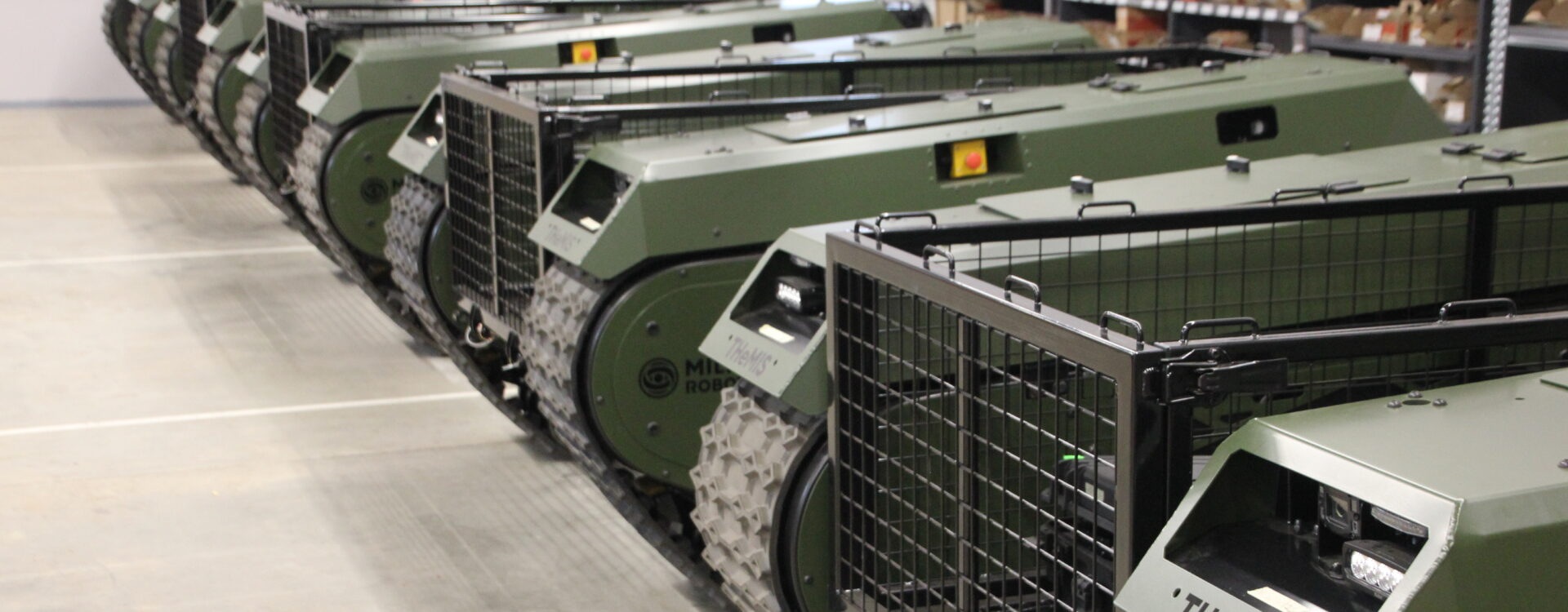
Milrem’s October 2025 published account announcement describes a donation of more than 150 THeMIS vehicles funded and coordinated by the Netherlands, with VDL Defentec involved in assembly and delivery. It also promises training for operators and support staff. These are commitments announced by the supplier. They establish the planned scale and organization of the contribution; they do not publish the number subsequently delivered or a fleet availability rate in Ukrainian use.
The company’s supporting source product description presents THeMIS as a modular tracked ground vehicle for different mission configurations. Modular means equipment can change without replacing the complete platform. That feature is useful for a donor trying to meet different needs, but it makes configuration important. A transport version, a sensor carrier and a vehicle fitted for another task may share tracks while requiring different training, parts and evaluation.
Scale the ability to use the machines
Our assessment is that final assembly in another country can do more than add manufacturing capacity. It can create a place to prepare configurations, supply documentation and organize the flow of spares. Whether it does those things effectively depends on the actual contracts and work distribution. The supplier’s announcement does not establish a full repair network, so readers should not infer that every support problem has been resolved merely because an assembly line is planned.
A growing fleet also creates a training demand that is easy to understate. Operators need to recognize failures, manage batteries or fuel and decide when a route is no longer acceptable. Maintainers need to identify whether a fault belongs to the vehicle, its payload or its control equipment. Training both groups is part of the announced contribution. A useful follow-up would show how that training keeps pace with deliveries and with changes introduced after field experience.
A donation should be measured across its service life
Consider a vehicle assigned to repeat a short supply route. This is an evaluation scenario rather than a claim about a particular Ukrainian unit. Successful delivery is only one result. The unit also needs to know how often the robot is available, how long a repair takes and whether the same job can be performed when its usual operator is absent. Those measures show whether a larger donated inventory translates into a larger daily capacity.
The same distinction applies to adaptation. A modular system can respond to new requirements, but unrecorded changes can leave training and spare stocks behind the actual field configuration. A common record of payload, control hardware and software release would help the donor, manufacturer and receiving unit understand what needs support. It would also make field feedback more useful than a general statement that the platform performed well or poorly.
Retain the human-risk calculation
The strongest reason to support such vehicles is the danger of the task they replace. A robot may be worth using even when it is lost, if the alternative exposes people. That judgment still needs to include the risk to recovery teams and the people maintaining it near the front. A fleet assessment should therefore report both mission outcomes and the human work surrounding failures, without assuming that uncrewed movement makes every part of the mission unexposed.
Delivery should become fleet learning
An assembly partnership can also create a practical buffer between production and the receiving force. Vehicles can be checked, documentation prepared and spare packages matched before shipment. That would reduce the chance that a unit receives a machine whose support kit describes a different configuration. These are potential functions of an organized delivery process, not additional deliverables confirmed by the announcement. The distinction matters because a donation’s headline number can otherwise conceal how much work the recipient must perform before a vehicle becomes usable.
The donor’s leverage continues after the shipment. Collecting recurring faults across several units could identify a common part that deserves a larger spare stock or an instruction that needs rewriting. A repair process that captures that knowledge would make later deliveries more valuable than simply repeating the first batch. The Netherlands-led initiative should therefore be understood as an opportunity to sustain a useful fleet over time. The wider benefit is the daily capacity to carry out dangerous work with fewer people exposed, supported by an industrial relationship that learns from actual use.
What would change the assessment
Track delivered configurations, trained crews and repair turnaround; the 2025 announcement is a commitment, not a current operational fleet count.
The wider impact
The wider value of the Dutch initiative could be a repeatable European route from production to usable frontline service. Vehicles, trained operators and accessible repair capacity need to grow together. If they do, a donation can become sustained capacity; if they do not, its most visible achievement may remain the number of machines handed over.
This analysis draws on the public sources linked in the text. Send corrections to [email protected].