Training against small drones has to give a soldier enough opportunity to recognize the situation and practice the intended response. Repeating the same lesson with physical equipment can impose practical limits on availability and resources. Virtual training offers another way to create repetitions, but a convincing display is only one part of the result. The decisive question is whether practice changes performance in the circumstances the training is intended to prepare people for.
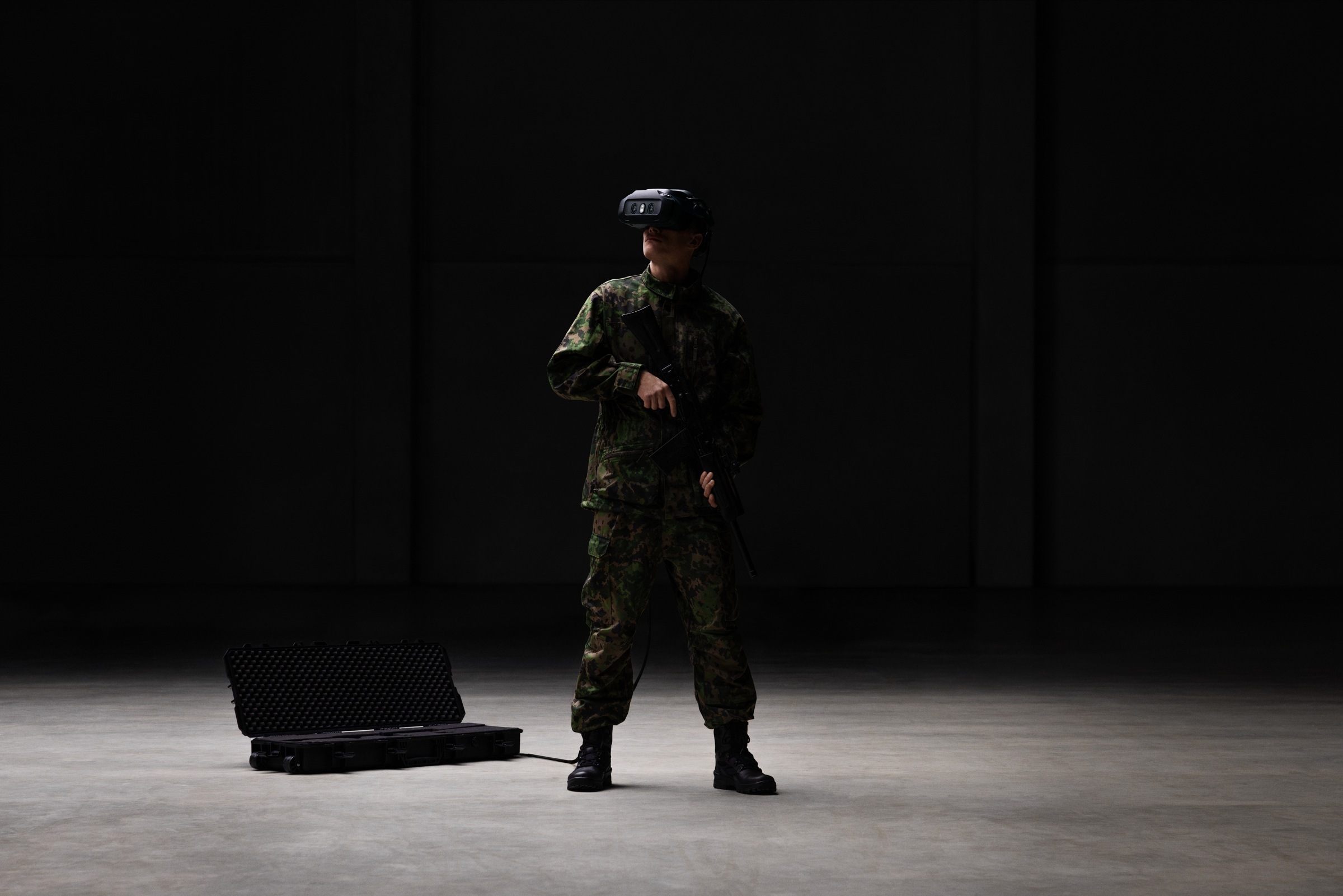
Varjo and the Finnish Defence Forces Innovation Unit announced a collaboration on October 29 to pilot and develop virtual counter-drone training. The work involves a brigade-level unit and XR-4 mixed-reality headsets, with preparations dating to February. Varjo says the visual clarity supports representation of a five-inch FPV drone at realistic distances. That is the supplier’s description of the training display, rather than a published measurement of improved soldier performance. Read the primary source account.
Repeatability creates an evaluation opportunity
A virtual scenario can hold selected conditions constant while a trainee practices or an instructor changes one variable. That can help make comparisons more interpretable than sessions in which every condition changes at once. The advantage depends on recording what was presented and what the trainee was asked to do. Repetition alone does not establish that the scenario contains the cues or decisions that matter outside the headset.
The collaboration’s pilot status is therefore important. It creates an opportunity to investigate suitability and gather feedback before treating the arrangement as a complete training solution. The announcement does not disclose a controlled study, a sample size or a quantified transfer result. Readers should not infer those findings from the partnership or from the fact that the equipment can display a small virtual object clearly.
Visual fidelity and instructional value are related but different
A display specification can support a particular kind of representation. The training outcome also depends on timing, scenario design, instruction and feedback. A trainee might become better at responding to a familiar virtual sequence without acquiring the intended skill in a different setting. That possibility makes an external assessment useful, while not establishing that the current pilot suffers from it. The release supplies the development objective, not the final answer.
For instructors, a useful record would connect the scenario to the behavior being taught and the criterion used to judge improvement. That makes it possible to distinguish familiarity with the interface from progress on the actual training objective. It also gives a later evaluator a way to understand which part of the course changed if performance differs between groups or over time.
Accessibility includes the complete training arrangement
The partners emphasize realistic, repeatable and available training. Availability involves more than having a headset in a room. The institution needs scenarios that remain current, staff who can conduct the session and a way to maintain the equipment and learning records. The announcement does not provide a full support or cost comparison, so those potential benefits should remain objectives to be evaluated rather than measured savings.
A changing threat environment adds a content-maintenance question. Updating a virtual lesson can be easier in some respects than replacing physical training equipment, but the update must still be checked for instructional accuracy. A visually compelling scenario that no longer reflects the intended operating context can teach the wrong expectation. The pilot’s connection to an actual unit is relevant because operational feedback can inform those choices, while the public release does not document the resulting changes yet.
The immediate change is a formal collaboration through which a defense institution and a display supplier can test the complete training proposition. Its wider significance depends on evidence that trainees learn the intended skills and retain them beyond a selected virtual exercise. A clear account of the pilot’s assessment method, feedback and transfer results would strengthen the case. Until that appears, the announcement supports a bounded conclusion: a repeatable training environment is being developed and tried, with readiness benefits still to be established.
Source organizations: Varjo, Finnish Defence Forces.
This analysis draws on the public sources linked in the text. Send corrections to [email protected].