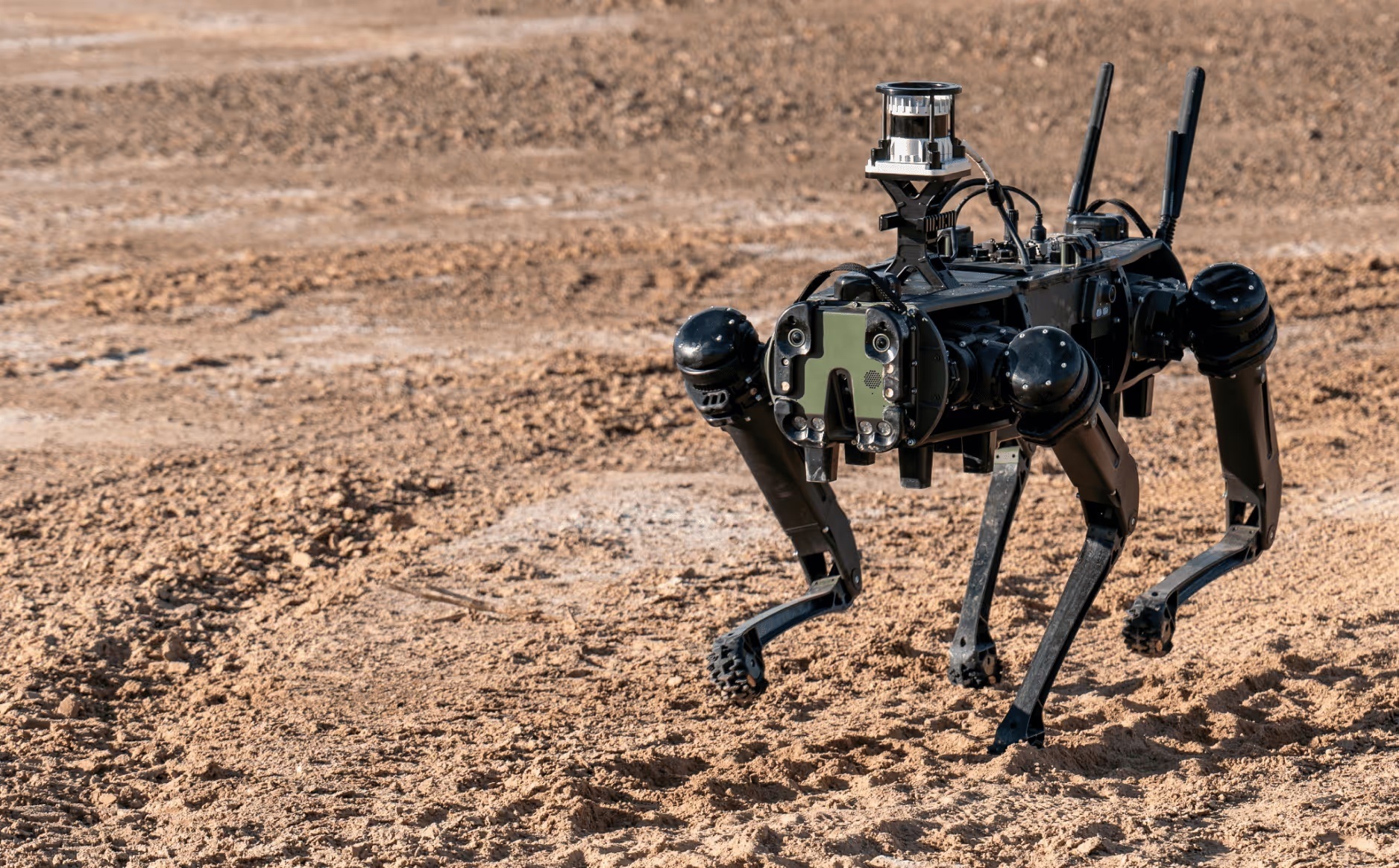
A security patrol has value when it discovers a problem early enough for people to respond. A legged robot can extend where sensors go and reduce the need for a person to make every routine inspection. Ghost Robotics’ Vision 60 illustrates that use of autonomy. The important question for a base is whether robotic patrols improve the complete response, rather than simply put a moving sensor beside the fence.
An Air Force published source account from 2021 describes semi-autonomous robotic dogs used for surveillance and perimeter security at Tyndall. Ghost Robotics’ current published source product description presents Vision 60 and its mission-control capabilities. The military account establishes a historical application; the product page explains the offered system. They do not publish a current installation-wide assessment of detection accuracy, avoided incidents or staffing savings, and this analysis does not imply otherwise.
Legs reach a sensor position
A quadruped uses four legs rather than tracks or wheels. Its attraction is access to places a particular wheeled platform may not reach conveniently. That proposition should be compared with the specific patrol route. A base needs to know which obstacles the robot handles, how often it stops and whether its sensors remain useful in site conditions. A general mobility claim cannot establish the best choice for every perimeter.
Our assessment is that movement autonomy and security judgment need separate treatment. Following a route can be automated while deciding whether an observed object is a threat remains with people. The interface should preserve that boundary. The controller needs context to distinguish a damaged fence, routine activity and an uncertain observation, rather than receive a confident alarm detached from the image or measurement behind it.
The response chain decides the payoff
A hypothetical patrol finds an object near a service entrance. This is an evaluation scenario, not a reported Vision 60 event. The base must know when the observation was made, where the robot stood and whether its view was obstructed. A person then needs authority and time to investigate. If the alert sits in a dashboard nobody watches, autonomous movement has produced data without strengthening security.
False alerts belong in the same workflow. Repeated nuisance alarms consume attention and can teach personnel to discount later warnings. A trial should record how often an observation produces a valid investigation, the review effort and the response delay. It should compare those results with the existing patrol method. That comparison can reveal a useful role even when the robot does not reduce total staffing.
Security includes availability
The robot needs charging, maintenance and a way to report status. The unit should know whether a missed patrol is obvious or whether the control room could mistake silence for a clear perimeter. A lost link, a stopped robot and a completed route should be distinct states. A sensor network is dependable only when gaps are visible to the people using it.
The Air Force account is intentionally a precedent, not a new 2026 deployment. A current purchase needs recent acceptance results for the exact sensor package and mission software. Weather, routes, personnel routines and the actual control room all determine whether the platform delivers a gain elsewhere. Evaluation should include the busiest shift and an equipment outage, because routine conditions alone cannot reveal how patrol automation competes for attention when the base already faces another incident.
Compare the gaps between patrols
The patrol route also creates a comparison with other ways of collecting the same observation. A fixed camera may provide continuous coverage of one point; a moving robot may inspect several locations but leave intervals between visits. A person may interpret unexpected activity immediately while a robot sends it for review. These approaches are not interchangeable. The base should identify the gap it is trying to close, then compare coverage, review effort and response time for that gap. A visually striking walking platform can be useful without becoming the best answer to every surveillance need.
An automated patrol schedule should make those intervals explicit. If the machine spends longer examining an uncertain observation, the next part of the route may be inspected later. The control room needs to see that consequence rather than assume the scheduled patrol happened exactly as planned. Vision 60’s larger significance is the possibility of shifting routine movement to a machine while keeping the human response informed. The operational gain would be better use of attention and safer inspection, supported by honest reporting of what was seen, what remains unseen and what action followed.
What would change the assessment
Use the 2021 account as precedent and require current site-specific evaluation.
The wider impact
Vision 60’s broader contribution could make routine observation more persistent while preserving people for important judgments and responses. That benefit depends on turning findings into action and making missing coverage visible. The robot’s shape is secondary to whether the protected installation becomes better informed and more responsive.
This analysis draws on the public sources linked in the text. Send corrections to [email protected].